
To generate power from your hips and stop arm-swinging, focus on initiating your swing with your hips rather than your arms. Engage your core and rotate your pelvis naturally, creating a coil that stores energy for the downswing. Keep your hips mobile through regular stretching and use drills that reinforce hip rotation. Consistent practice with feedback tools helps you develop a smooth, hip-driven motion. If you keep working on this, you’ll master a more powerful and controlled swing.
Key Takeaways
- Initiate the downswing with your hips to promote proper sequence and reduce arm overuse.
- Use drills like “hip turn only” to reinforce hip-driven movement and muscle memory.
- Maintain a strong, balanced stance to support full hip rotation and prevent arm dominance.
- Focus on keeping your arms passive and connected to your torso for efficient energy transfer.
- Incorporate feedback tools such as video analysis to monitor and correct arm-swinging tendencies.
As an affiliate, we earn on qualifying purchases.
Understanding the Role of Your Hips in a Golf Swing
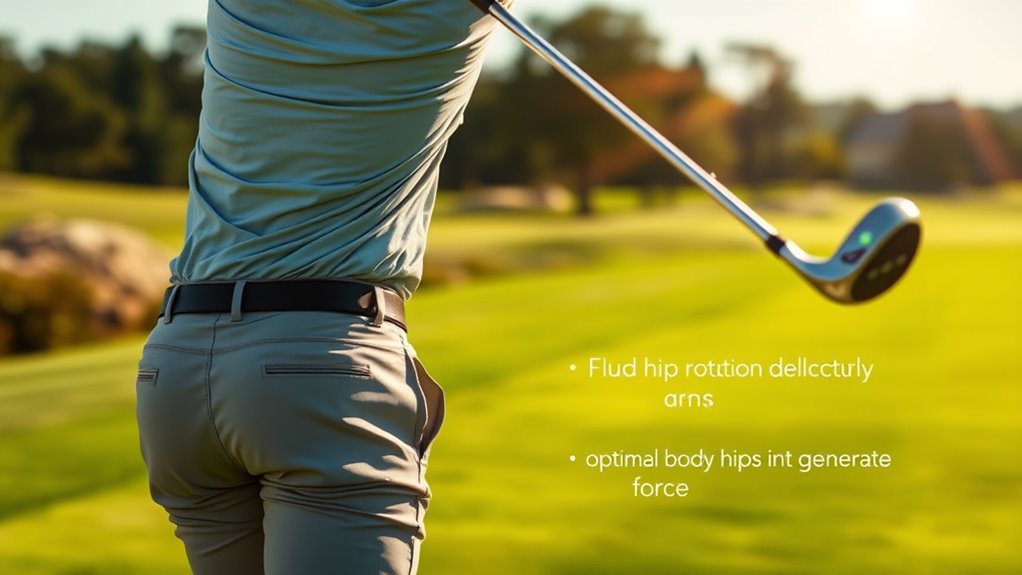
Your hips play a crucial role in generating power and maintaining balance during a golf swing. Proper hip engagement allows you to harness your body’s core strength, leading to a more efficient and powerful swing. Focus on pelvis rotation as you initiate your backswing; this movement sets the stage for a smooth transfer of energy. When your hips turn correctly, they create a coil that stores potential energy, which is then released during the downswing. Avoid overusing your arms by relying on your hips to lead the motion. Pelvic rotation is fundamental to maintaining a consistent swing plane and preventing arm-swinging. Consistent pelvis rotation also helps keep your swing on plane and promotes better balance. Mastering this hip movement is essential to stop arm-swinging and develop a more powerful, controlled golf swing. Incorporating core strength exercises can enhance your ability to control your hips and improve overall swing stability. Additionally, understanding the importance of hip rotation can help you make more informed adjustments to your technique. Developing hip mobility can further optimize your swing mechanics and prevent injuries.
As an affiliate, we earn on qualifying purchases.
Common Causes of Excessive Arm Movement

Excessive arm movement often happens when your swing path is off or you rely too much on your arms instead of your hips. Poor body rotation can also cause you to overuse your arms to generate power. Recognizing these causes helps you stay connected and maintain better control during your swing. Incorporating modern training techniques can further improve your swing efficiency and reduce arm-swinging. Additionally, understanding the importance of proper swing mechanics can help you develop a more consistent and effective golf swing. Recognizing auditory processing challenges can be beneficial in refining your technique and ensuring you maintain focus throughout your game. Understanding athletic background and how it influences your movement patterns can also be beneficial in refining your technique.
Swing Path Flaws
Swing path flaws often stem from a tendency to rely heavily on the arms during the swing rather than using the hips and torso to generate power. This reliance causes an outside-in or steep swing path, leading to inconsistent strikes and lost control. Excessive wrist action can exaggerate these flaws, causing the club to approach the ball from improper angles. Maintaining a steady grip pressure helps keep the wrists quiet, promoting a more natural swing path. Focus on initiating the downswing with your hips rather than your arms to correct the path. Visual cues like feeling the club drop inside just before impact can help. Remember, a smooth, connected swing relies on proper sequencing and avoiding overuse of the arms.
Overactive Arms
Overusing the arms during the swing often results from trying to generate power without properly engaging the hips and torso. When you rely too much on arm speed, your arms tend to take over, causing excessive movement and inconsistent contact. A tight or overly strong club grip can also contribute, encouraging you to manipulate the club with your hands instead of turning your body. This arm-dominant motion leads to overactive arms and a loss of swing rhythm. To fix this, focus on loosening your grip and initiating your swing with your hips. Let your body do the work, reducing the urge to overly arm your shot. This shift helps you develop a more efficient, powerful swing that minimizes unnecessary arm movement. Incorporating proper body rotation into your swing can further enhance control and consistency.
Poor Body Rotation
Poor body rotation often leads to excessive arm movement because your torso isn’t turning enough during the swing. When your torso stays rigid, your arms compensate by swinging more, causing inconsistency. To improve, focus on maintaining mental focus on your core rotation and keeping grip pressure steady. This helps you stay connected and promotes fuller body turn. Visualize your shoulders and hips working together, rotating smoothly through the shot. Common issues include:
- Overlooking the importance of torso turn in favor of arm action
- Clenching the grip too tightly, restricting natural movement
- Losing focus mid-swing, causing incomplete rotation
- Remembering that a calmer, more organized swing begins with proper body rotation and relaxed muscles.
golf core strength training equipment
As an affiliate, we earn on qualifying purchases.
As an affiliate, we earn on qualifying purchases.
The Impact of Arm-Swinging on Power and Accuracy

When you incorporate arm-swinging into your movement, it can considerably boost both power and accuracy. A controlled swing creates a more consistent ball flight and improves swing tempo, helping you strike the ball with better timing. However, excessive arm-swinging can lead to inconsistent results. To understand its impact, consider this table:
| Effect on Power | Effect on Accuracy | Key Considerations |
|---|---|---|
| Increases club speed | Can cause off-center hits | Maintain balance between arms and hips |
| Enhances swing tempo | May disrupt timing | Focus on smooth, controlled movement |
| Adds momentum | Risks misalignment | Use arms to complement, not dominate |
| Boosts ball flight | Could create hooks or slices | Practice deliberate arm motion |
| Improves timing | May reduce control | Keep arms synchronized with hips |
Balancing arm-swinging with your hips optimizes power and accuracy, ensuring consistent shots. Proper coordination is essential to achieve the best results from your swing.
As an affiliate, we earn on qualifying purchases.
Recognizing Signs That You Are Overusing Your Arms

If you notice your arms are moving excessively or your swing feels jerky, you’re likely overusing them. Limited hip rotation and a consistent, smooth tempo are signs you should rely more on your hips. Paying attention to these cues can help you develop a more efficient, power-driven swing. Incorporating proper load‑planning ensures you use your body’s energy effectively rather than over-relying on your arms.
Excessive Arm Movement
Excessive arm movement often signals that you’re relying too much on your arms rather than engaging your hips effectively. You might notice your wrists flicking too much, causing jerky swings. Your shoulder turn may seem limited or inconsistent, forcing your arms to compensate. This overuse can lead to a disjointed swing, reducing power and accuracy. Watch for these signs:
- Excessive wrist flicks that feel forced or uncontrolled
- Minimal or uneven shoulder rotation during the swing
- Over-swinging with your arms, rather than turning your hips smoothly
When your arms dominate the motion, you lose the natural flow of power. Focusing on engaging your hips will help you develop a more efficient, fluid swing, minimizing unnecessary arm action and improving overall control.
Limited Hip Rotation
Limited hip rotation often reveals that you’re relying too heavily on your arms, which can hinder your swing’s efficiency. When your hips lack flexibility, you tend to compensate by overusing your upper body, causing your pelvis to become unstable during the swing. This instability limits your ability to turn fully, reducing power and consistency. You might notice a stiff feeling in your hips or an inability to rotate smoothly through the shot. Improving hip flexibility is vital to enable a full, natural turn. Focus on exercises that enhance pelvis stability, allowing your hips to move freely and maintain control. When your hips rotate properly, you’ll generate more power from your core and reduce unnecessary arm action, leading to a more efficient, balanced swing. Incorporating advanced biomechanics understanding can further optimize your movement patterns for better performance.
Inconsistent Swing Tempo
When your swing feels disjointed or inconsistent, it often indicates you’re relying too much on your arms instead of maintaining a smooth, balanced rhythm. Overusing your arms can throw off your swing rhythm and cause inconsistent tempo. You might notice:
- Jerky, uneven swings that lack fluidity
- Your hips not rotating enough, leading to arm-dominant motion
- A sudden change in tempo, making it hard to find a steady rhythm
- Free Floating can sometimes cause your swing to become unsteady if not controlled properly
These signs show you’re not allowing your hips to lead the swing. Instead, your arms take over, disrupting the natural flow. To fix this, focus on initiating the movement with your hips, ensuring your swing rhythm remains steady and controlled. Developing consistent hip rotation is key to achieving a more reliable, powerful swing.
Drills to Develop Hip Rotation and Engagement

To improve your hip rotation and engagement, incorporating targeted drills is essential. Focus on rotational drills that emphasize turning your hips smoothly and efficiently. One effective drill is the “hip turn only” swing, where you practice rotating your hips without moving your upper body or arms. This isolates hip engagement and builds muscle memory. Another useful exercise is the “step-through” drill, where you take a small step forward as you rotate your hips into the follow-through, encouraging natural hip turn. Repeating these drills consistently helps develop a sense of proper hip movement, reduces arm-swing reliance, and promotes a more powerful, connected swing. Incorporating feedback mechanisms can enhance your awareness of hip engagement during practice. Using smart training tools can also provide real-time feedback to refine your hip rotation. Additionally, mindful practice with muscle activation techniques can further strengthen the muscles responsible for proper hip movement. Developing a consistent training routine that includes these drills will accelerate your progress and ensure lasting improvements. Regularly monitoring your movement patterns can help identify and correct flaws early on. Over time, these rotational drills will become second nature, allowing your hips to lead naturally during your swing.
Proper Stance and Posture for Hip-Driven Swings

Your stance starts with your feet, so make sure they’re aligned correctly to create a stable base. Keep your spinal angles consistent to maintain balance and power throughout the swing. Proper foot positioning and posture set the foundation for effective, hip-driven movement.
Aligning Feet Correctly
Properly aligning your feet is essential for harnessing the power of your hips during a swing. Your foot alignment and stance width set the foundation for effective hip rotation and control. When you position your feet correctly, you promote balanced weight transfer and smooth movement through the swing. Focus on maintaining a proper stance that encourages natural hip movement and stability. This proper stance encourages a strong, centered pivot without unnecessary sway or arm-swinging. By aligning your feet consciously, you create a solid platform to generate maximum power from your hips. Additionally, understanding electric power generation principles can help you develop better awareness of energy transfer and efficiency in your swing motion. Recognizing how kinetic energy flows through your body can further optimize your swing mechanics and power output.
Maintaining Spinal Angles
Maintaining the correct spinal angles is essential for supporting a powerful, hip-driven swing. When your spine stays properly angled, your hips can rotate freely, maximizing power and control. To achieve this, focus on maintaining good core stability, which supports your posture and prevents unnecessary movement. Hip flexibility allows smooth rotation without strain, ensuring your spinal angles remain consistent throughout the swing. Keep your spine tilted forward slightly at address, avoiding excessive upright or over-leaning positions. This alignment helps transfer energy efficiently from your hips through your core to the club. Here’s a visual to clarify:
| Spinal Position | Key Focus | Effect |
|---|---|---|
| Neutral Spine | Core Stability | Maintains balance and control |
| Tilted Forward | Hip Flexibility | Enables smooth rotation |
| Consistent Angle | Proper Posture | Supports powerful swings |
| Proper Alignment | Spinal Angles | Ensures energy transfer and control |
Additionally, understanding the importance of body alignment can significantly enhance your ability to maintain these spinal positions during your swing. Proper muscle engagement is also crucial for maintaining stability and preventing injury. Developing awareness of proper posture can further improve your consistency and overall swing efficiency.
Using Golf Swing Aids to Reinforce Hip Movement

Golf swing aids are effective tools for reinforcing proper hip movement, ensuring you develop a more consistent and powerful swing. These aids help you focus on hip mobility and maintaining a smooth swing tempo, reducing arm dominance and promoting body rotation. Using aids such as rotational training belts or alignment sticks can give you immediate feedback on your hip turn, encouraging more efficient movement. Imagine feeling your hips initiating the downswing, creating a fluid transfer of power. With consistent use, you’ll develop better timing and rhythm, making your hip action more natural and automatic. These tools serve as visual and tactile cues, helping you ingrain the habit of turning your hips correctly every time you swing. Proper use of swing aids ultimately leads to more control and increased distance.
Step-By-Step Exercises to Transition From Arm to Hip Power
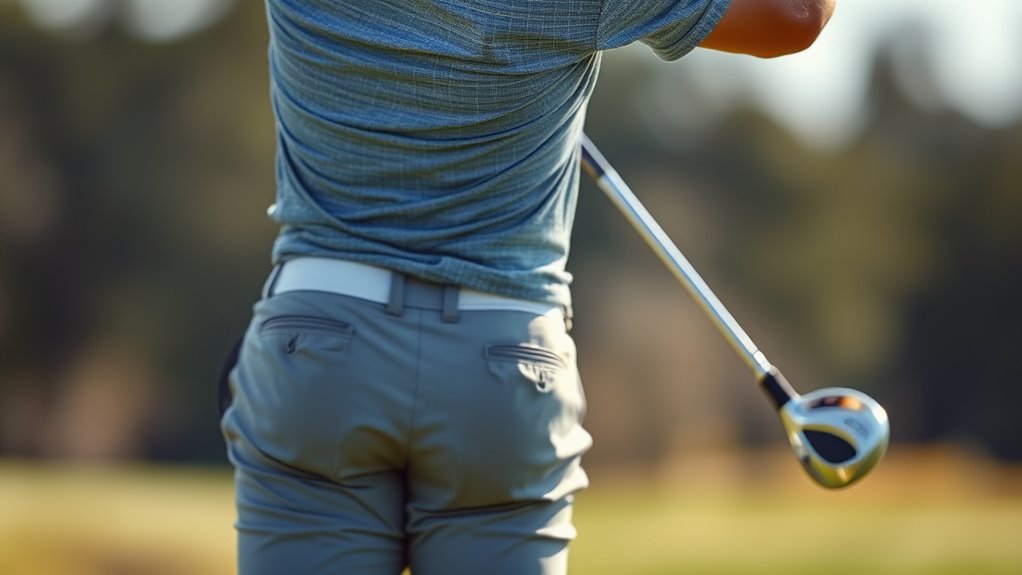
To effectively shift your power source from your arms to your hips, you need a clear, step-by-step approach that builds muscle memory and coordination. Start with slow swings focusing on rotating your hips before your arms move. This helps you feel the correct sequence, improving swing timing. Practice drills like pausing at the top of your backswing, then initiating the downswing with your hips leading. As you progress, increase your swing speed gradually, emphasizing hip rotation to boost ball speed. Use mirror feedback or video to monitor your movement, ensuring your arms stay passive. Repeating these exercises reinforces the hip-driven motion, leading to more consistent power transfer and better timing, ultimately resulting in longer, more accurate shots.
Tips for Maintaining Consistency With Hip-Driven Swings

Once you’ve learned to initiate your swing with your hips, keeping that movement consistent becomes the next challenge. To do this, focus on maintaining your hip flexibility and core engagement throughout your swing. This ensures your hips lead smoothly without slipping into arm dominance or losing power.
- Keep your hips mobile with regular stretching to prevent stiffness that can disrupt timing
- Maintain a strong core to stabilize your pelvis and support consistent rotation
- Practice slow, deliberate swings to reinforce muscle memory and identify any movement inconsistencies
Tracking Progress and Adjusting Your Technique

Tracking your progress is essential to refining your hip-driven swing. Pay close attention to your hip flexibility and pelvis tilt throughout practice. Use video recordings or swing analyzers to observe changes and identify areas for improvement. Focus on maintaining proper pelvis tilt during your swing, ensuring your hips lead smoothly without arm interference. If you notice your pelvis tilt isn’t consistent or your hip mobility feels limited, incorporate targeted stretches and mobility drills. Adjust your technique gradually, emphasizing a fluid hip turn and controlled pelvis tilt. Regularly reviewing your progress helps you recognize patterns and make necessary modifications. Staying mindful of these elements ensures your hips generate power effectively, reducing arm-swinging and improving overall consistency.
Frequently Asked Questions
How Do I Know if I’M Using My Hips Correctly During My Swing?
You can tell you’re using your hips correctly if you notice a smooth hip turn that initiates your swing, rather than relying on your arms. Keep your pelvis stable during the rotation, preventing excessive sway. Feel your hips leading the movement, with your pelvis staying steady as your hips turn through the shot. If your hips drive the swing and your pelvis remains stable, you’re using your hips properly.
Can Arm-Swinging Be Beneficial in Certain Golf Shots?
Arm-swinging can be beneficial for certain shots if you maintain good hip flexibility and a smooth swing tempo. It helps generate clubhead speed and control, especially for shorter or delicate shots. Focus on engaging your hips properly to keep the swing fluid. When your hips lead naturally, arm movement is more controlled, making those shots more accurate. Balance your swing with hip rotation and a consistent tempo for ideal results.
What Are Common Mistakes Beginners Make With Hip Rotation?
Did you know that over 60% of beginners struggle with proper hip rotation? Common mistakes include over-rotating, which causes loss of control, or under-rotating, leading to poor power transfer. These beginner errors often result in inconsistent shots and decreased accuracy. Focus on smooth, controlled hip movement to generate better power and balance. Remember, proper hip rotation is essential for a consistent, effective golf swing.
How Long Does It Typically Take to See Improvements in Hip-Driven Swings?
You’ll usually see improvements in your hip-driven swings within a few weeks, especially with consistent practice. Focus on making timing adjustments and strengthening your core and hips through targeted exercises. As you develop muscle conditioning, your hips will naturally lead your swing more effectively. Remember, patience is key—regular practice and mindful adjustments will help you see noticeable progress in a month or two.
Are There Specific Golf Clubs Better Suited for Practicing Hip Engagement?
Yes, some clubs are better for practicing hip engagement. Opt for clubs that are custom-fitted to your swing, emphasizing proper length and shaft flexibility, which helps promote a natural swing tempo and better hip rotation. A club fitting can optimize your setup, making it easier to incorporate your hips effectively. Using the right clubs encourages a smooth, consistent swing, so you can develop better hip engagement and improve your overall game.
Conclusion
Remember, your hips are the true engine of your golf swing—without them, your power stalls. By embracing hip rotation and letting go of over-relying on your arms, you’ll release greater accuracy and distance. Think of your hips as the master conductor guiding your swing’s rhythm—ignore them, and the harmony falls apart. Shift your focus, develop that rotation, and watch your game transform from the ground up. The power you seek is already within your hips—just give it the stage.