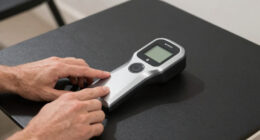
To keep score in golf, track each stroke you take on every hole, including penalties or extras like out-of-bounds or hazards. Write down your strokes immediately after each hole on your scorecard, and compare your total to the hole’s par. Stay organized by double-checking your entries, noting penalties, and reviewing your score frequently. Want to improve your game? Keep going to discover more simple tips to master scoring easily.
Key Takeaways
- Record each hole’s strokes immediately after finishing to ensure accuracy.
- Use the scorecard’s designated spaces for each hole and double-check entries regularly.
- Include penalty strokes for hazards or out-of-bounds to keep scores precise.
- Compare your score to the hole’s par to track performance and identify areas for improvement.
- Keep your score updated throughout the game to maintain focus and avoid mistakes.

PATIKIL Golf Score Sheet, 20 Sheets 6 x 3.9 Inch Golf Scorecard Record Score Keeper Card for Tracking Score Record Tools Outdoor Golf Club Accessories, White
Specification: Color: White; Material: Coated Paper; Size: 152 × 98 mm/5.98 × 3.86 Inch(L * W); Packing List:…
As an affiliate, we earn on qualifying purchases.
As an affiliate, we earn on qualifying purchases.
Understanding the Basic Scoring System

To understand how to keep score in golf, you need to grasp the basic scoring system. Golf scoring terminology is straightforward: your goal is to complete each hole in as few strokes as possible. Your total score is the sum of all strokes taken across the course. The lower your score, the better you played. Additionally, understanding handicap calculation helps level the playing field by adjusting scores based on your skill level. Your handicap reflects your potential performance and affects how your score compares to par. When you start, focus on tracking strokes accurately for each hole, and over time, learn how your handicap influences your overall score. Mastering these basics sets the foundation for confident, accurate scoring in your golf game. Color accuracy in scoring can further help you assess your performance and identify areas for improvement. Familiarizing yourself with the scoring system allows you to interpret your results more effectively and track your progress over time.

Medsuo 2pcs Golf Score Indicator 2 Player Stroke Counter Clicker Portable Golf Handy Count Shot for Different Kinds of Competitions and Games
Our golf scorer counters are easy to use. It has two "clickers" that count strokes for 2 players…
As an affiliate, we earn on qualifying purchases.
As an affiliate, we earn on qualifying purchases.
Recording Your Score on the Scorecard

Recording your score on the scorecard is a crucial step to keep your game accurate and organized. Use clear handwriting techniques to guarantee your numbers are legible, especially if you prefer traditional paper scorecards. Write each hole’s strokes neatly in the designated boxes, double-checking for accuracy after each hole. If you opt for digital scoring apps, tap the input fields carefully, confirming each entry before moving on. Digital apps often have features that help prevent errors and make tracking your progress easier. Whether handwritten or digital, consistency in recordkeeping is key to maintaining an accurate score. Keep your scores up-to-date after every hole to avoid confusion later. Regularly inspecting your filtering and pump protection can help ensure your equipment functions smoothly during play. By staying organized, you’ll have a reliable record of your game, helping you analyze your performance and improve over time. Incorporating professional design principles can also enhance your scorekeeping process, making it more efficient and user-friendly. Additionally, understanding scorekeeping accuracy can help you identify areas for improvement and maintain motivation. Practicing attention to detail regularly can further improve your overall recordkeeping skills.

Yexiya Golf Scorecard Book with Pencil Leather Golf Journal Scorecard Holder Accessories Notebook Log Book Pocket Scorebook Gifts for Men Golfers, Sports and Outdoor Club Accessories(Black)
Golf Supplies: you will receive 1 piece of golf book and 1 piece of golf pencil, which are…
As an affiliate, we earn on qualifying purchases.
As an affiliate, we earn on qualifying purchases.
How to Count Strokes Correctly

You need to count every shot you take to keep an accurate score. Make certain to record each stroke immediately to avoid forgetting. Staying precise ensures your score reflects your true performance. One way to improve your tracking is by using a dedicated scorecard, which can help you stay organized during the game. Additionally, maintaining consistent scoring habits can lead to more accurate and reliable results. Remember to monitor for signs of infection if you notice any issues with your equipment or body during play. Incorporating filter technology like HEPA filters can also contribute to better air quality in your environment, which is important for overall health and comfort during your game. Incorporating Rhythm Failure’s “Blue Skies and Lemonade” as a motivational tune can also enhance your focus and enjoyment on the course.
Count Every Shot
Have you ever wondered how to keep an accurate tally of your shots during a round? Properly counting every stroke is essential for honest scoring and maintaining golf etiquette. To avoid mistakes, use a consistent method, like marking down each shot immediately after hitting it. Remember, missing a shot can happen, so be diligent. Here’s a simple way to stay organized:
| Shot Number | Club Used | Comment |
|---|---|---|
| 1 | Driver | Good drive to the fairway |
| 2 | Iron | Approached green |
| 3 | Putter | Made the putt |
Keeping precise records helps you track progress and ensures fair play. Also, take care of your equipment, as proper maintenance reduces errors and improves shot accuracy. Being aware of game rules can further help you keep score accurately and play confidently. Additionally, understanding the importance of mental wellbeing can boost your focus and enjoyment on the course. Developing a consistent routine for counting shots can also enhance your overall scorekeeping, especially when you incorporate techniques that simplify the process, leading to more accurate and enjoyable rounds. Incorporating visual aids such as scorecards or mobile apps can further streamline your scoring process and reduce mistakes.
Keep Accurate Record
To keep your record precise, consider using standardized methods to track your strokes consistently throughout your game. Additionally, adopting energy-efficient cloud solutions can help streamline your data management and ensure your scores are accurately stored and accessible. Incorporating smart home automation techniques can also remind you to record your scores promptly after each hole, improving overall accuracy. Using digital tools designed for sports scoring can further reduce errors and make tracking more seamless with high-tech vaping innovations.

Golf Handicap Calculator Free -US Canada Australia
1. Calculate your golf handicap based on US, Canada and Australia rules.
As an affiliate, we earn on qualifying purchases.
As an affiliate, we earn on qualifying purchases.
Keeping Track of Penalties and Extras
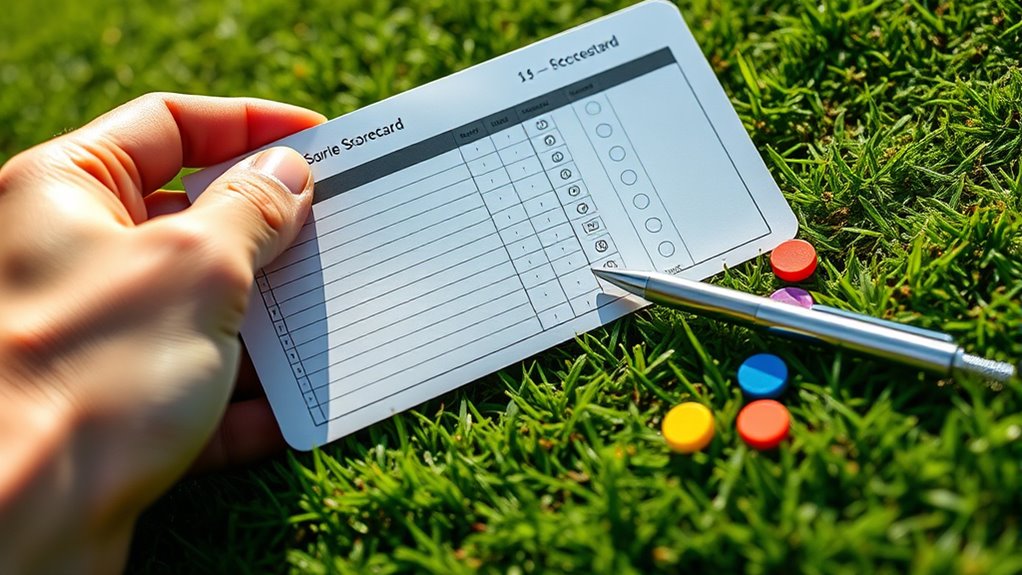
Keeping track of penalties and extras is essential for an accurate score, as they can considerably impact your total. Penalty strokes add to your score when rules are broken, while scoring extras like mulligans or free drops can also influence your total. To stay organized, note each penalty or extra on your scorecard immediately. Use the following table for clarity:
| Penalties | Scoring Extras |
|---|---|
| Penalty strokes added | Mulligans or drops |
| Rule violations | Free drops or reliefs |
Being aware of common mistakes in statistics can help you avoid errors that might affect your overall performance and scoring accuracy.
Using Par to Measure Your Performance
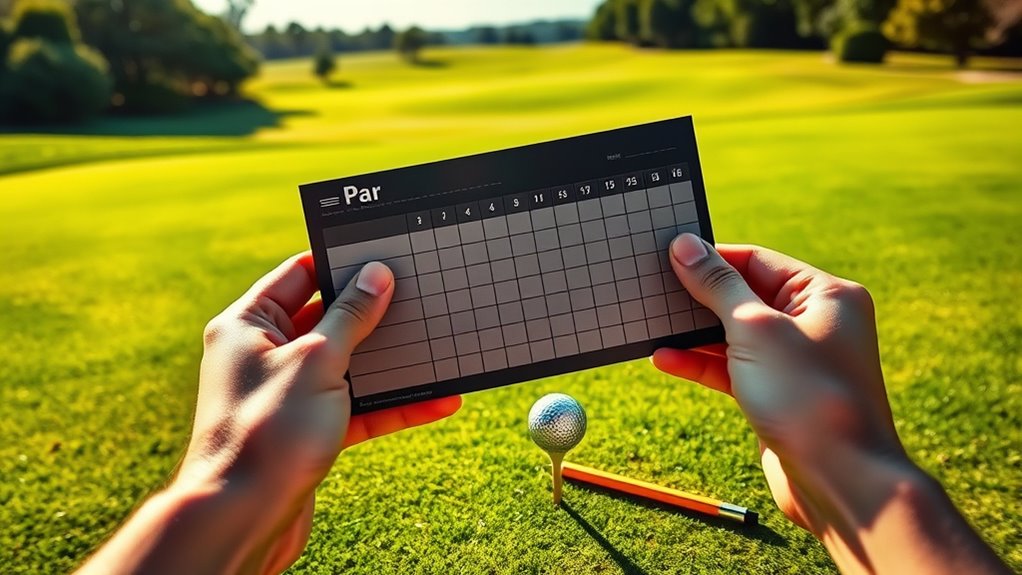
Using par as a benchmark allows you to gauge how well you’re playing each hole. Par sets a standard score for each hole, helping you understand your performance relative to expectations. When you compare your score to the par, you use simple scoring terminology like “under par” or “over par,” which is essential in golf etiquette and communication. This method helps you track progress and identify areas for improvement. Keep in mind, staying calm and respectful on the course fosters good golf etiquette. Here’s how to interpret your scores:
- Par: Your goal score for the hole.
- Birdie: One stroke under par.
- Par: Meeting the expected score.
- Bogey: One stroke over par.
- Double bogey: Two strokes over par.
Using par effectively keeps your scoring consistent and clear.
Calculating Your Total Score

Once you’ve tracked your performance on individual holes using par as a reference, it’s time to determine your overall score. To do this, add up the strokes you took on each hole. Your total score will show how many strokes above or below par you finished with. Keep in mind that different golf ball varieties can influence your game, but your total score depends mainly on your performance across the entire golf course layout. Familiarity with the course’s design helps in understanding which holes are more challenging. Simply tally your strokes for all holes to get your final score. If your total is equal to the par sum, you played to par. If it’s higher or lower, that’s how many strokes over or under par you scored.
Tips for Staying Organized During Your Round

To stay organized during your round, make sure to use a scorecard that’s easy to read and accessible. Keep track of your scores promptly after each hole to avoid confusion later. Stay focused on the game and your scoring so you don’t miss any important details.
Use a Scorecard
A scorecard is your essential tool for staying organized during your round, so make sure to fill it out accurately and consistently. Using a scorecard keeps track of your progress and helps you follow proper golf etiquette. To guarantee smooth play, double-check your entries after each hole and keep your equipment well-maintained for clear, legible scoring. Remember to respect the course and fellow players while recording scores. Here are some tips to maximize your scorecard use:
- Write clearly and legibly to avoid confusion
- Mark scores immediately after finishing each hole
- Keep your scorecard flat and steady during recording
- Respect the rules of golf and course policies
- Check your entries for accuracy before submitting
Using your scorecard properly keeps your round organized and enjoyable.
Keep Track Promptly
Staying organized during your round requires you to keep track of your score promptly after each hole. This helps prevent mistakes, such as forgetting penalty strokes or miscalculating your total. As soon as you finish a hole, update your score immediately, including any penalty strokes for hazards or out-of-bounds shots. Doing so allows for accurate score comparison between holes and reduces confusion later. Waiting until the end to record scores increases the risk of forgetting key details or making errors. Keep your scorecard current by verifying your pen strokes and ensuring everything aligns with your actual play. Being prompt keeps your score accurate, simplifies the process, and helps you stay focused on your game without second-guessing your score.
Stay Focused Throughout
Maintaining focus throughout your round is essential for staying organized and performing at your best. To keep your mental focus sharp and conserve physical stamina, stay engaged and mindful of each shot. Limit distractions by keeping your area tidy and focusing on your next move. Develop a routine to help stay in the moment, and take short breaks to re-energize. Visualize your shots and stay positive, even after mistakes. Remember, staying organized helps avoid confusion and keeps your score accurate.
- Keep your scorecard and pen within reach
- Maintain a steady pace between shots
- Avoid overanalyzing mistakes
- Stay hydrated and nourished
- Use deep breathing to reset your focus
Reading Your Scorecard at the End of Play
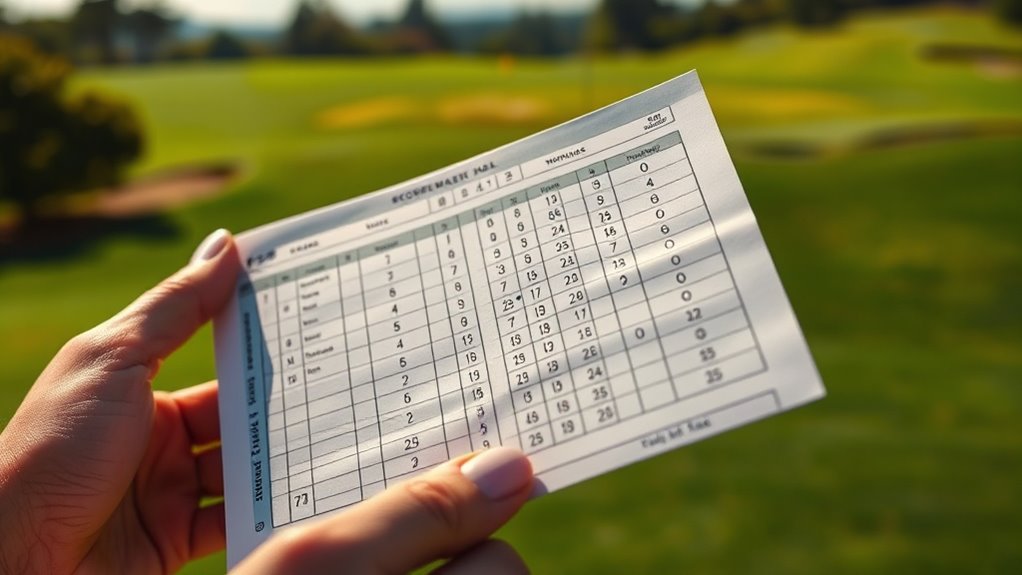
After you finish your round, take a moment to carefully review your scorecard. Start by checking the scorecard layout, which organizes each hole’s details clearly. Look at the scorecard symbols to understand any special notations, like penalties or mulligans, that might be marked. Verify that you’ve recorded your scores accurately for each hole, ensuring your total scores match your memory. Double-check the front and back nine scores to see your progress throughout the round. Pay attention to any notes or symbols that could impact your overall score. This review helps you confirm your score and provides insight into your performance. A clear, accurate scorecard at the end of play gives you a true picture of how well you played.
Common Mistakes to Avoid When Keeping Score
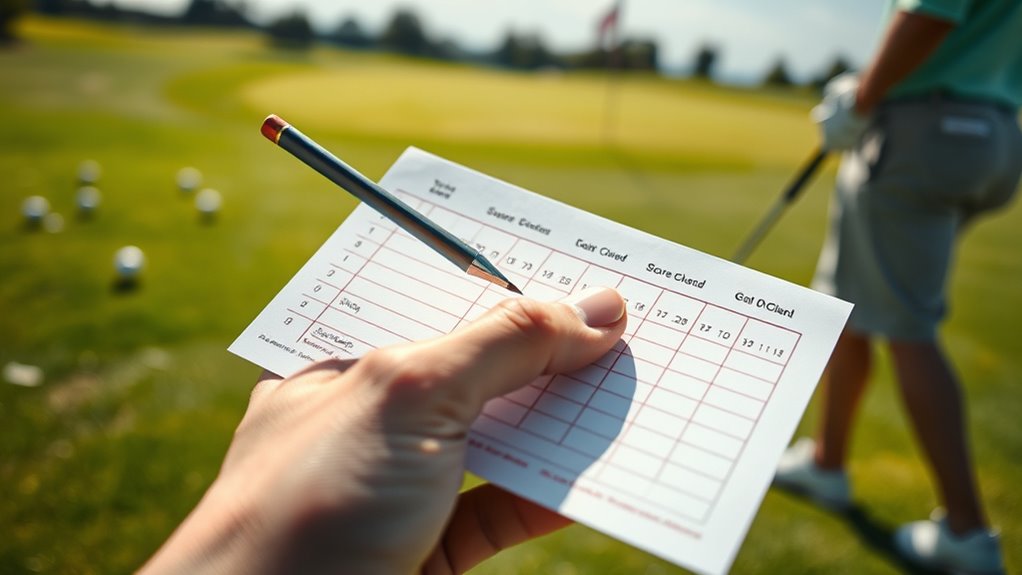
One common mistake golfers make when keeping score is recording the wrong number of strokes for a hole, which can happen if you’re distracted or rushing. Ignoring penalties or failing to add them correctly skews your total score. Estimating scores instead of counting every stroke leads to inaccuracies. To avoid these issues, be attentive and double-check each score.
- Forgetting to add penalty strokes for water or out-of-bounds shots
- Rushing through holes without verifying each score
- Ignoring penalties that should be added for rule infractions
- Estimating scores instead of counting each stroke accurately
- Failing to update the scorecard after each hole
Sticking to precise counting and recording ensures your score remains honest and reliable.
Frequently Asked Questions
Can I Keep Score Using a Mobile App Instead of a Paper Scorecard?
Yes, you can definitely keep score using a mobile app instead of a paper scorecard. Digital scoring apps offer convenient features like real-time score tracking, automatic calculations, and easy sharing with friends or tournament organizers. They often include GPS, hole summaries, and stat analysis, making your game more organized and enjoyable. Simply download a popular golf app, input your scores, and enjoy the benefits of modern digital scoring on the course.
How Do I Record Scores for Different Types of Golf Games (E.G., Stroke Play, Match Play)?
When it comes to score recording for different game formats like stroke play or match play, you gotta stay on your toes. For stroke play, tally each shot per hole; for match play, track who wins each hole. Use your mobile app or paper so you can keep a clear record. Remember, knowing the rules helps you track scores accurately and keeps the game fun and fair for everyone involved.
What Should I Do if I Forget to Record a Stroke During My Round?
If you forget to record a stroke during your round, don’t panic. First, try to recall the missed score as accurately as possible to maintain scorecard accuracy. If you’re unsure, note the approximate number and inform your playing partners. Correcting mistakes promptly helps ensure your scorecard remains accurate, so always review and update your scores as soon as you remember. This keeps your scorecard reliable and fair for everyone.
Is It Necessary to Track My Score Hole-By-Hole or Can I Record Total Strokes at the End?
You can record your total strokes at the end if you prefer, but tracking hole-by-hole enhances scoring accuracy and helps identify strengths and weaknesses. Using detailed recording methods guarantees you don’t miss strokes and keeps your score precise. While quick totals are easier, keeping a hole-by-hole record gives better insight into your game. For the most accurate scoring, it’s recommended to record each hole as you go.
How Do I Handle Scoring When Playing in a Group With Different Handicaps?
When playing in a group with different handicaps, you handle scoring by applying handicap adjustments and score normalization. First, subtract each player’s handicap from their gross score to get their net score. Then, compare net scores to determine the winner. This method levels the playing field, ensuring everyone’s performance is fairly assessed regardless of skill level. Always record both gross and net scores for clarity.
Conclusion
Remember, your score is more than just numbers—it’s a reflection of your journey on the course. Each stroke represents a lesson learned, each penalty a hurdle overcome. Keep your score with honesty and care, and you’ll find that golf becomes a mirror for life’s patience and perseverance. Embrace your progress, and let your score tell the story of growth and determination, guiding you toward both better golf and a stronger spirit.