To improve your golf game at home without a range, start with warm-up routines like stretches and posture exercises to prepare your body. Incorporate swing drills using mirrors or alignment sticks, and focus on consistency. Include flexibility exercises such as spinal twists and shoulder stretches to enhance mobility. Strengthen your core and balance with stability and coordination drills. Finish with a cool-down to prevent injuries. Keep exploring these techniques to elevate your practice and performance.
Key Takeaways
- Practice swing plane drills with mirrors or alignment sticks to improve consistency without needing a driving range.
- Incorporate core stability and balance exercises like single-leg stands and stability ball drills to enhance swing control.
- Use resistance bands for strength training and muscle activation tailored to golf-specific movements at home.
- Perform flexibility routines such as seated spinal twists and shoulder stretches to maintain mobility and prevent injury.
- Engage in mental focus techniques and visualization exercises to simulate on-course concentration and game readiness.

TSG TrueShot Golf PVC Teaching & Training Golf Mirror (2'x4') – PVC Golf Mirror
Folds For Easy Storage
As an affiliate, we earn on qualifying purchases.
As an affiliate, we earn on qualifying purchases.
Warm-Up Routines to Prepare Your Body for Practice

Before starting your golf practice, warming up your body is vital to prevent injuries and improve performance. Begin with posture correction exercises to guarantee your spine stays aligned and your muscles are activated properly. Stretch your shoulders, hips, and hamstrings to increase flexibility and reduce strain. Incorporate mental focus techniques like deep breathing or visualization to prepare your mind for the session. These methods help you stay present and reduce anxiety, sharpening your concentration. Use light cardio, such as jogging in place or jumping jacks, to get your blood flowing. A well-rounded warm-up primes both your body and mind, setting the stage for effective practice. Remember, a proper warm-up minimizes injury risk and boosts your consistency on the course. Engaging in aquatic exercise can also promote joint mobility and flexibility, complementing your warm-up routine. Additionally, understanding the contrast ratio of your training environment can help you optimize your focus and comfort during practice. Incorporating dynamic stretching further prepares your muscles for the specific movements involved in golf swings. Incorporating muscle activation exercises can also help target key muscle groups used in your swing, enhancing stability and power. Including proper hydration during warm-up can further improve your physical readiness and prevent fatigue.

Seticek Golf Alignment Sticks 2 Pack,Upgraded 48" Collapsible Alignment Stick Golf Training Aid for Aiming, Putting, Swing Trainer, Golf Training Sticks with Clear Tube Case(Green)
IMMEDIATE IMPROVEMENT: Golf alignment stick designed to keep your shoulders properly aligned with your feet and hips, keep…
As an affiliate, we earn on qualifying purchases.
As an affiliate, we earn on qualifying purchases.
Swing Drills to Improve Technique and Consistency
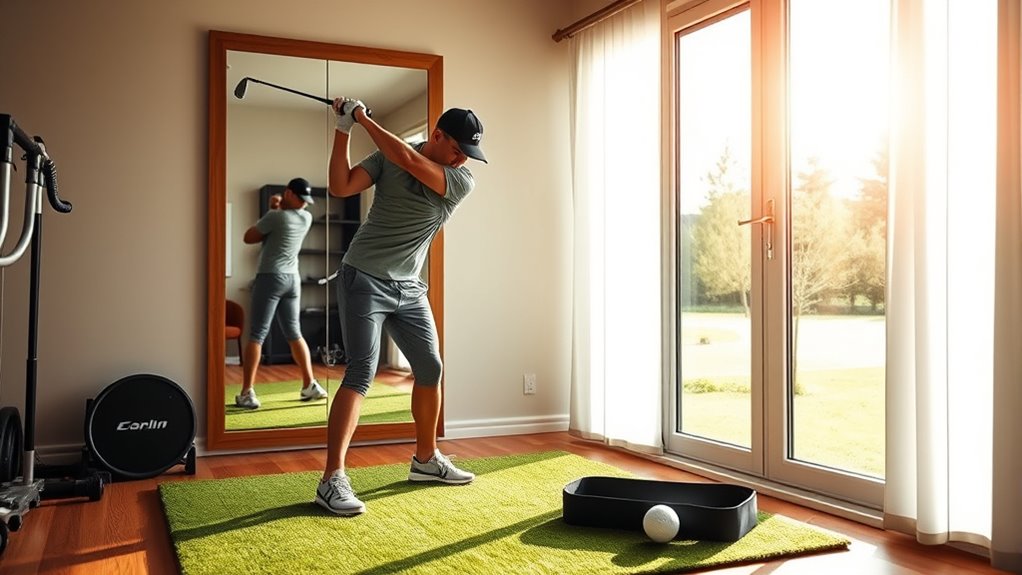
Once you’ve completed your warm-up, focusing on swing drills can considerably enhance your technique and consistency. Start by practicing your swing plane; use a mirror or alignment sticks to guarantee your club stays on the correct path throughout the swing. This helps develop a more repeatable motion. Pay close attention to grip consistency, as a stable grip promotes better control and shot accuracy. Use drills that emphasize maintaining your grip and swing plane, such as slow-motion swings or pausing at key points in your swing. Repeating these drills regularly builds muscle memory, making your swing more reliable under pressure. Remember, small adjustments made consistently lead to significant improvements in your overall technique and shot consistency. Incorporating European cloud innovation and sustainable practices into your training routine can further optimize your practice environment and results.

KIKIGOAL Golf Exerciser Resistance Bands Exercise Fitness or Pilates Workout Gym Sports Swing Cord
Golf swing training resistance band. High strength door buckle, perfect match with various kinds of doors
As an affiliate, we earn on qualifying purchases.
As an affiliate, we earn on qualifying purchases.
Flexibility Exercises for Better Mobility and Range of Motion

Improving your flexibility is essential for achieving better mobility and a more fluid golf swing. Incorporating yoga poses and breathing exercises helps release tension and enhance range of motion. To start, try these exercises:
- Seated Spinal Twist – Sit cross-legged, twist your torso, and breathe deeply to improve spinal mobility.
- Downward Dog – Push back into this pose, feeling a stretch through your hamstrings, calves, and shoulders.
- Chest Opener – Clasp your hands behind your back, lift your arms, and breathe to open up the chest and shoulders.
- Cat-Cow Stretch – Alternate between arching and rounding your back, syncing movements with breath for spinal flexibility.
This routine not only boosts mobility but also supports artistic expression, which can make your golf swing more fluid and natural.

Trideer Exercise Ball for Yoga, Pilates & Fitness – Stability Ball Equipment for Home Gym & Office Chair, Core & Balance Training Accessories, Physical Therapy Equipment, Quick Pump Included, 5 Sizes
Designed with anti-slip stripes and a fine frosted texture for enhanced grip and stability. The increased surface friction…
As an affiliate, we earn on qualifying purchases.
As an affiliate, we earn on qualifying purchases.
Strengthening Moves to Increase Power and Stability
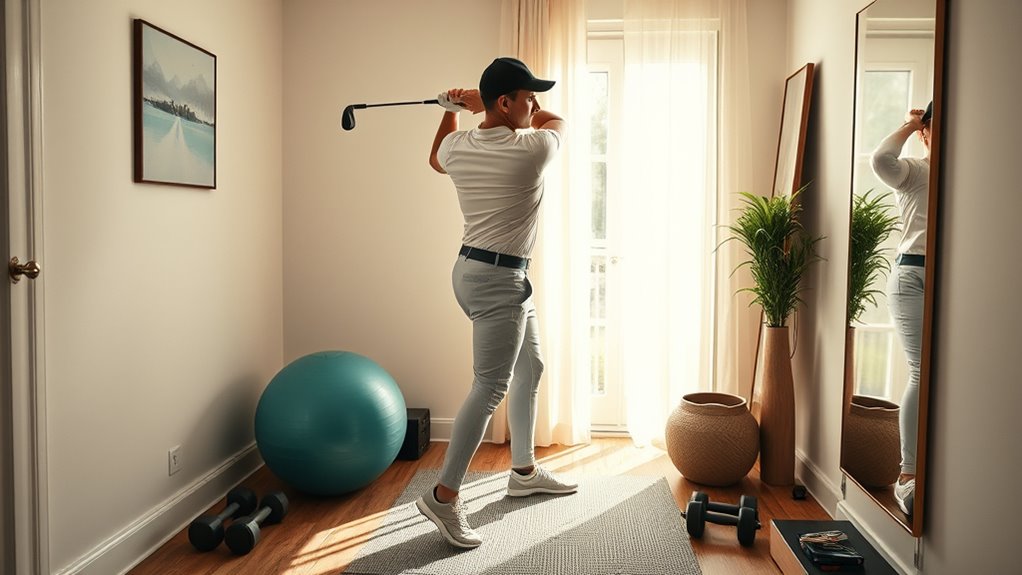
To boost your golf game, focus on core engagement drills that build strength and stability. Incorporate balance and stability exercises to improve your control during swings. Add explosive power moves to generate more force and maximize your distance on shots. Incorporating innovative technology in sports can also provide real-time feedback and tracking to optimize your training routines.
Core Engagement Drills
Building a strong core is essential for increasing both power and stability in your golf swing. Core engagement drills focus on improving core stability through targeted abdominal workouts. These exercises help you generate more power and maintain control during your swing. To get started, try these moves:
- Plank holds: Keep your body straight, engaging your abdominals and glutes.
- Russian twists: Sit with knees bent, twist your torso side to side, squeezing your core.
- Bird-dogs: On hands and knees, extend opposite arm and leg, maintaining balance.
- Leg raises: Lie on your back and lift legs, engaging your lower abs.
- Incorporate core stability exercises regularly to develop a resilient, stable core that enhances your overall golf performance. Developing muscle endurance in your core muscles can also contribute to sustained strength throughout your game. Additionally, integrating functional movement patterns can improve your ability to transfer power efficiently during swings.
Balance and Stability Exercises
Are you looking to boost your golf swing’s power and consistency? Improving balance and stability is key. Start by practicing single-leg stands to enhance your golf posture, which helps maintain control during your swing. Focus on keeping your core engaged and your grip techniques firm yet relaxed. Incorporate exercises like balance board holds or stability ball pushes to strengthen your stabilizer muscles. These moves help you stay steady through the swing, reducing mishits and increasing power transfer. Remember, a solid foundation is essential for consistent shots. Keep your movements controlled, and gradually challenge yourself with longer holds or added difficulty. Consistent practice of stability exercises can significantly improve your overall performance. By building your balance and stability, you’ll develop a more reliable, powerful golf swing that translates well on the course. Additionally, understanding core engagement can further improve your overall stability and swing control. Incorporating stability training devices like balance boards or stability balls can further enhance your training routine and results, much like how traditional bread pudding uses simple ingredients to create a rich, satisfying dish.
Explosive Power Moves
Adding explosive power to your golf swing requires dynamic movements that activate fast-twitch muscle fibers and enhance overall stability. Plyometric training is excellent for this, helping you develop quick, powerful movements. Resistance bands also play a key role by providing resistance that boosts your strength and control during explosive exercises. To build this power, try these moves:
- Jump squats with resistance bands around your thighs, focusing on rapid, explosive upward movements.
- Medicine ball throws, releasing the ball forcefully to mimic the swing’s explosive rotation.
- Plyometric push-ups, pushing off the ground with maximum force to develop upper-body power.
- Resistance band lateral lunges, exploding back to the center to engage hips and core muscles.
These exercises increase power, stability, and swing speed—all crucial for better golf performance.
Balance and Coordination Drills to Enhance Control
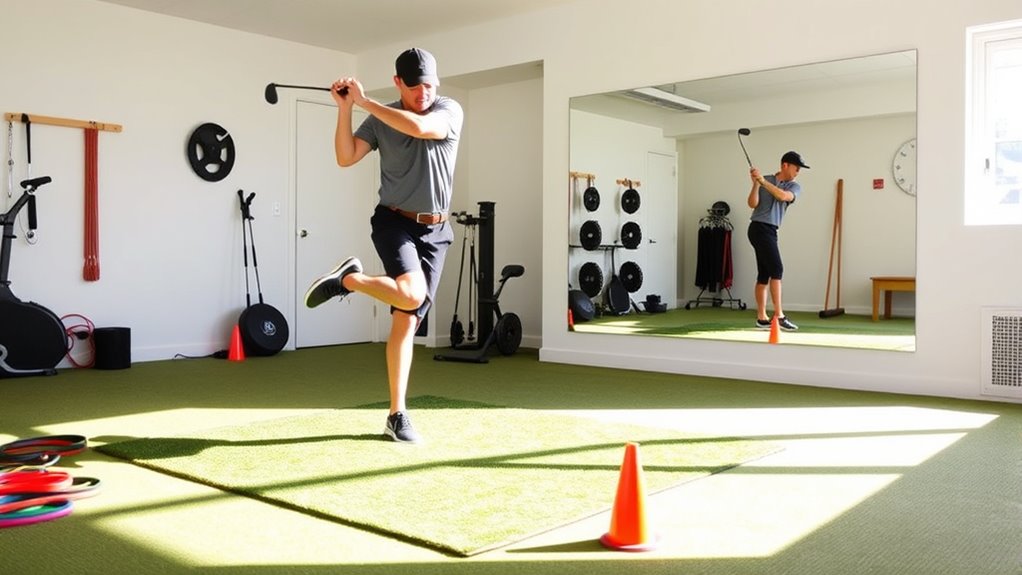
To improve your control on the course, focusing on balance and coordination is essential. These drills sharpen footwork precision and enhance proprioception training, helping you stay steady during swings. Start with single-leg balance exercises, maintaining posture for 30 seconds each side. Incorporate dynamic drills like heel-to-toe walks, focusing on controlled movement. These exercises improve your awareness of body position and coordination. Developing sensory feedback can also help you fine-tune your movements and maintain control. Here’s a motivating chart to keep you engaged:
| Exercise | Focus Area | Repetition |
|---|---|---|
| Single-leg balance | Balance stability | 3 sets of 30 sec |
| Heel-to-toe walk | Footwork precision | 2 laps |
| Standing hip swings | Coordination | 10 reps per side |
| Arm-leg reaches | Proprioception | 15 reps |
| Balance with eyes closed | Sensory awareness | 1 minute |
Consistent practice enhances your body awareness, which is a critical aspect of at-home training. Engaging in neuromuscular control exercises can further improve your ability to stay balanced during swings. Incorporating sensory-motor integration exercises can boost your overall coordination and control. Understanding the importance of multisensory integration training can help you develop a more comprehensive approach to control. Stay consistent, and you’ll see control and confidence grow.
Cool-Down and Stretching to Prevent Injuries

After focusing on balance and coordination exercises to sharpen your control, winding down with proper cool-down and stretching routines helps your body recover and stay injury-free. This step is essential for injury prevention and muscle recovery. To maximize benefits, consider these stretches:
- Gently bend forward at the hips, reaching for your toes to stretch your hamstrings and lower back.
- Perform shoulder rolls to loosen tight muscles and improve flexibility.
- Cross one arm over your chest, pulling it closer to stretch your shoulder and upper back.
- Sit and twist your torso to release tension in your spine and obliques.
- Incorporating stretching into your routine can also help maintain your flexibility and prevent stiffness that could affect your performance. Consistent stretching supports your overall software quality assurance by promoting muscle health and reducing the risk of setbacks due to injuries. Engaging in proper cool-down routines is also crucial for injury prevention, especially after intensive exercise sessions. Proper stretching techniques can also improve your muscle elasticity, which is vital for maintaining agility and reducing strain during play. Additionally, incorporating dynamic stretches before your workout can prepare your muscles for activity and enhance your overall mobility.
These movements promote blood flow, reduce stiffness, and help your muscles recover faster, keeping you ready for your next at-home golf session.
Frequently Asked Questions
Can I Effectively Practice Golf Indoors Without Special Equipment?
Yes, you can effectively practice golf indoors without special equipment. Focus on your indoor swing to refine your mechanics and improve consistency. Incorporate grip exercises to strengthen your hold and enhance control. Use mirrors or video recordings to analyze your posture and swing. Even without a range, these drills help you develop muscle memory and stay sharp, making your practice sessions productive and beneficial.
How Often Should I Perform At-Home Golf Drills for Best Results?
You should perform at-home golf drills about three to four times a week for best results. Maintaining scheduling consistency helps build muscle memory and improve your swing. Incorporate exercise variety to target different aspects of your game, such as putting, chipping, and driving. Don’t overdo it—rest days are essential. Stay committed, and you’ll see progress over time with steady practice and diverse drills.
Are There Specific Exercises Suitable for Beginners Versus Advanced Players?
You know what they say, “practice makes perfect.” As a beginner, focus on flexibility drills to improve your range of motion and basic swing speed. Advanced players should add more complex drills to refine their swing speed and consistency. Tailor exercises to your skill level, gradually increasing intensity. Both groups benefit from targeted flexibility drills; beginners build a solid foundation, while advanced players sharpen their skills for better performance.
What Common Mistakes Should I Avoid During At-Home Golf Workouts?
You should avoid common pitfalls like workout distractions and skipping warm-ups, which can hinder progress. Focus on maintaining proper form to prevent injury, and don’t rush through drills—quality beats quantity. Stay consistent and set clear goals to stay motivated. Avoid multitasking during exercises, as it can lead to poor technique. By staying focused and disciplined, you’ll get the most out of your at-home golf workouts and improve steadily.
How Can I Track Progress Without Access to a Golf Range or Coach?
You can’t judge your progress if you don’t keep score, so start by using shot tracking apps to record your shots and analyze patterns over time. For golf swing analysis, film yourself regularly to spot improvements and areas needing work. It’s a learning curve, but staying consistent with recording and reviewing your performance helps you see progress, even without a range or coach by your side.
Conclusion
By incorporating these at-home golf workouts, you’ll boost your skills just like a pro sharpening their game. These drills are your secret weapon to improve your swing, flexibility, and stability without leaving your house. Think of it as building a strong foundation—solid and reliable. Keep consistent, stay motivated, and you’ll see progress that’s as steady as a well-aimed putt. Your best game is just a few exercises away!