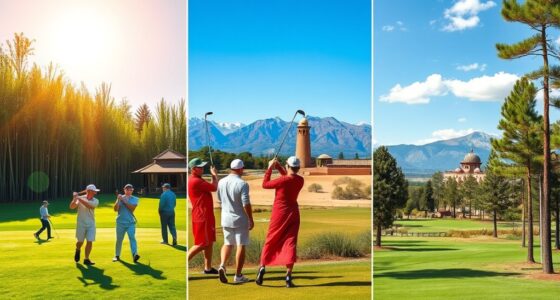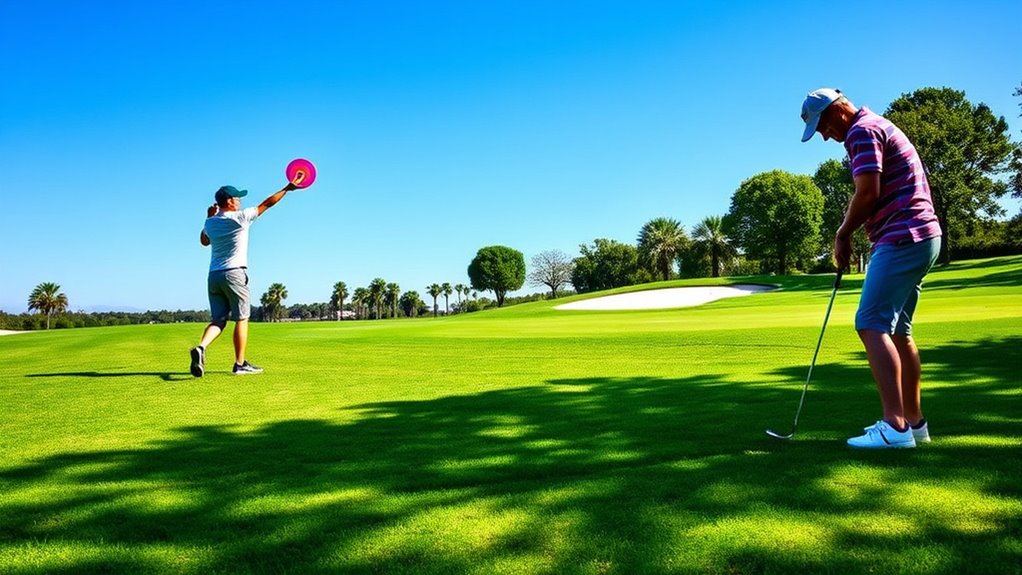

When comparing disc golf and traditional golf, you’ll find disc golf offers lower costs, easier access, and a quicker learning curve, making it more inviting for beginners. It uses simple equipment like discs and is played in natural outdoor spaces, minimizing environmental impact. Golf involves expensive clubs, complex rules, and manicured courses, often requiring more time and money. Want to discover which sport suits your lifestyle? Keep exploring to find out more about their differences.
Key Takeaways
- Disc golf is more affordable and accessible, with low-cost equipment and numerous free courses, unlike traditional golf’s high costs and exclusive courses.
- The sport utilizes natural terrain for varied and sustainable environments, whereas traditional golf relies on manicured, often environmentally intensive courses.
- Disc golf features simple rules and quicker skill development, making it more beginner-friendly compared to traditional golf’s complex regulations.
- It promotes casual social interactions and community building, attracting a broader demographic through its approachable and inclusive nature.
- Disc golf’s rapid growth, versatility, and eco-friendly practices support its status as a sustainable, accessible outdoor activity for all skill levels.

TaylorMade Golf SIM 2 MAX DRIVER 10.5 DEGREE MENS RIGHT HAND GRAPHITE REGULAR
New Forged Ring Construction. Forged from a lightweight and high strength aluminum that is milled to an exacting...
As an affiliate, we earn on qualifying purchases.
Equipment and Gear Differences
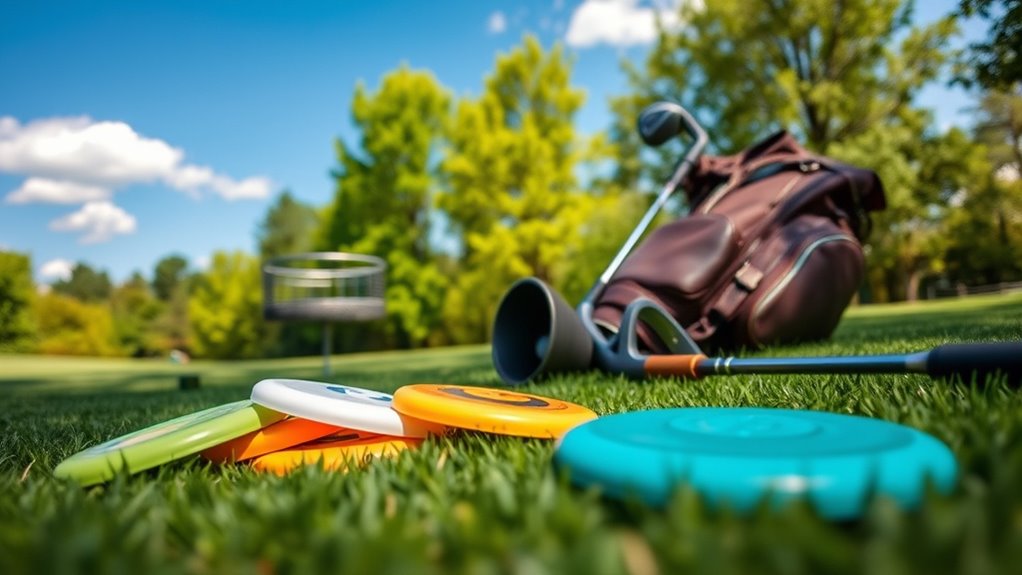
While both disc golf and traditional golf require specialized equipment, the gear used in each sport varies considerably. In disc golf, you’ll need discs, which differ in weight and design for various throws, making disc golf equipment more affordable and versatile. Golf gear, on the other hand, includes clubs and balls that are often costly and require careful selection based on course design and scoring rules. The physical demands and skill barriers differ, with disc golf emphasizing accuracy and adaptability through different discs, while traditional golf demands precise swing mechanics. Community engagement and environmental impact also vary, as disc golf’s land preservation and sustainability practices promote ecosystem conservation. Additionally, the equipment diversity in disc golf allows for a broader range of player styles and strategic choices, making it accessible to newcomers. This diversity supports inclusive participation, encouraging players of all skill levels to engage with the sport. Moreover, the environmental impact of disc golf courses typically has a smaller ecological footprint compared to traditional golf courses, which often require extensive land modification. Furthermore, the cost of equipment in disc golf is generally lower, making it more accessible for casual players and beginners. Overall, the sport’s popularity and training difficulty influence accessibility, but both sports foster unique skills and social connections through their equipment and gear. Additionally, the contrast ratio of projectors can significantly enhance the visual experience in home cinema setups by providing deeper blacks and brighter whites.

Speed System Golf Titanium Driver Golf Club, Loft Lightweight Graphite Shaft, Oversized Sweet Spot, Aerodynamic, USGA Conforming Mens Driver + Deluxe Headcover - Blue 11.5° Loft, Right
Ultra-Lightweight Graphite Shaft: Weighing under 60g, the golf drivers’ 100% graphite shaft is made for faster swing speeds...
As an affiliate, we earn on qualifying purchases.
Playing Environment and Course Design
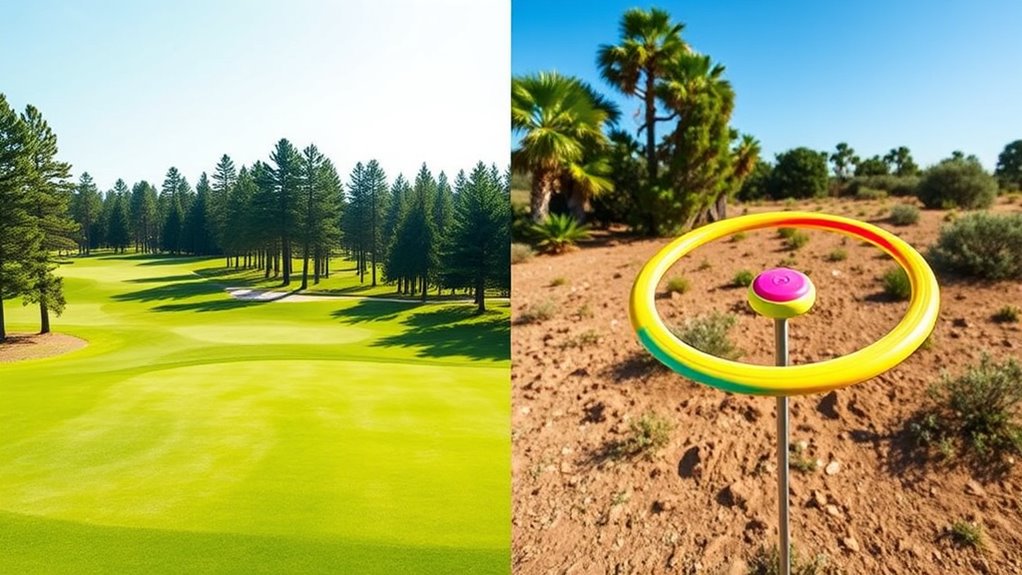
Both disc golf and traditional golf are shaped by their unique playing environments and course designs, which considerably influence how you experience each sport. Disc golf courses often utilize natural terrain like wooded areas, hills, and open fields, creating a diverse and dynamic playing environment. The course variety in disc golf means you can find layouts that challenge your skills with trees, water hazards, or elevation changes, all integrated into natural surroundings. The natural terrain allows for a more adaptive and flexible experience, as courses can be easily modified or expanded based on available space and terrain features. Additionally, course design in disc golf often emphasizes adaptability and integration with existing natural features, making each course a unique experience. This emphasis on natural integration results in courses that are not only challenging but also environmentally conscious and sustainable. The use of natural elements often encourages ecological awareness among players and course designers alike. Traditional golf courses typically feature manicured fairways, greens, and water hazards, crafted to maintain a consistent aesthetic and playability. While golf courses tend to be expansive and open, disc golf courses often fit into smaller, more varied spaces. Both sports leverage their environments to shape gameplay, but disc golf’s natural terrain offers greater variety and flexibility.

Rapsodo MLM2PRO Golf Launch Monitor, Simulators for Home & Training, Mobile Launch Monitor for Golf Swing Analysis, Measures Spin Rate & Axis, Tracker & Swing Analyzer, Indoor Outdoor (3 Pro V1 Balls)
Advanced Golf Launch Monitor – The Rapsodo MLM2PRO golf launch monitor delivers pro-level accuracy, measuring 13 core golf...
As an affiliate, we earn on qualifying purchases.
Cost and Accessibility for Beginners
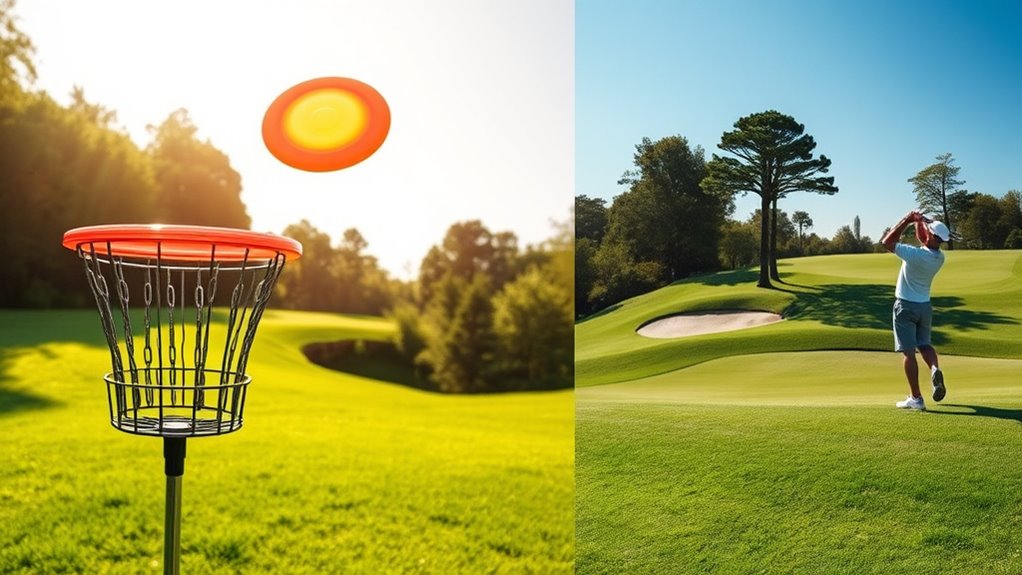
When starting out, you’ll find that disc golf usually costs less with inexpensive equipment options, whereas golf can require a bigger investment in clubs and accessories. Course availability also plays a role, as disc golf courses are often more numerous and easier to access for beginners. Additionally, skill level barriers in traditional golf might make it harder for newcomers to enjoy the game without feeling out of place or overwhelmed. Incorporating visual and auditory cues into your practice can also make learning and improving more accessible and fun for new players. Moreover, disc golf’s equipment affordability makes it an appealing entry point for many beginners looking to try a new sport without a significant financial commitment. The learning curve for disc golf is generally less steep, allowing newcomers to experience quick progress and increased enjoyment early on.
Equipment Expenses
Getting started in disc golf generally costs less than traditional golf, making it more accessible for beginners. You won’t need expensive gear to begin; a basic set of disc golf gear can be purchased for under $20, whereas golf club selection can run into hundreds of dollars. You might find that equipment costs is a common barrier for new players trying to get into traditional golf. Unlike golf, where you might feel overwhelmed choosing from dozens of clubs, disc golf requires just a few discs suited for different throws. This simplicity keeps initial costs down. You don’t need a full set or specialized equipment, and many courses are free or low-cost to access. Overall, disc golf’s lower equipment expenses make it easier to try out and continue playing without a hefty financial commitment. Free Floating also means you can enjoy the sport without the need for costly memberships or memberships. Additionally, the self-guided nature of disc golf allows players to practice and improve at their own pace without additional expenses.
Course Availability
Have you noticed how easy it is to find a place to play disc golf? The course variety across parks and dedicated courses makes it highly accessible, often free or low-cost. Many courses are open to the public, offering flexible hours without the need for memberships or fees. Accessibility options are also plentiful, with urban parks and community spaces providing courts that are easy to reach. In contrast, traditional golf courses can be limited in number, often requiring reservations and higher fees. For beginners, disc golf’s wide availability and minimal cost make it a more approachable sport. You don’t need specialized gear or memberships—just a disc and a desire to play—making course accessibility a major advantage. Additionally, the cost-effectiveness and affordability of disc golf contribute to its popularity among newcomers, especially since public parks and community spaces often host free or low-cost courses that encourage new players to try the sport without financial barriers. The ease of access and low entry barriers further solidify disc golf as an inviting option for beginners. Furthermore, the minimal equipment requirements help lower the initial investment needed to get started.
Skill Level Barriers
For beginners, skill level barriers in disc golf are generally lower than in traditional golf because the initial costs and access are minimal. Disc golf is beginner friendly, allowing you to start without expensive equipment or memberships. You can learn the basics quickly and focus on skill development without feeling overwhelmed. Unlike golf, where clubs and course fees can be costly, disc golf only requires a few discs, which are affordable and easy to carry. Public parks and open spaces make it accessible for anyone, regardless of location or budget. This low barrier to entry encourages more new players to develop their skills at their own pace. Additionally, the energy-efficient infrastructure of disc golf courses helps promote sustainable outdoor recreation options. Overall, disc golf’s simplicity and affordability help you progress comfortably and enjoyably, making it a great starting point for developing your game. The cost-effective nature of disc golf equipment and play environments further enhances its appeal to beginners.
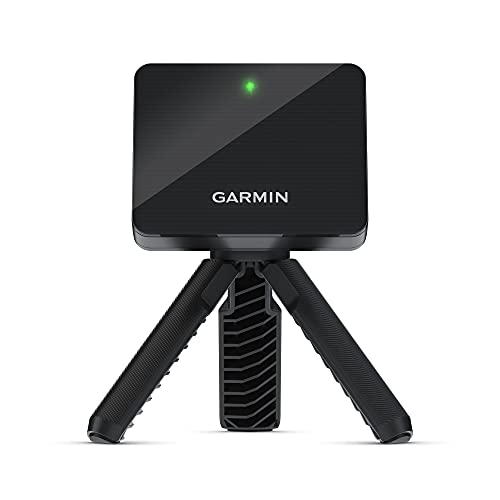
Garmin Approach R10, Portable Golf Launch Monitor, Take Your Game Home, Indoors or to The Driving Range, Up to 10 Hours Battery Life - 010-02356-00
Work to improve your game at home, indoors or on the driving range with a portable launch monitor...
As an affiliate, we earn on qualifying purchases.
Rules and Scoring Systems

While both disc golf and traditional golf have their unique rules and scoring methods, understanding how they differ is key to appreciating each game. Disc golf features straightforward scoring variations, typically counting strokes or throws, making it easy to track progress. In contrast, traditional golf involves more complex rule systems, including penalties, handicaps, and different formats like match play or stroke play.
- Disc golf generally has less rule complexity, simplifying gameplay for newcomers.
- Traditional golf’s scoring systems can include various formats, adding depth and strategic complexity.
- Both sports require adherence to specific rules, but the intricacies of golf’s rule variations often demand more familiarity.
Knowing these differences helps you better grasp each sport’s unique appeal and gameplay style.
Physical Demands and Skill Levels

Disc golf and traditional golf differ markedly in their physical demands and the skill levels required to play effectively. In disc golf, you rely heavily on physical endurance to walk long distances and navigate uneven terrain. Your hand-eye coordination plays a vital role in accurately throwing discs over varying distances and angles. Traditional golf demands a different set of skills, focusing more on precision and control with clubs, and less on endurance since walks tend to be shorter. While both sports require practice to improve your technique, disc golf emphasizes staying physically active throughout the game, whereas golf centers on mastering swings and shot accuracy. Overall, disc golf offers a more physically demanding experience, especially for those who enjoy moving and engaging their coordination skills consistently.
Social Aspects and Community Vibe
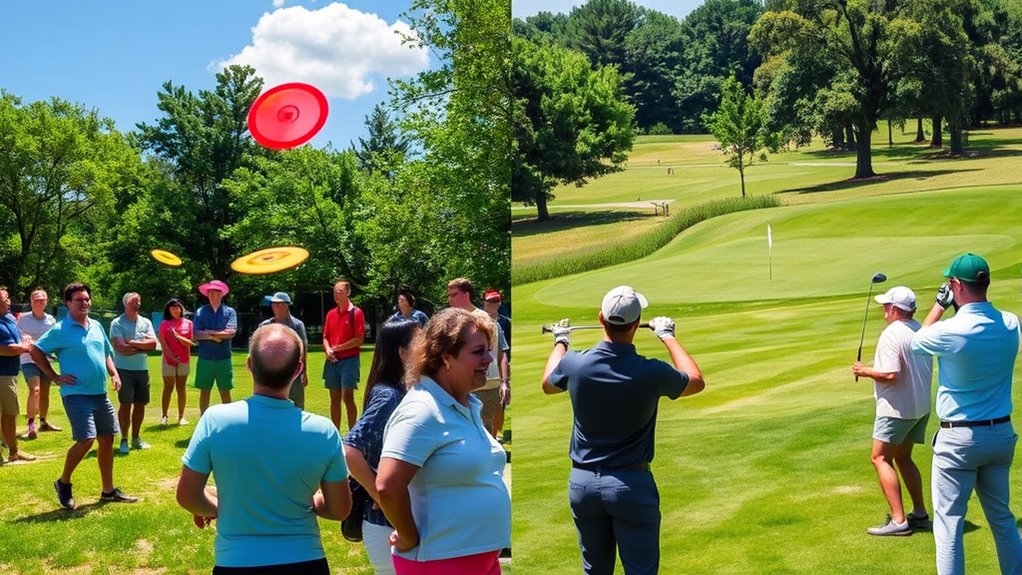
Both disc golf and traditional golf foster strong social connections, but they do so in different ways. You’ll find that disc golf often encourages casual social interactions through informal rounds and friendly competitions. Community events like tournaments or meetups create a sense of belonging and shared passion. Traditional golf, on the other hand, emphasizes long-standing relationships built over time through regular rounds with the same group.
Consider these aspects:
- Disc golf’s inclusive atmosphere attracts players of all skill levels for social interactions.
- Community events in both sports promote camaraderie and networking.
- Golf courses often host tournaments that strengthen community bonds.
Whether you prefer the laid-back vibe of disc golf or the tradition of golf, both sports offer opportunities to connect and build lasting friendships.
Environmental Impact and Sustainability
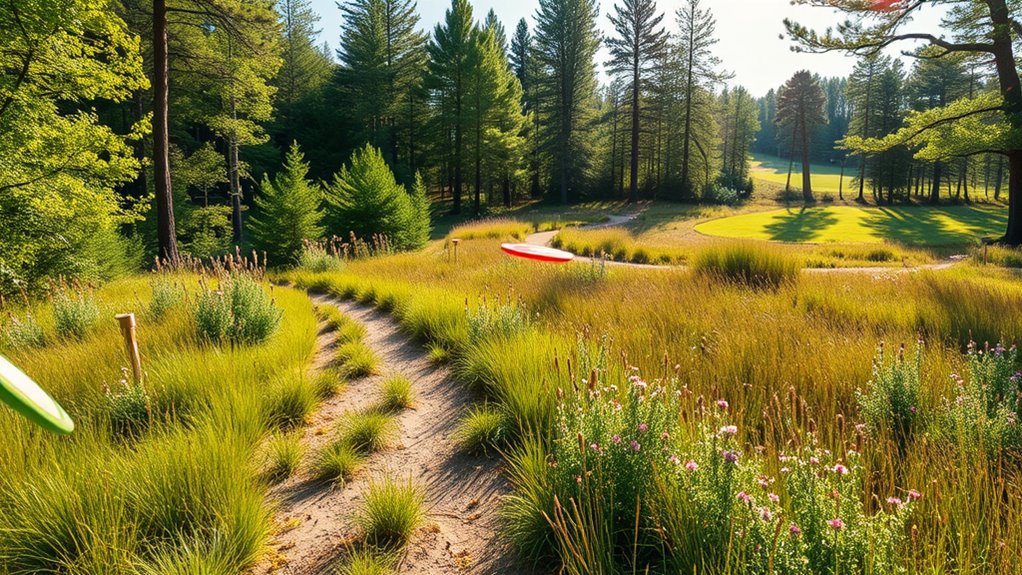
You might notice that disc golf courses often require less land than traditional golf courses, helping preserve natural spaces. Using sustainable materials and eco-friendly maintenance practices can reduce environmental harm for both sports. It’s also important to contemplate how each sport affects local ecosystems and efforts to protect native plants and wildlife.
Land Use and Preservation
Land use and preservation are critical factors when comparing disc golf and traditional golf, as they directly influence environmental sustainability. Disc golf typically requires less land, allowing for more flexible placement within urban development zones and reducing the need for extensive land conservation efforts. This sport often utilizes underused or degraded areas, minimizing habitat disruption. In contrast, traditional golf courses usually demand large, carefully maintained spaces that can limit urban expansion and impact local ecosystems. By choosing disc golf, you support land preservation and reduce ecological footprints.
- Less land needed for course setup
- Minimizes disruption to natural habitats
- Promotes efficient land conservation practices
Material Sustainability Practices
Material sustainability practices play a vital role in reducing the environmental impact of disc golf and traditional golf courses. Both sports are increasingly adopting eco friendly practices, such as using recycled materials for equipment and course infrastructure. For example, disc golf manufacturers are producing discs from recycled plastics, minimizing waste and resource consumption. Similarly, golf courses are replacing traditional turf and construction materials with eco-friendly options that lessen environmental strain. These sustainable choices help lower carbon footprints, reduce landfill waste, and promote resource conservation. By prioritizing recycled materials and eco friendly practices, both sports demonstrate a commitment to environmental responsibility. Your awareness of these efforts can influence more sustainable decisions, encouraging the industry to continue minimizing its ecological impact while offering enjoyable recreation.
Ecosystem Impact and Conservation
Both disc golf and traditional golf courses can substantially impact local ecosystems, making sustainability efforts vital for minimizing environmental harm. You should consider how each sport affects wildlife preservation and habitat destruction. Traditional golf courses often require large areas of land, leading to habitat loss for native species and disrupting ecosystems. Disc golf courses typically use smaller spaces and can be integrated into existing parks, reducing habitat destruction. To further protect the environment, look for courses that implement eco-friendly practices such as native plant landscaping, minimal pesticide use, and habitat restoration.
- Use of native plants to support local wildlife
- Avoidance of chemical pesticides and fertilizers
- Preservation of natural habitats during course development
Popularity and Cultural Presence
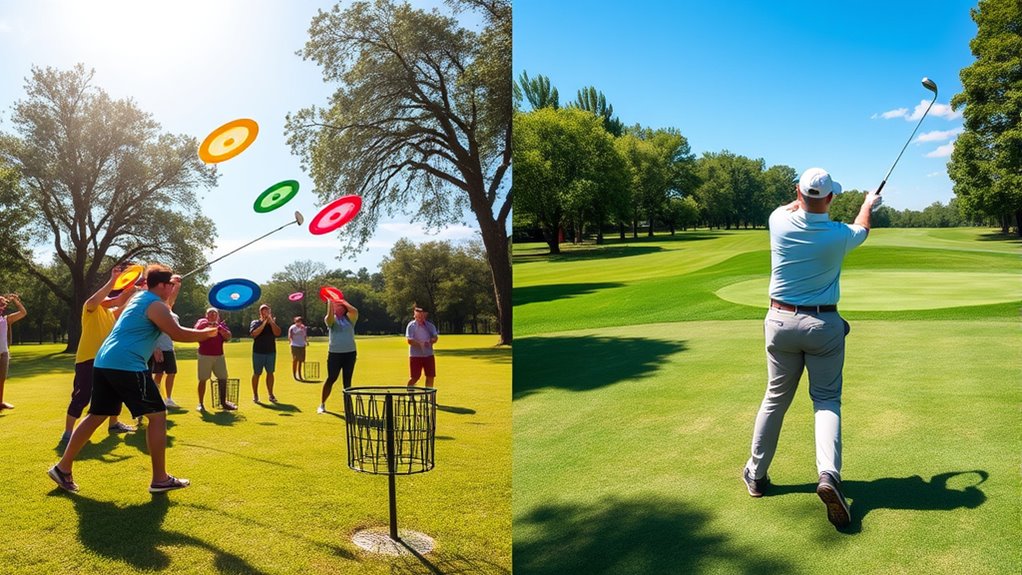
Although disc golf is gaining popularity rapidly, it still lags behind traditional golf regarding cultural presence. You’ll notice that golf has long-established popularity trends, with a deep-rooted influence on sports culture, media, and social events. Its history and tradition have helped it become ingrained in the global sports landscape. In contrast, disc golf’s cultural influence is growing, especially among younger audiences and in urban areas, but it hasn’t yet achieved the same level of recognition or mainstream visibility. While more people are discovering disc golf and its community-oriented vibe, it still lacks the widespread media coverage and sponsorships that solidify golf’s place in popular culture. As disc golf continues to expand, its cultural presence may strengthen, but golf remains the dominant presence today.
Training and Learning Curve

Getting started with disc golf is generally easier than learning traditional golf because it requires less technical skill and equipment. You can see quick progress, making the learning progression smoother for beginners. With minimal gear, you’ll develop beginner proficiency faster, boosting confidence early on. The sport’s straightforward rules and focus on accuracy help new players pick up skills without feeling overwhelmed.
Key benefits include:
- Faster skill development due to simple techniques
- Shorter time to achieve beginner proficiency
- Easier to understand and practice the fundamentals
This accessible learning curve encourages more participation, especially for those new to outdoor sports. Unlike golf, where mastering swings takes time, disc golf offers a more immediate sense of achievement, making it an attractive option for newcomers.
Versatility and Adaptability of the Sports

Disc golf demonstrates remarkable versatility and adaptability, making it suitable for players of all ages and skill levels. Its multifaceted gameplay allows you to enjoy different strategies, shot types, and course layouts, keeping the game fresh and engaging. You can play casually in local parks or compete in organized tournaments, showcasing its flexible nature. The sport accommodates diverse skillsets, from beginners mastering basic throws to advanced players executing complex shots. Its minimal equipment requirements and accessible courses mean you can easily guarantee to adapt to various environments. Whether you prefer a relaxed game with friends or a competitive challenge, disc golf’s versatility ensures it remains inclusive and adaptable, fitting seamlessly into different lifestyles. This broad appeal highlights why it continues to grow in popularity worldwide.
Frequently Asked Questions
How Do Weather Conditions Affect Gameplay in Disc Golf Versus Traditional Golf?
Weather impact markedly influences your gameplay in disc golf and traditional golf. Rain can make course conditions muddy and slippery, affecting grip and control for both sports. Wind impacts your throws in disc golf by pushing discs off course, while in golf, it alters club selection and shot accuracy. Sunny and dry conditions generally improve performance, but you need to adapt your strategy based on weather impact to succeed in either game.
What Are the Safety Considerations Unique to Each Sport?
Picture yourself steering a battlefield, where safety is your shield. In disc golf, you should wear protective gear like sunglasses and gloves to prevent injuries from thrown discs. Watch out for course hazards such as uneven terrain or hidden obstacles that could cause falls. In traditional golf, be mindful of golf cart accidents or stray balls. Staying alert and prepared ensures you stay safe while enjoying your game.
How Do Scoring Strategies Differ Between Disc Golf and Golf?
You focus on scoring accuracy in disc golf by aiming for precise throws to minimize strokes, while in traditional golf, you might adapt your strategy by choosing clubs and shot types based on course conditions. Your approach changes as you analyze each hole’s layout, adjusting your strategy to lower your score. In both sports, mastering scoring strategies means continuously adapting your tactics to improve your overall performance.
Can a Player Easily Transition From One Sport to the Other?
You can shift between disc golf and golf, but it’s not always easy. Your skill transfer depends on your experience with aim, control, and throwing or swinging techniques. Equipment adaptation is also essential; while similar, discs and clubs require different handling. With practice, you’ll find that your core skills help, but expect some adjustment time to master the nuances of each sport.
Which Sport Offers More Opportunities for Competitive Tournaments?
You’ll find that traditional golf offers more opportunities for competitive tournaments, with extensive tournament structures and a long-standing history of professional events. Sponsorship opportunities are also more abundant, attracting major brands and endorsements. While disc golf is growing rapidly with increasing local and national competitions, it still lags behind golf in regarding the sheer number of tournaments and sponsorship deals available.
Conclusion
Whether you’re aiming to conquer the skies with disc golf or master the greens with traditional golf, one thing’s clear: these sports will transform your life. You’ll find yourself hooked on the thrill, battling the elements, and chasing that perfect throw or shot. Immerse yourself now—because once you experience the exhilarating clash of disc golf versus golf, there’s no going back. Prepare for the most addictive, adrenaline-pumping adventure of your life!