
To escape deep rough effectively, assess the lie carefully—note grass density, ball position, and turf conditions. Choose a club with more loft and a wider sole, then adjust your stance by widening it and keeping your weight slightly forward. Maintain a smooth, controlled swing along a proper path, focusing on clean, ball-first contact. Be mindful of turf moisture and density to adapt your technique. Continue exploring these tips to master tough lies and improve your scores.
Key Takeaways
- Select clubs with more loft and wider soles, and adjust stance and ball position for better contact in deep rough.
- Use a steeper swing path and keep clubface open to lift the ball out of thick grass effectively.
- Widen your stance, grip down slightly, and focus on smooth tempo to maintain control in tough lies.
- Assess turf moisture and density to choose appropriate club and shot technique for optimal results.
- Practice visualization, pre-shot routines, and adaptability to build confidence and improve shot execution from deep rough.
Assessing the Lie and Choosing the Right Club
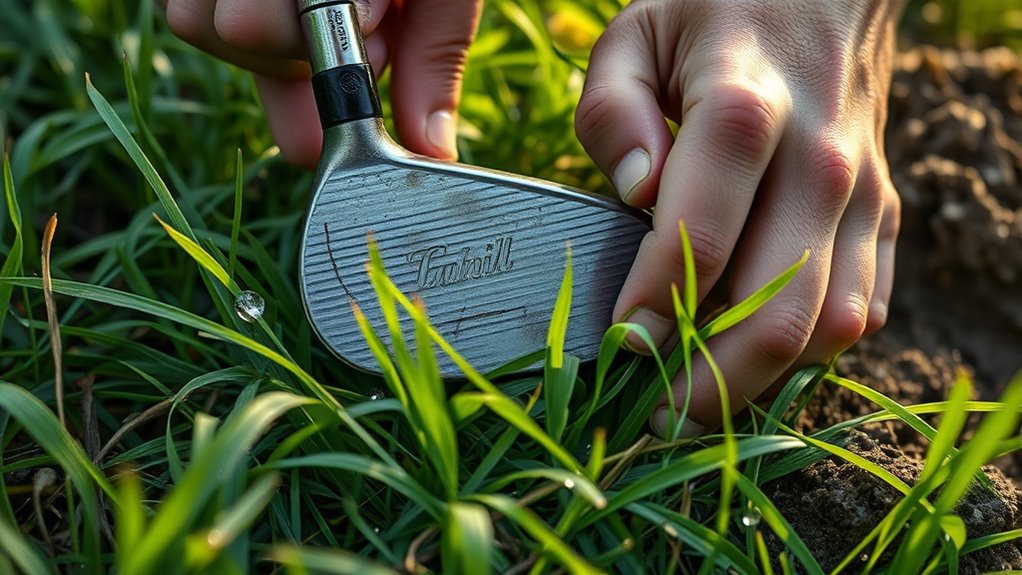
When facing a deep rough lie, the first step is to carefully assess the position of the ball and the surrounding grass. Effective lie detection helps you understand how much the grass will interfere with your shot, whether it’s thick, tangled, or lying down. This insight guides your club selection; for tougher lies, you’ll want a club with more loft and a wider sole to help lift the ball cleanly. Avoid choosing a club that’s too strong or too weak, as either can make it harder to control distance and accuracy. Take note of the grass length and density, as well as the ball’s depth. Making an informed club selection based on an accurate lie detection sets the foundation for executing a successful shot from the deep rough. Additionally, understanding your equipment’s technology can help you optimize shot execution in challenging lies, especially when leveraging innovative cloud-based training tools to improve your swing analysis.
Adjusting Your Stance and Swing for Thick Grass

To effectively navigate thick grass, you need to adjust your stance and swing to account for the resistance and tangled grass fibers. Start by choosing a club with more loft and slightly shortening your swing to prevent digging too deep. Your club selection should prioritize loft to lift the ball cleanly out of the rough. Grip adjustment is also essential; grip down slightly on the club to gain better control and prevent the clubface from twisting. Widen your stance to maintain stability and guarantee a smooth, controlled swing. Keep your weight slightly forward to help shallow the angle of attack, reducing the chance of the club catching heavy grass. These adjustments help you make cleaner contact and escape tough lies more effectively. Additionally, understanding your swing mechanics can help optimize your shot execution in challenging conditions. Developing a consistent swing path tailored to thick grass can further improve your chances of success. Practicing specific shot techniques designed for rough terrain can build confidence and consistency in your game. Incorporating proper club selection based on the lie can also significantly enhance your ability to escape difficult situations. Moreover, practicing auditory processing strategies can improve your focus and overall shot execution under pressure.
Using Proper Ball Position to Maximize Contact

Placing the ball correctly in your stance helps you make clean contact and avoid thin or fat shots. You should adjust your ball position based on the lie to guarantee you’re striking the ball first. Focusing on ball-first contact gives you better control and consistency, especially in deep rough.
Position for Clean Contact
Achieving clean contact from deep rough starts with the right ball position, which can substantially improve your chances of making solid contact. Proper placement depends on lie assessment and club selection. Here’s how to position yourself effectively:
- Place the ball slightly back in your stance to ensure contact with the ball before the thick grass.
- Adjust your stance wider to maintain balance and stability through the shot.
- Use a club with more loft to help elevate the ball and clear the rough.
- Focus on a slightly steeper swing to penetrate the thick grass and strike cleanly.
- Remember that understanding shot consistency and practicing these techniques can help improve your success in tough lies.
- Incorporating proper wiring basics can also help ensure your swing mechanics are optimized for challenging conditions.
Adjust Based on Lie
When you’re faced with varying lies in the deep rough, adjusting your ball position can make a big difference in contact quality. Lie detection is essential to determine whether the ball sits up or is buried, guiding your placement. For a lie that’s more upright or sits on top of the grass, position the ball slightly forward in your stance to ensure clean contact. If the ball is deeply embedded or lies down, move it back in your stance to help you dig under the ball and lift it out. Staying mentally resilient helps you adapt quickly to these changes, avoiding hesitation. Consistently adjusting your ball position based on the lie improves your chances of solid contact and successful escape from tough lies.
Focus on Ball-First Contact
Focusing on ball-first contact is essential for escaping deep rough effectively. Proper ball position helps you make clean ball contact, even with challenging lies. To optimize your chances:
- Assess your lie carefully to determine the best ball position—play it slightly forward for a higher shot or back for control.
- Move the ball position closer to your front foot on thick grass to avoid hitting the ground first.
- Keep your weight slightly forward to promote downward contact and prevent digging.
- Concentrate on a smooth, accelerating swing to ensure consistent ball contact, regardless of the lie.
Executing a Controlled, More Steady Swing

To improve your shot from deep rough, focus on maintaining a smooth tempo throughout your swing. Keep your body balanced and avoid rushing, even when the lie feels challenging. A steady, controlled swing will give you better contact and more consistent results. Incorporating free floating techniques can help you maintain the ideal swing path and reduce unwanted tension.
Maintain a Smooth Tempo
Maintaining a smooth tempo during your swing is essential when escaping deep rough, as it helps you stay in control and make solid contact. A steady rhythm prevents you from rushing and losing accuracy. Focus on your club selection first; choose a club that matches the lie and the shot distance. Keep your mental focus sharp, avoiding overthinking or swinging too hard. To keep a controlled tempo:
- Take a deep breath before your shot to settle nerves.
- Maintain a consistent backswing and follow-through.
- Avoid rushing the downswing, emphasizing rhythm over power.
- Visualize a smooth, gliding swing to reinforce your tempo.
This approach ensures you stay composed and execute a controlled shot, even from tough lies.
Focus on Balanced Swing
A balanced swing helps you maintain control and consistency, especially when you’re faced with challenging lies. To achieve this, focus on grip adjustments that promote stability and a smooth tempo. A slightly firmer grip can prevent the club from twisting, while a lighter grip allows for better feel and control. Club selection is essential; choose a club with enough loft to lift the ball out of the rough without sacrificing control. Maintain a steady, controlled tempo throughout your swing, avoiding hurried or jerky motions. Keep your hands steady and your weight balanced, ensuring your swing remains smooth and deliberate. This focus on balance and control helps you execute a more controlled, steady swing, increasing your chances of escaping tough lies effectively. Additionally, cultivating consistent storytelling can help you build confidence in your technique and approach, making your shots more reliable under pressure.
Applying the Correct Swing Path to Avoid Friction

When your swing path is aligned correctly, you considerably reduce the chances of creating unnecessary friction with the turf. This is vital in deep rough, where minimizing turf interaction preserves control and consistency. To achieve this, focus on a proper lie assessment to understand how the club interacts with the ground. Proper club selection helps you choose a club with the right loft and bounce, aiding your swing path. Additionally, consider these tips:
- Keep your swing on a slight inside path to avoid digging.
- Guarantee your hands lead through impact for a clean strike.
- Maintain a smooth tempo to prevent abrupt contact.
- Practice drills that emphasize a consistent swing plane.
- Researching club options can help you select the best equipment for tough lies.
Applying these techniques helps you develop a swing path that reduces friction, making tough lies more manageable.
Managing Turf Interaction and Ground Conditions

Understanding how turf and ground conditions influence your shot is essential for maneuvering deep rough successfully. When ground moisture is high, the turf tends to be softer and more forgiving, helping the club glide through without excessive resistance. Conversely, dry ground creates a firmer surface, increasing turf density and making it tougher to make clean contact. To adapt, select a club with more loft to lift the ball out of thick grass, and focus on a steeper swing angle to avoid digging. Pay attention to the turf’s density; dense turf requires a more aggressive strike, while softer turf allows for a smoother, more controlled swing. Recognizing the ground conditions can help you adjust your technique effectively, ensuring better contact and control even in challenging deep rough situations. Additionally, understanding the soil type can assist in predicting how the turf will respond under different weather conditions. Being aware of soil composition can further refine your approach to different playing environments. Moreover, assessing the turf root structure can provide insights into how stable or loose the ground is, influencing your shot strategy.
Practicing Skills to Improve Confidence and Consistency

Practicing specific drills consistently builds both your confidence and your ability to hit reliable, repeatable shots. To improve, focus on mental visualization before each shot, picturing the ball’s trajectory and landing zone. Establish a steady routine to reinforce routine consistency, which helps reduce nerves and enhances focus. Here are four key practices:
- Repetitive short-game drills to develop touch and control
- Visualizing successful outcomes to build mental confidence
- Practicing your pre-shot routine to promote routine consistency
- Simulating tough lies to adapt your swing under pressure
Additionally, incorporating mindfulness techniques can help you stay organized and focused during practice sessions. Understanding the importance of net worth and other related factors can also boost your confidence by reminding you of the value of consistent effort and self-improvement. Recognizing the horsepower of your swing can motivate you to refine your technique for better performance.
Frequently Asked Questions
How Do Wind Conditions Affect Shots From Deep Rough?
Wind conditions considerably impact your shots from deep rough. When the wind blows, it can alter your ball spin and trajectory, making it harder to control. You should adjust your club selection to counteract the wind’s effect—using a club with less loft for headwinds or more for tailwinds. Always consider the wind speed and direction before swinging, and make subtle adjustments to stay on target and avoid mishits.
What Are Common Mistakes to Avoid When Escaping Deep Rough?
When escaping deep rough, avoid common mistakes like neglecting your reading course and failing to adjust your stance properly. You might attempt to lift the ball too much or swing too hard, which can worsen your lie. Instead, focus on reading the course to understand the grass and terrain, and make a stance adjustment to stay balanced. Keep your swing controlled, and trust your setup to improve your shot success.
Can Equipment Modifications Improve Performance in Thick Grass?
Yes, equipment modifications can improve your performance in thick grass. You should focus on club selection, choosing clubs with wider soles or lower lofts to glide through the grass more easily. Additionally, making swing adjustments, like increasing your swing speed or altering your angle of attack, can help you escape tougher lies. These tweaks allow you to better navigate dense rough, giving you more control and consistency in tough conditions.
How Does Lie Angle Influence Shot Success in Tough Lies?
You might find it surprising, but your lie angle can markedly influence shot success in tough lies. When the lie angle is properly adjusted, it helps your clubface stay square at impact, ensuring more accurate contact. A correct lie angle prevents your club from digging too much or skimming over the surface, giving you better control and consistency. Ultimately, matching your lie angle to your swing style boosts your confidence in challenging situations.
What Mental Strategies Help Maintain Focus in Challenging Roughs?
To stay focused in challenging roughs, use visualization techniques to picture a successful shot, boosting your confidence. Practice breath control to keep calm and steady your nerves, preventing tension from affecting your swing. Focus on your pre-shot routine, block out distractions, and trust your skills. These mental strategies help you stay present, reduce anxiety, and execute precise shots even in tough lies, giving you a better chance to escape successfully.
Conclusion
Mastering tough lies is like steering a wild river—you need patience, skill, and the right tools. By evaluating the lie, adjusting your stance, and controlling your swing, you can tame even the most stubborn turf. Practice these techniques regularly, and you’ll find your confidence growing stronger with each shot. Remember, the right approach turns obstacles into opportunities, transforming rough terrain from a challenge into a stepping stone toward smoother, more confident swings.