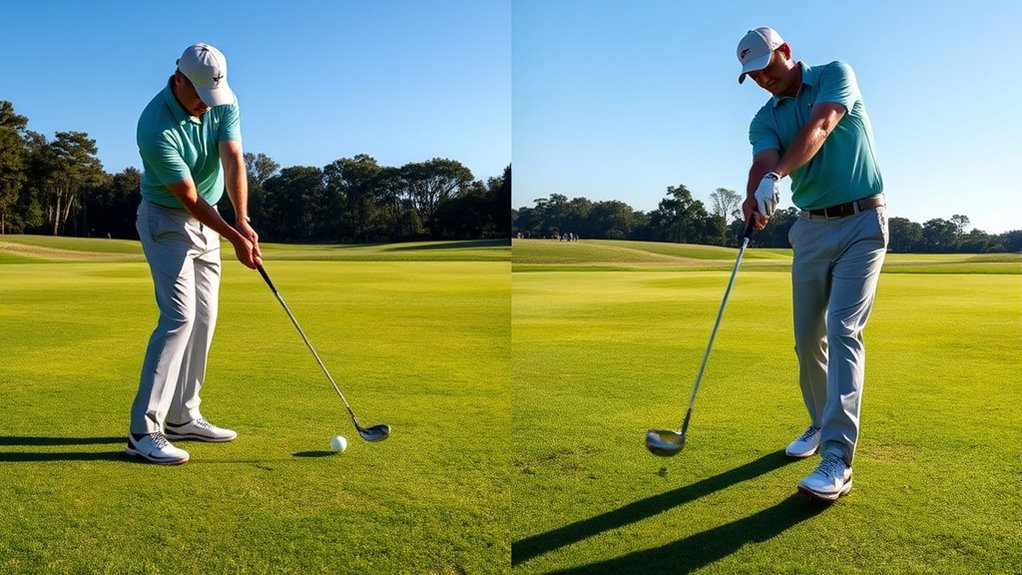

You should use chipping when you’re close to the green on flat terrain and need a low-trajectory, roll-out shot with a short backswing. Opt for pitching when you face longer shots needing higher, softer landings over obstacles or slopes. Club choice, lie, and shot distance influence your decision. Continual practice helps improve accuracy, so if you want to master these nuances and make smarter shots around the greens, keep exploring further.

Get travel and outdoor gear delivered free with Prime
- Fast, free delivery on millions of items
- Prime Video, Amazon Music and more included
- Member-only deals all year
Key Takeaways
- Use chipping for short, flat, or closely surrounded areas where roll-out is acceptable.
- Opt for pitching when needing higher, softer landings over obstacles or on slopes.
- Choose chipping with lower-loft clubs for quick, controlled roll, and pitching with higher-loft clubs for elevation and spin.
- Apply chipping in tight spaces with limited green height, and pitching on longer or uneven lies requiring softer landings.
- Match shot choice to terrain, lie, and distance: chips for control on flat ground, pitches for elevation and stopping power.
As an affiliate, we earn on qualifying purchases.
Understanding the Basic Techniques of Chipping and Pitching

To master short game shots, grasping the fundamental differences between chipping and pitching is essential. When choosing the right shot, your club selection plays a key role. For chips, opt for a lofted club like a 7-iron or pitching wedge, which helps control distance and roll. Pitching requires a more lofted club, such as a sand wedge or lob wedge, to get the ball airborne quickly. Swing tempo also matters; a smooth, controlled rhythm ensures accuracy. For chips, keep your hands steady and swing with a consistent tempo, focusing on a shorter backswing. Pitch shots involve a slightly longer, more fluid swing to generate height and distance. Understanding these basics helps you better control your shots and select the right technique for each situation. Additionally, club selection is crucial for optimizing shot outcomes and adapting to different course conditions. Developing a consistent technique for each shot type will further enhance your short game performance.
As an affiliate, we earn on qualifying purchases.
Key Differences in Setup and Swing Mechanics
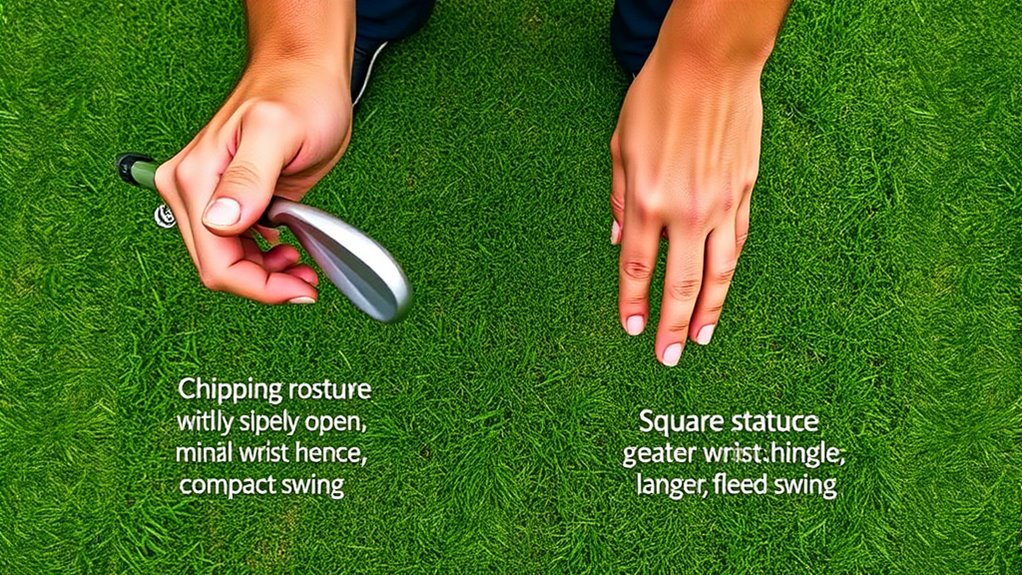
When setting up for a chip or pitch shot, your stance and posture differ to suit each technique’s mechanics. For a chip shot, you stand closer to the ball with a narrower stance, keeping your hands ahead of the ball to produce a lower, running ball trajectory. The club loft is lower, often a 7- or 8-iron, promoting controlled roll. In contrast, a pitch shot requires a wider stance and more upright posture, with your hands more centered to generate a higher ball trajectory. The club loft is typically higher, like a sand wedge or lob wedge, helping the ball ascend quickly and land softly. Swing mechanics also vary: chipping involves a more pendulum-like stroke, while pitching incorporates a wrist hinge for added height and spin.
As an affiliate, we earn on qualifying purchases.
Ideal Situations for Chipping

Chipping works best when you’re facing a short distance to the pin, making a full swing unnecessary. It’s ideal in areas with limited green space where precision matters more than power. Flat terrain conditions also help you control your shot better, ensuring accuracy and consistency. Additionally, understanding short game techniques can significantly improve your overall performance around the greens. Mastering club selection can further enhance your control and shot precision in these situations. Proper piercing care and hygiene also ensures your equipment remains in optimal condition for consistent play. Being aware of vetted information guarantees you are practicing with reliable and accurate knowledge to refine your skills effectively. Recognizing ear wax odor can also help you monitor personal health, keeping your focus sharp on the course.
Short Distance Approach
Short distance approach shots are ideal when the ball is just a few yards from the green, especially if you’re close enough to the hole that a full swing feels unnecessary. Using a chipping stroke here allows you to control the shot trajectory and ball flight for a soft landing and minimal roll. The goal is precision rather than power, enabling better placement near the hole. Consider these factors:
| Situation | Recommended Shot Type | Key Focus |
|---|---|---|
| Slightly uphill approach | Short pitch shot | Shot trajectory for height |
| Flat, level ground | Chipping stroke | Ball control and roll |
| Slightly downhill | Short pitch shot | Ball flight for softer landing |
| Close to the fringe | Chipping | Accurate distance control |
| Windy conditions | Low punch shot | Reduced ball flight |
Mastering these situations ensures you choose the right shot for consistent scoring. Additionally, understanding the short game options available allows for better decision-making under various course conditions. A good grasp of club selection can further improve shot accuracy and consistency.
Limited Green Space
Have you ever found yourself with limited green space, making full swings risky or impractical? When the area around the green is tight, chipping becomes your best option. Since green speed can vary, controlling your chip shot helps prevent overshooting or leaving yourself a difficult putt. Chipping allows for more precision and less risk of knocking the ball too far past the hole. It’s especially useful when you’re close to the green but don’t have enough room for a full swing. Additionally, if you face bunker shots near the green with limited space, chipping can help you keep the ball low and controlled, avoiding hazards. In these situations, sticking with a chip shot offers better control and reduces the chances of mishaps.
Flat Terrain Conditions
When the terrain is flat and smooth, it creates the perfect conditions for effective chipping. In these situations, you can control the ball flight more easily and select the right club to optimize your shot. Flat terrain minimizes uneven bounces, allowing for a more predictable roll and better accuracy. Additionally, understanding the easy homemade flautas can help you prepare for social gatherings after your game. Here are some ideal scenarios for chipping on flat terrain: 1. You want a low, running ball flight to keep the ball under wind or obstacles. 2. The lie is clean, so club selection is straightforward and consistent. 3. You need precise control to land the ball softly on the green without overshooting. Recognizing the flat terrain advantages can further improve your short game strategy. In these cases, chipping is often more reliable than pitching, giving you better control and consistency in your shots. A solid understanding of terrain conditions can help you choose the most effective shot type and improve your overall performance. Additionally, practicing different club selections can enhance your ability to adapt to various flat terrains.
As an affiliate, we earn on qualifying purchases.
When to Opt for a Pitch Shot

Knowing the right moments to choose a pitch shot can make a significant difference in your game. You should opt for a pitch shot when the ball is on a challenging slope or when you need to clear an obstacle with accuracy. It’s ideal when you have a longer distance to cover, but a softer landing is necessary to stop close to the hole. Your club selection plays a key role—typically a sand wedge or lob wedge provides the loft needed. Weather considerations also matter; in windy conditions, a pitch shot can help control the trajectory better than a chip. Use a pitch shot when precision is essential, and the terrain demands a higher, softer shot to land softly and stay close to the target. Additionally, understanding shot selection fundamentals can help you decide when a pitch shot is most appropriate compared to other short game options.
Choosing the Right Club for Each Shot

Choosing the right club for each shot is crucial to executing your strategy effectively. Your club selection directly impacts the shot trajectory and overall success. To make confident choices, consider these factors:
- Distance to the hole – Pick a club that comfortably covers the yardage without forcing a tough shot. Understanding club selection can help you make better decisions on the course. Additionally, knowing your own distance control can improve accuracy and consistency. Developing a reliable yardage measurement system can further enhance your club choices. Being aware of club loft angles can also assist in selecting the appropriate club for various shot types.
- Lie and terrain – A clean, level lie allows more control, while uneven ground may require a more forgiving club.
- Shot type needed – For a high, soft landing, choose a wedge; for a lower, running shot, opt for a less lofted club.
- Equipment considerations – Understanding pinball machine weights can be helpful when transporting golf equipment or setting up a practice area.
Factors Influencing Shot Selection on the Course

Your shot choice depends heavily on lie conditions and turf, which can affect how the club interacts with the ground. You also need to take into account the distance to the hole and how precise you must be to avoid trouble. Balancing these factors helps you select the best shot for each situation.
Lie Conditions and Turf
Lie conditions and turf play a crucial role in determining whether you should chip or pitch your shot. The lie surface markedly impacts your decision—whether the ball sits up nicely or is buried in the grass. Turf conditions also matter, especially grass length, which influences how cleanly you can make contact. Understanding Gold IRA Markets can help you recognize the importance of selecting the right shot for long-term success on the course. Additionally, different electric bike features, such as motor power and battery capacity, can influence how effectively you navigate various terrains, similar to adjusting your golf shot based on the course conditions. Consider these factors: 1. lie surface: A clean, even lie favors pitching, while a rough or uneven lie may require chipping. 2. grass length: Short grass allows for a cleaner strike, ideal for pitching, whereas longer grass calls for chipping. 3. Turf firmness: Soft turf might absorb your shot, so adjust your club choice accordingly. Always assess your lie and turf to choose the best shot for control and accuracy. For optimal results, also evaluate the ball lie to determine how the club will interact with the turf during your swing.
Distance and Accuracy Needs
When selecting between chipping and pitching, considering how far you need to send the ball and how precisely you want it to land becomes essential. Your club selection directly impacts the shot trajectory, influencing both distance and accuracy. For shorter, controlled shots with a high trajectory and soft landing, a wedge or higher-lofted club works best. If you need to cover more ground with a lower, more penetrating shot, a lower-lofted club like a 9-iron or pitching wedge may be ideal. Understanding these needs helps you choose the right club to achieve your desired distance and landing precision. This decision guarantees your shot fits the situation, balancing power and control effectively.
Common Mistakes to Avoid in Short Game Shots

One of the most common mistakes in the short game is misjudging the distance, which often leads to overshooting or falling short of the target. To avoid this, pay close attention to your ball position and wrist action. Poor ball placement can cause inconsistent contact, while improper wrist movement can disrupt control and accuracy. Here are three mistakes to watch out for:
Misjudging distance causes inconsistent shots; focus on ball position and wrist control for better accuracy.
- Placing the ball too far forward or back, which alters your swing path and reduces control.
- Overusing wrist action, resulting in inconsistent shots and lack of precision.
- Relying on the same technique for all shots instead of adjusting ball position and wrist movement based on the shot required.
Practice Tips to Improve Your Chipping and Pitching Skills

Practicing your chipping and pitching skills regularly can substantially boost your short game confidence and consistency. Focus on proper club selection; choose a wedge or short iron suited to the shot distance and lie. Experiment with different clubs to understand their control and roll-out. Pay close attention to your grip techniques—maintain a firm but relaxed hold, ensuring your hands stay quiet during the swing. Consistent grip pressure helps improve control and accuracy. Incorporate drills that emphasize clean contact and smooth tempo, such as hitting from various lies and distances. Practice both shots with intentionality, gradually increasing difficulty. By honing your club selection and grip techniques through focused practice, you’ll develop a more reliable short game and make smarter shot choices on the course. Additionally, studying local golf traditions and course layouts can give you insights into typical shot requirements and help tailor your practice sessions more effectively.
Frequently Asked Questions
How Do Wind and Weather Affect Shot Choice?
Wind and weather heavily influence your shot choice. You should modify your wind strategy by considering wind direction and strength, which can push or pull the ball off course. Weather adaptation also means choosing the right club and shot type—opting for a lower punch shot in strong winds or softer shots in rain or humidity. Always assess conditions carefully to ensure your shot remains accurate and controlled despite the elements.
Can I Use the Same Technique for Both Shots?
You can’t use the same technique for both shots because technique consistency and shot selection criteria differ. Chipping requires a lower, more controlled swing focused on accuracy, while pitching involves a higher, more lofted shot with a slightly longer, more aggressive swing. Assess the situation carefully—consider distance, lie, and obstacles—then choose your shot based on those criteria. Adjusting your technique to each situation ensures better control and results.
How Do Course Conditions Influence Shot Selection?
Think of the course surface as your playing field’s mood; it guides your shot like a seasoned conductor. If the grass is lush and thick, you’ll want to choose a shot that cuts through the surface smoothly. Shorter grass demands a delicate touch, while longer grass calls for a more lofted, lofty shot. Adjust your technique to the grass length and surface texture, and your shots will sing perfectly with the course’s rhythm.
What Are Common Mental Errors in Short Game Shots?
You often make mental errors like losing focus or doubting your shot, which hurt your short game. Lack of mental focus can cause rushed swings or hesitation, while confidence issues make you second-guess your club choice or swing. To improve, stay present, trust your practice, and develop a pre-shot routine. Building mental resilience helps you stay calm and execute better, reducing these common errors.
How Do Lie Angles Impact Shot Decision-Making?
Lie angles considerably influence your shot decision-making. When evaluating your lie, consider how flat or upright it is, which affects club selection. A clean, level lie allows for more control, so you might choose a standard club. If the lie is uneven or buried, you may need to adjust your club choice or stance. Proper lie assessment helps you select the right club, ensuring better contact and more accurate shots around the greens.
Conclusion
Mastering the dance between chipping and pitching transforms your short game into a finely tuned symphony. Think of each shot as a brushstroke on your golf canvas, adding depth and precision. When you choose the right shot at the right moment, your game blossoms like a well-tended garden. Keep practicing, stay patient, and soon you’ll be weaving through your course with the grace of a seasoned artist painting perfect shots every time.
Halloween Picks
halloween
As an affiliate, we earn on qualifying purchases.