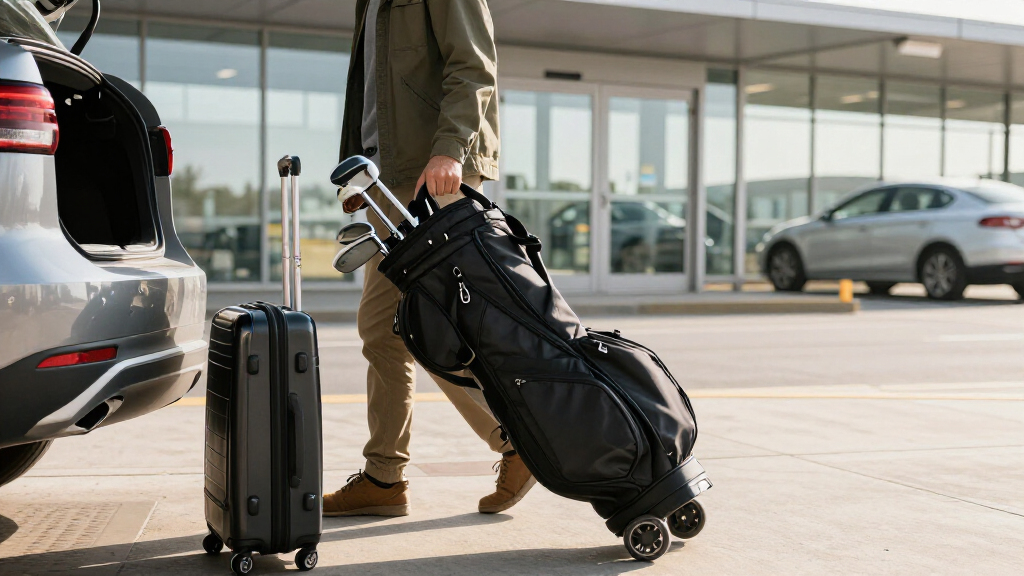

Choose a compact golf travel bag that fits your clubs, protects them on the journey, and meets your carrier’s baggage rules. This guide is for golfers preparing a set for air or car travel who want to compare bag types, measure their equipment, pack it securely, and confirm the bag is ready to go. Allow 30–45 minutes, plus time to check the airline’s current policies.

Get travel and outdoor gear delivered free — and shop member deals
- Fast, free delivery on millions of items
- Access to Prime Big Deal Days deals on October 6–7
- Prime Video, Amazon Music and more included

FIRED-UP Hard-Top Golf Travel Bag with Wheels
- ✔ Type: Golf travel bag
- ✔ Material: 1680D water-resistant nylon with hard-shell top
- ✔ Wheels: Smooth-rolling

Himal Outdoors Soft-Sided Golf Travel Bag with Wheels
- ✔ Material: 600D polyester Oxford fabric
- ✔ Dimensions: 13 x 15 x 50 inches
- ✔ Type: Soft-sided golf travel bag

Himal Outdoors Soft-Sided Golf Travel Bag with Wheels
- ✔ Brand: Himal Outdoors
- ✔ Model number: GTB002
- ✔ Material: 600D Oxford polyester
Difficulty: Beginner | Time: 30–45 minutes
What You’ll Need
Tools & Materials:
- Your golf clubs and golf bag
- Tape measure
- Compact golf travel cover or travel bag
- Soft clothing or towels for padding
- A luggage scale, if available
Knowledge:
- Know whether you will travel by air, car, or both
- Know the approximate number and length of your clubs
Check the baggage rules for every airline on your itinerary before buying a bag or packing. Size, weight, fees, and treatment of golf equipment vary by carrier and route. A soft-sided cover may fold smaller for storage, while a hard case offers a rigid shell but takes more room.
FIRED-UP Hard-Top Golf Travel Bag with Wheels
The FIRED-UP Hard-Top earns the top spot because it addresses more travel concerns in one design than the two Himal soft-sided bags. Its rigid top is intended to help guard clubs against impacts, while the water-resistant 1680D nylon offers more weather protection detail than the 600D Oxford polyester listed for the Himal options. An internal strap can help keep the contents stabilized, a practical addition when the bag is rolling or being handled.Its advantage has limits: the description specifies a hard shell at the top only, so we should not treat it as full hard-case protection. The foldable design may also help when it is empty, though no folded dimensions are given. Compared with the Himal models, it offers more explicit structure and organization through external pockets, but its 14-day listed warranty is a notable drawback. This is the strongest all-around pick for buyers who value top impact protection and storage flexibility, provided they accept a partly soft-sided body.
Pros:
- Hard-shell top helps protect clubs from impacts.
- Water-resistant 1680D nylon helps shield gear from spills and rain.
- Internal strap, wheels, and handle support stability and transport.
- Foldable construction and external pockets aid storage and organization.
Cons:
- The hard shell covers the top, not the entire bag.
- The listed warranty is only 14 days.
- No dimensions or specific cart-bag and stand-bag fit details are provided.
Best for: Travelers seeking a wheeled bag with a rigid top, an internal stabilizing strap, and foldable storage.
Not ideal for: Golfers who need full hard-shell coverage, a stated fit for a particular golf bag, or a longer listed warranty.
Bottom line: Choose FIRED-UP when its added top protection and foldable design matter more than full-shell coverage or a longer listed warranty.
“Choose FIRED-UP when its added top protection and foldable design matter more than full-shell coverage or a longer listed warranty.”
Himal Outdoors Soft-Sided Golf Travel Bag with Wheels
This Himal Outdoors soft-sided bag keeps the feature set direct: 600D polyester Oxford fabric, wheels, carrying handles, and a cushion intended to help protect clubs. The stated 13 x 15 x 50-inch dimensions give buyers a concrete size to compare with their storage space and travel plans. Unlike FIRED-UP, it has no hard top, water-resistant claim, or internal stabilizing strap in the supplied details, so its appeal is simplicity rather than extra structure.It is described as having room for clubs and accessories, making it a more natural fit for buyers packing clubs directly than the GTB002, which is explicitly described as holding a golf bag rather than loose clubs. The included cushion is a useful protection feature, but the description does not specify its coverage or thickness. Choose this model when you want wheeled transport and basic cushioning without the FIRED-UP design’s rigid top and foldable-storage feature. Skip it if your priority is documented weather resistance or stronger impact shielding.
Pros:
- 600D polyester Oxford fabric forms the soft-sided exterior.
- Included cushion is intended to help protect clubs.
- Wheels and carrying handles provide two transport options.
- Stated dimensions make storage planning more straightforward.
Cons:
- No hard-shell section is listed for impact protection.
- Water resistance and an internal club restraint are not specified.
- Cushion coverage and accessory capacity are not detailed.
Best for: Golfers who want a soft-sided wheeled carrier with a cushion and room for clubs and accessories.
Not ideal for: Travelers who want a hard top, specified water resistance, or a bag explicitly designed to carry a cart or stand bag.
Bottom line: Pick this Himal model for uncomplicated rolling transport and a cushion, but look to FIRED-UP for more explicit impact and weather features.
“Pick this Himal model for uncomplicated rolling transport and a cushion, but look to FIRED-UP for more explicit impact and weather features.”
Himal Outdoors Soft-Sided Golf Travel Bag with Wheels
The second Himal Outdoors entry is also a 600D Oxford polyester soft-sided bag, and its listed dimensions match the other Himal model. Its distinct role comes from the stated fit: it is designed to hold a golf cart bag or stand bag during travel. That makes the intended packing arrangement clearer than for the B07P5D4N2M, whose description simply says there is space for clubs and accessories.Rolling wheels, carrying handles, smooth zippers, and a padded interior support a familiar travel setup. The tradeoff is equally specific: this model is for golf bags, not loose clubs directly. Buyers who pack clubs without a separate cart or stand bag should consider the first Himal option instead, while those who want a hard top or a stated foldable design should favor FIRED-UP. The supplied details do not describe padding thickness, internal restraints, or weather resistance, so buyers should not assume those protections from the general padded-interior description.
Pros:
- Designed to hold golf cart bags and stand bags.
- Padded interior helps protect gear.
- Rolling wheels and carrying handles ease transport.
- 600D Oxford polyester and smooth zippers are specified.
Cons:
- Designed for golf bags rather than loose clubs directly.
- No hard-shell section or water-resistance claim is listed.
- The supplied description does not detail internal restraints or padding thickness.
Best for: Golfers who travel with their clubs already packed in a cart bag or stand bag.
Not ideal for: Anyone looking to pack loose clubs directly or seeking a hard-shell top, foldable storage, or specified water resistance.
Bottom line: Choose the GTB002 when you need a wheeled cover for a packed cart or stand bag, and choose the other Himal model for loose-club capacity.
“Choose the GTB002 when you need a wheeled cover for a packed cart or stand bag, and choose the other Himal model for loose-club capacity.”
As an Amazon Associate we earn from qualifying purchases.
Before You Start
Check the bag’s usable length and interior width against your longest club and golf bag. Compare the maker’s internal dimensions where available; external dimensions can include wheels and padding that reduce usable space. If flying, check how your carrier counts golf bags, whether it allows a separate club cover, and what weight or size limits apply. Do not assume that a bag labeled “compact” qualifies for free or standard baggage handling.
Step-by-Step Instructions
Step 1: Measure your clubs and golf bag
Stand your golf bag upright and measure from its base to the top of the longest club. Measure the widest point across the bag, including any side pockets. Write down both measurements, then check how much room your shoes, rain gear, or other items will add.
Tip:Measure with the clubs in the bag. A headcover or tall driver can add length beyond the bag’s rim.
Check: You have a maximum length and width to compare against the travel bag’s interior measurements.
Step 2: Choose a travel bag style
Compare soft covers, hybrid bags, and hard cases. Choose a soft cover if foldable storage and low weight matter most; choose a hard case if you want a rigid outer shell and have room to store it; consider a hybrid if you want a shaped base or some rigid panels without a full hard case. Check the wheels, handles, zippers, closures, padding, and warranty before deciding.
Tip:Look for internal straps or compression points that hold your golf bag in place. Extra pockets add space but can also add bulk and weight.
Check: The selected bag has enough internal room for your measured equipment and a closure that can fasten without forcing it.
Step 3: Confirm the bag fits your trip
Look up your carrier’s current golf-equipment policy and compare its size and weight limits with the packed bag’s expected dimensions and weight. Check whether the trip includes connecting flights with different carriers, and follow the strictest applicable policy. For car travel, measure the folded or empty bag against your available trunk or storage space.
Tip:Include wheels, handles, and any attached accessory pockets when checking external dimensions. Leave weight margin for padding and travel items.
Check: You know the relevant baggage limits, fees, and any carrier-specific packing or check-in rules.
Step 4: Prepare the clubs for packing
Remove loose items from the golf bag’s pockets, then take out detachable accessories that could shift or snag. Fit headcovers on the clubheads. If your travel cover allows it, remove the driver or other long clubs and place them alongside the golf bag; keep each club grouped and protected rather than loose in the case.
Tip:Do not force a club into a travel cover that is too short. Check the manufacturer’s instructions before disassembling any club.
Check: Clubs and accessories are grouped, clubheads are covered, and nothing loose can rattle freely.
Step 5: Pack padding and secure the set
Place the golf bag inside the travel cover and add soft clothing or towels around exposed clubheads and empty spaces. Use the cover’s internal straps to hold the bag steady. If you use a support rod, set it according to its instructions so it extends above the longest club without pressing against the case closure.
Tip:Keep padding snug rather than tightly compressed. Avoid placing hard objects against clubheads or shafts, and do not pack prohibited items in checked baggage.
Check: The golf bag does not slide around when you gently tilt the travel cover, and the clubs have padding between them and the outer shell.
Step 6: Close and weigh the travel bag
Close every zipper, buckle, or latch without pulling hard. Check that fabric is not caught in a zipper and that the clubheads do not press against the top. Weigh the packed bag and measure its exterior if your carrier sets limits. Remove optional items or repack if the bag exceeds the applicable allowance.
Tip:Take a photo of the packed clubs and the bag’s condition before handing it over. Keep valuables and items you may need during the journey out of checked baggage.
Check: The cover closes smoothly, stays shut when lifted by its intended handle, and falls within your trip’s size and weight rules.
Step 7: Label and store the bag for departure
Attach a luggage tag with your name and a phone number or email address. Add a second contact card inside the cover in case the exterior tag is lost. Keep your baggage receipt and any golf-equipment declaration with your travel documents, then store the bag where it will not be crushed before departure.
Tip:Remove old destination tags so the bag is not routed using outdated information.
Check: The bag has current contact details, the clubs remain secure, and your required travel paperwork is accessible.
Common Mistakes to Avoid
- Choosing by external dimensions alone. — Compare your measured clubs with the travel bag’s usable internal length and width, then test the fit before your trip.
- Assuming every airline treats golf bags the same way. — Review current rules for each carrier and flight segment, including fees, weight limits, and oversize handling.
- Leaving clubs loose inside the cover. — Use the internal straps and padding to keep the golf bag and clubheads from shifting during handling.
- Overpacking pockets until the bag exceeds its allowance. — Weigh the packed bag and remove nonessential gear before check-in.
Troubleshooting
Problem: The longest club does not fit with the cover closed.
Solution: Recheck the usable interior length and remove only detachable parts that the club maker permits. Otherwise, use a longer travel cover rather than forcing the zipper.
Problem: The cover closes, but the clubs rattle or slide.
Solution: Reposition the golf bag, tighten its internal straps, and add soft padding around gaps. Retest by gently tilting the closed cover.
Problem: The packed bag is over the carrier’s weight limit.
Solution: Remove nonessential items, especially heavy accessories, and weigh it again. If needed, compare the carrier’s published options for extra or overweight baggage before arriving at the airport.
Problem: The cover’s wheels or handles seem loose.
Solution: Check the maker’s care and repair guidance before travel. Avoid checking a bag with a failing wheel, handle, zipper, or latch; transfer the clubs to a sound cover.
What Success Looks Like
Your compact golf travel bag fits the measured clubs and golf bag, closes without force, and keeps the set from shifting when gently tilted. The packed exterior dimensions and weight meet the rules for your itinerary, and the bag has current contact details. Before check-in, confirm that the carrier accepts the packed equipment under the policy you reviewed.
Next Steps
After the trip, inspect the travel cover, straps, wheels, zippers, and clubs for damage. Let damp padding or clothing dry before storing the cover, then fold or store it according to the maker’s instructions. Record any fit or baggage-limit issues so you can adjust your packing or cover choice before the next trip.
Frequently Asked Questions
Can I use a compact golf travel bag for a full set of clubs?
Yes, if the cover’s usable interior dimensions accommodate your longest club and your golf bag. Check the fit with the clubs installed; the word “compact” alone does not confirm compatibility.
Is a soft travel cover safe for flying?
A well-padded soft cover can work for air travel, but it has less rigid protection than a hard case. Use internal straps and padding, and choose a case style that suits your trip, handling concerns, and storage space.
Can I pack golf shoes and clothes with my clubs?
Often you can, but first check the carrier’s rules and your bag’s weight limit. Pack soft items as padding where they will not put pressure on clubheads, and keep valuables out of checked baggage.
Should I remove my driver before packing?
Remove it only if the travel cover requires it or doing so improves the fit. Follow the club maker’s instructions, cover the head, and secure the driver alongside the bag so it cannot move freely.
How do I store a compact golf travel bag between trips?
Clean and dry it first, then fold or collapse it as the maker directs. Store it in a dry place away from sharp objects and heavy items that could damage the fabric, shell, wheels, or frame.
Fall Picks
fall essentials
As an affiliate, we earn on qualifying purchases.