
TL;DR

Get travel and outdoor gear delivered free with Prime
- Fast, free delivery on millions of items
- Prime Video, Amazon Music and more included
- Member-only deals all year
A portable golf push cart carries your golf bag on wheels so you can walk the course without carrying a bag on your shoulders. Compare real folded dimensions and weight, bag fit, brakes, wheels, course rules, and replacement-part support; the right choice depends on your car, terrain, and comfort rather than wheel count or marketing claims.
A golf bag can feel surprisingly heavy by the sixth hole, especially when the course climbs and the morning dew darkens your shoes. A portable golf push cart lets you walk while rolling your clubs instead of carrying a bag on your shoulders. You still walk the course and push the load, but you change where the effort lands.
This guide explains what these carts do, how to compare folding designs, wheels, brakes, and bag fit, and which details matter once you get to the parking lot. You’ll also find practical advice for matching a cart to your car and course, plus a checklist for checking current course, airline, and product rules before you buy.
Compare actual folded dimensions and weight; “portable” is not a standard measurement.
Check whether the listed weight includes removable wheels and accessories.
Choose wheels and brakes for the terrain you play, not just the cart’s wheel count.
Test your own bag on the cart and make sure it stays secure through turns.
Confirm course rules, warranty support, and travel or battery policies before buying.
What a Portable Golf Push Cart Does for Your Round
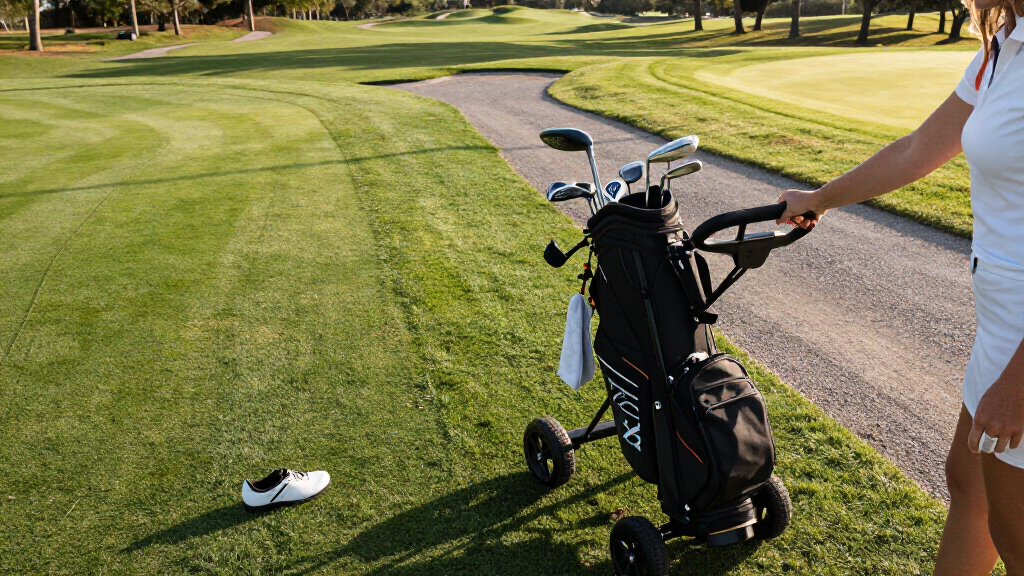
A portable golf push cart is a hand-pushed, folding frame that carries your golf bag while you walk the course. It replaces carrying a bag on your shoulders with pushing it on wheels, but it does not remove the walking or all physical effort. That distinction matters if your course has long gaps between holes or steep paths.
You may also see these called push carts or trolleys. Powered models, often called electric golf trolleys, use a motor to move the bag and need a charged battery. For example, if you play a flat municipal course and want to stay on foot, a hand-pushed cart may suit you; if pushing feels uncomfortable, an electric model may be worth comparing, though it costs more and adds battery care.
The appeal is straightforward: your clubs travel beside you rather than weighing on your back. A push cart can make a walking round more manageable, but the loaded cart still has weight, and rough ground can take real effort. Think of it as moving the burden from your shoulders to your hands and wheels—not making the burden disappear.
That change can be useful when your bag is packed with extra layers, water, and a full set of clubs. Still, a golfer’s strength, mobility, weather, bag weight, and course terrain all affect comfort. The right cart fits your actual round, not an idealized one.
As an affiliate, we earn on qualifying purchases.
Compare Folded Size and Weight Before You Buy
A cart is portable only if you can lift, store, and transport it without a struggle. Compare the manufacturer’s folded dimensions and listed weight, rather than relying on a compact label, because “portable” is not a standardized category. A cart that folds small on paper can still be awkward to grab if its shape is bulky or its latch sits in an inconvenient spot.
Picture loading your car after an early round: the trunk already holds shoes, a rain jacket, and your golf bag. A cart that fits only when you unload everything may not be convenient, even if it folds in seconds. Measure your available space and leave room to lift the cart in and out; folded dimensions do not tell you how easy it is to handle.
| What to compare | Why it matters | What to check |
|---|---|---|
| Folded dimensions | Shows how much storage space the cart occupies | Measure trunk or closet space and allow room to load it |
| Listed weight | Affects lifting and carrying when folded | Check whether removable wheels and accessories count |
| Folding latch | Affects setup and transport | Try the fold if possible; look for secure latching and safe hand clearance |
| Quick-release wheels | Can reduce the space needed in a vehicle | Check that removal and reattachment feel simple |
Before choosing, compare the cart’s actual specifications with the space you have. If you store it in a small apartment, a shorter folded profile may matter more than shaving off a little weight. If you often lift it into a high trunk, manageable weight and good grip points may matter more than a few inches of length.
As an affiliate, we earn on qualifying purchases.
Choose Wheels and Brakes for the Ground You Play
Wheel design, placement, and braking matter more than wheel count alone when a cart meets slopes, wet paths, or rough grass. Three-wheel carts are common and often turn easily; four-wheel designs may offer a broader base. Neither arrangement is automatically steadier or easier to steer, because frame layout and the course surface also shape handling.
Suppose your regular course has a short, steep rise between the fairway and the next tee. A parking brake that holds the loaded cart can stop it creeping downhill while you take a club out. On a dry, flat path, that same slope may feel like no trouble, but wet grass can turn a casual stop into a rolling-cart chase.
Look at wheel size and tread as well as wheel count. The cart that glides along a paved path may bog down in deep rough, mud, or sand. Check whether the front wheel aligns easily and whether the frame feels steady with your bag loaded, not just empty in a shop.
Course conditions change the answer. Check your course’s cart rules before you play, especially after rain or on steep and protected areas. A cart suited to the fairway may not be permitted everywhere on the course.
Try to match the cart to the ground you actually cover. If your usual route is smooth and mostly level, quick steering and easy folding may beat heavy-duty wheels. If you often cross uneven paths, put stability and a dependable brake higher on your list—and accept that no hand-pushed cart makes every patch of terrain effortless.
As an affiliate, we earn on qualifying purchases.
Make Sure Your Bag Fits Without Twisting
A push cart works well only when it holds your bag securely. Check the stated bag compatibility, support shape, and strap range, because stand bags and cart bags do not all sit the same way. A bag that twists can block pockets, shift the load, or make the cart harder to steer.
For instance, a stand bag’s legs may press against a support or swing loose as you move. A cart bag may sit securely but place a large pocket where a strap needs to go. If a shop allows it, test the cart with your own bag; if you order online, inspect the fit and return terms before loading up for a round.
- Set the bag on both supports. Check that the base and upper section rest against the cart’s intended contact points.
- Fasten and adjust the straps. Tighten them enough to limit movement without crushing pockets or handles.
- Check bag features. Make sure stand legs, shoulder straps, and frequently used pockets remain accessible.
- Test the loaded cart. Push it through a turn and on a gentle slope, then see whether the bag shifts.
Those steps can reveal a poor match before you reach the first tee. For example, if the bag stays put on a smooth floor but rotates when you turn, adjust the supports or try a different strap layout. The useful test is not whether the bag can be attached; it is whether you can push, steer, and reach your gear without fighting it.
As an affiliate, we earn on qualifying purchases.
Pick Accessories and Features You’ll Really Use
Accessories help when they solve a problem you face every round, but extras can add bulk, cost, and another thing to store. Phone or GPS holders, drink holders, umbrella mounts, and storage compartments are common options; they are not always included in the price. Read the listing carefully rather than assuming the pictured cart comes with every attachment.
Think about a rainy Saturday when you want an umbrella within reach, or a hot afternoon when a bottle holder keeps water from rolling around your bag. Those additions can feel handy. Yet a player who carries a rangefinder in a pocket and a bottle in the bag may prefer fewer attachments and a simpler fold.
Newer designs increasingly include compact folding frames, lighter materials, quick-release wheels, and integrated holders, but these are category trends, not promises about any particular model. Check current specifications and availability before buying, since features and product versions change. Also inspect the folding joints and wheel connections: extra convenience means little if mud and grass jam the parts after a wet round.
A low purchase price may leave out accessories or long-term support. Compare warranty terms, replacement-part availability, and included items alongside the sticker price. A cheaper cart can be a sensible buy, but not if a small broken latch turns it into a disposable one after a season.
Keep maintenance simple: brush off mud and grass around the wheels and hinges, check fasteners and brakes periodically, and follow the maker’s storage instructions. A quick rinse and wipe after a muddy round is easier than scraping dried dirt from a folding joint days later. If you play often, the ability to get replacement parts can matter more than a cup holder.
Use This Checklist for Cars, Travel, and Course Rules
Before buying, match the cart to your storage, transport, and course rules—not just the product photo. Folded measurements, airline policies, and course restrictions vary, and a cart that suits your home course may not suit a trip. A few checks now can prevent a bulky surprise at the trunk or a cart you cannot use after heavy rain.
Imagine a weekend golf trip: you load a cart into a rental car, then discover the folded frame takes up the space you planned for luggage. Or you choose an electric trolley and find its battery is subject to separate transport rules. These are not reasons to avoid travel carts; they are reasons to verify the details for your route and equipment.
- Measure your storage space. Compare the cart’s listed folded dimensions with your trunk, closet, or travel case, leaving room to handle it.
- Confirm weight and configuration. Check whether the listing counts removable wheels and accessories, then judge whether you can lift it comfortably.
- Ask your course about cart access. Policies can change with wet turf, steep ground, or protected areas, so check before the round.
- Check transport rules for travel. Ask the airline or carrier about the cart and, for electric models, any lithium battery restrictions.
- Review support and included parts. Check the warranty, replacement parts, and whether accessories shown in product images come with the cart.
These checks matter most when your situation is unusual: a compact hatchback, frequent air travel, a hilly home course, or limited strength for lifting. Visa, entry, and health rules also change when golf takes you abroad, so verify current requirements with official government sources before booking. For cart and battery transport, check directly with your carrier instead of relying on an old forum post.
Decide Whether Pushing Beats Carrying or Going Electric
A hand-pushed cart suits you when you want to walk but would rather roll your clubs than carry them. Carrying avoids an extra frame to load and store; an electric trolley reduces the effort of moving the bag but adds a motor, battery, and often a higher price. Your comfort and course conditions decide which tradeoff feels best.
Take a golfer who plays nine holes on a flat course with a light stand bag. Carrying may be simple. Another golfer walking a full round with a heavier bag may prefer a push cart; someone who finds pushing difficult on steep terrain may investigate electric options. None of these choices is a universal upgrade, because each keeps some demands and removes others.
| Option | Main benefit | Tradeoff to weigh |
|---|---|---|
| Carry your bag | No cart to fold, lift, or store | Your shoulders carry the bag throughout the round |
| Hand-pushed cart | Walk while rolling the clubs | You still push, lift, and steer a loaded frame |
| Electric trolley | Motor moves the bag with less pushing | Higher cost, extra weight, and battery charging and care |
If you are unsure, test how each option feels over the distance and terrain you play. Renting or borrowing can tell you more than a feature list: notice whether you can steer comfortably, stop safely on a hill, and lift the folded cart into your car. Choose the setup that leaves you able to enjoy the round, not the one with the most accessories.
Frequently Asked Questions
Is a push cart worth it compared with carrying a golf bag?
A push cart can be worth it if you want to walk without carrying the bag on your shoulders. You still walk and push a loaded frame, so comfort, fitness, course terrain, and bag weight all matter.
Are three-wheel or four-wheel golf push carts better?
Neither is always better. Three-wheel carts are common and often maneuver easily, while four-wheel models may have a broader base; compare frame stability, turning, brakes, folded size, and the ground you play.
How can I tell if a push cart will fit in my car?
Compare the manufacturer’s folded dimensions with your available trunk space and leave room to lift the cart in and out. Check whether the listed measurements assume the wheels are removed, and consider the space your golf bag and other gear need.
Will a portable push cart fit both stand bags and cart bags?
Many carts can hold both, but fit varies by support shape and strap range. Check the cart’s stated compatibility, and make sure stand legs, pockets, and straps do not interfere with the frame.
Can I take a golf push cart on an airplane?
Airline and carrier rules vary, so check the current policy before travel. If you have an electric trolley, ask specifically about its lithium battery and how it must be transported.
Conclusion
Choose a cart you can lift, fold, store, and steer with the bag you already own. Start with real measurements, then check the brakes, bag fit, course rules, and support—not just the feature list.
The best cart is the one that gets your clubs rolling and leaves your shoulders, trunk, and next round in better shape.
Halloween Picks
halloween
As an affiliate, we earn on qualifying purchases.