
The evolution of the golf ball shows how innovation has transformed your game. From handcrafted featheries, made of leather and goose feathers, to the durable gutty ball, each step improved resilience and control. The rubber-core revolution led to more consistent performance, while modern dimpled spheres and advanced materials boost aerodynamic stability and distance. With innovations like multi-layer covers and the Pro V1, your equipment now maximizes spin, durability, and performance—if you’re curious, there’s much more behind these incredible changes.
Key Takeaways
- Golf balls evolved from handcrafted featherie shells to durable rubber-core balls, improving resilience and gameplay consistency.
- Material breakthroughs like gutta-percha and rubber cores enhanced durability, control, and affordability.
- Aerodynamic innovations, especially dimpled surfaces, significantly increased flight distance and stability.
- Modern multi-layer and synthetic materials optimize spin, durability, and environmental sustainability.
- The Pro V1 era features advanced urethane covers and precise manufacturing, delivering superior performance and consistency.
Early Beginnings: The Featherie and Its Innovations
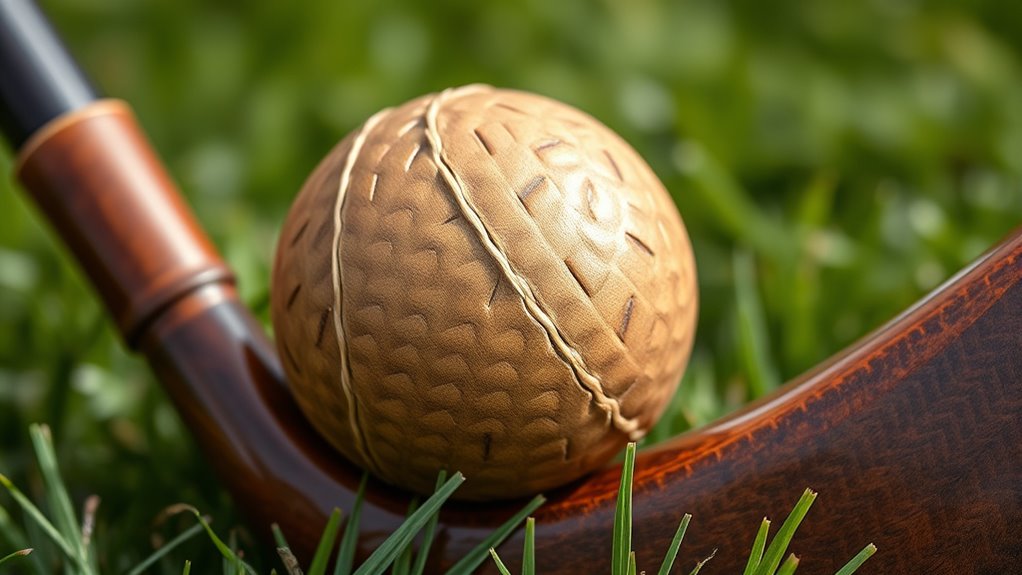
Before modern golf balls, players relied on the featherie, a handcrafted ball that marked a major innovation in the sport’s early days. This early design showcased remarkable historical craftsmanship, as skilled artisans meticulously stitched together leather shells filled with goose feathers. The process required precision and artistry, making each featherie unique and highly valued. Beyond its functional role, the featherie held cultural symbolism, representing the evolving identity of golf and its traditions. Players saw these balls not just as equipment but as symbols of innovation and craftsmanship, reflecting the passion and dedication of early golfers. The featherie’s design laid the groundwork for future developments, bridging the gap between traditional craftsmanship and the technological advancements that would come later. Additionally, these techniques helped pave the way for innovations in material science, which further improved golf ball performance and longevity. Moreover, the manufacturing techniques employed in creating featheries influenced the development of more durable and consistent golf ball designs in subsequent eras, inspiring ongoing manufacturing innovations in the sport. Such craftsmanship also emphasized the importance of quality control in ball production, contributing to the continuous evolution of golf equipment standards.
The Gutty Ball: A Step Towards Durability and Performance
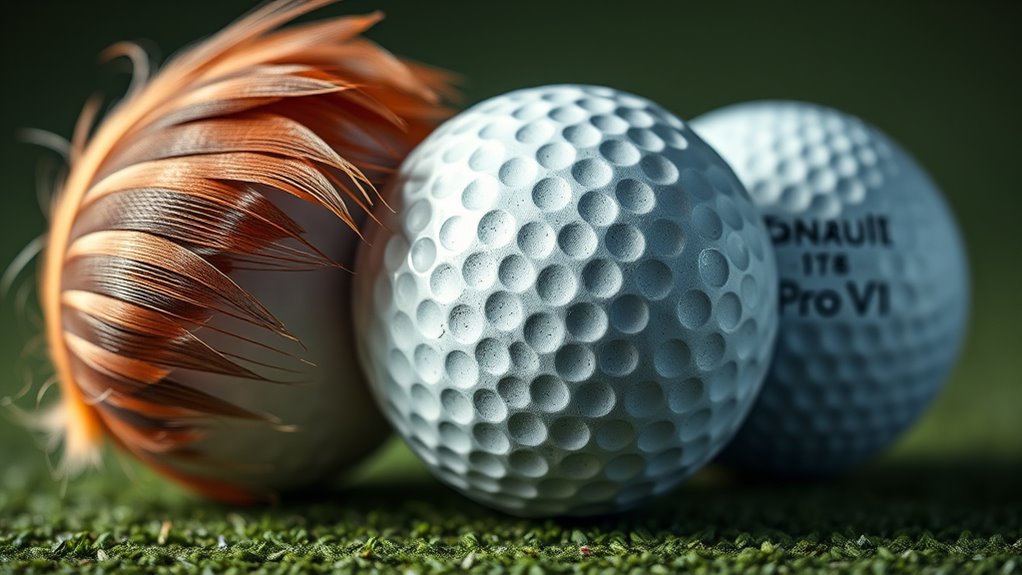
As golfers sought more durable and reliable options, the gutty ball emerged as a significant step forward in golf ball technology. This early golf innovation replaced fragile featheries with a rubber core wrapped in gutta-percha, making balls more resilient and cost-effective. The gutty ball could withstand repeated strikes, reducing the need for frequent replacements and increasing playability. Its design also allowed for better control and consistency, helping players improve their game. You’ll notice that the gutty ball:
The gutty ball revolutionized golf with durability, affordability, and improved control.
- Offered improved durability over featheries
- Introduced rubber cores for better performance
- Made golf more accessible due to lower costs
- Benefited from material innovation, which enhanced its durability and functionality
This innovation marked a key shift in golf’s evolution, setting the stage for further advancements in ball design and performance.
The Rubber-Core Revolution and the Haskell Ball

The rubber-core revolution transformed golf ball design by introducing a highly resilient core that dramatically improved performance and durability. The Haskell ball, developed in 1898, featured a rubber core encased in gutta-percha, offering greater control and distance. This shift marked a significant breakthrough from featheries, providing a more consistent and durable option for players. The rubber core’s elasticity allowed for better energy transfer upon impact, enhancing overall playability. Additionally, the integration of AI-powered data analytics in modern golf equipment has further optimized ball design for individual swing characteristics. The table below highlights key aspects of the Haskell ball:
| Feature | Material | Impact on Play |
|---|---|---|
| Rubber core | Natural rubber | Increased resilience |
| Outer cover | Gutta-percha | Better control |
| Performance gains | Improved distance | Enhanced durability |
You now experience a game shaped by these innovations, driven by advancements in golf ball materials and manufacturing techniques.
The Rise of the Modern Dimpled Sphere

You’ll notice how modern golf balls have tiny dimples that drastically improve their flight. These design features help reduce drag and increase lift, making shots more consistent and longer. By optimizing dimple patterns, manufacturers enhance aerodynamics and give players a real advantage on the course.
Dimple Design Impact
Dimple design revolutionized golf balls by dramatically improving their flight performance. The key lies in how dimple patterns and surface roughness influence aerodynamics. When you strike the ball, the dimples create a turbulent airflow that reduces drag and extends carry distance. The specific pattern and depth of the dimples affect how air flows around the ball, optimizing lift and stability. Additionally, advancements in dimple pattern engineering continue to enhance the efficiency of modern golf balls.
Aerodynamics Enhancement
Have you ever wondered how modern golf balls achieve longer, more accurate shots? It all comes down to golf ball aerodynamics and airflow optimization. Engineers have refined dimple patterns to reduce drag and increase lift, allowing the ball to travel farther. The dimples create turbulence in the airflow around the ball, delaying airflow separation and decreasing air resistance. This aerodynamic design maximizes distance and stability during flight. Advanced simulations and wind tunnel testing help optimize dimple shape, size, and distribution for peak performance. By enhancing airflow management, modern golf balls deliver more consistent results, especially in varying wind conditions. This focus on aerodynamics has transformed the golf ball into a high-tech sphere capable of improving your game with every strike.
Advancements in Materials and Manufacturing Techniques

Recent advancements in materials and manufacturing techniques have considerably transformed the design and performance of golf balls. Modern innovations include the use of synthetic composites that enhance durability and control, allowing for better spin and distance. Manufacturers are also focusing on eco-friendly materials to reduce environmental impact without sacrificing quality. These improvements enable you to play more efficiently and sustainably. Incorporating modern flushing mechanisms in manufacturing processes has also contributed to more consistent quality and performance. Additionally, insights from nanotechnology are beginning to influence the development of golf ball coatings and cores, promising even more precise control and durability in future models. The integration of advanced synthetic composites further enhances resilience and longevity, providing better value and performance over time. Moreover, ongoing research into piercing materials and their interaction with golf ball surfaces is opening new possibilities for customization and performance tuning. Furthermore, innovations in surface texturing techniques are helping optimize aerodynamics and stability during flight.
You might notice:
You might notice improved resilience, sustainability, and consistent quality in your golf balls.
- Incorporation of advanced synthetic composites for improved resilience
- Use of eco-friendly materials to promote sustainability
- Precision manufacturing techniques that ensure consistent quality and performance
These advancements give you a better feel and performance, making your game more enjoyable and environmentally conscious. Staying updated on these innovations helps you select the right ball for your style and values.
The Introduction of Multi-Layer and Surlyn Cover Balls
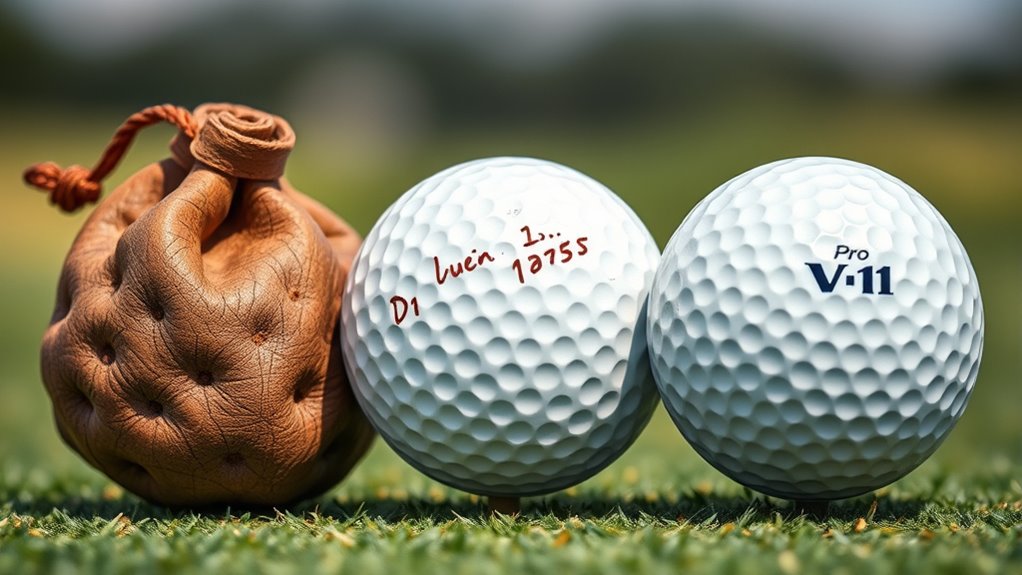
The introduction of multi-layer and Surlyn cover balls has revolutionized golf ball design by combining different materials to optimize performance. These balls feature cores with varied compression levels, allowing players to better control spin and achieve desired distances. The multi-layer construction enhances durability and enables a tailored balance between speed and feel. Surlyn covers provide durability and affordability while still offering decent spin control on shorter shots. By adjusting core compression, manufacturers can fine-tune how much spin you generate, especially around the greens, without sacrificing distance off the tee. This innovation gives you the ability to customize your game, blending the benefits of high compression cores for power with softer outer layers for improved spin control. Overall, these balls mark a significant step forward in golf ball technology.
Modern Technologies and the Pro V1 Era

Modern technologies have transformed golf balls, making them more reliable and longer off the tee. Advanced materials, like urethane covers and core innovations, improve durability and spin control. Breakthrough aerodynamic designs also help you achieve greater distance and stability in flight. For example, innovations in ball design continue to enhance performance on the course. Additionally, modern manufacturing techniques ensure consistency and precision in each ball produced. Moreover, these technological improvements are supported by ongoing research into material science, which drives further enhancements in golf ball performance.
Advanced Material Innovations
Have you ever wondered how advancements in materials have transformed golf balls into high-tech tools? Today’s innovations focus on synthetic composites and biodegradable materials that enhance performance and sustainability. These advanced materials improve durability, control, and distance while reducing environmental impact. For example, synthetic composites allow for more precise control of the ball’s spin and flight, giving players better accuracy. Biodegradable materials are now incorporated to minimize ecological footprints, helping golf courses and players be more eco-conscious. Additionally, the integration of advanced manufacturing techniques has further optimized ball designs for maximum efficiency and longevity. Incorporating lease options for manufacturing equipment can also contribute to cost-effective production and innovation. Furthermore, ongoing research into eco-friendly materials continues to push the boundaries of sustainable golf ball technology. The adoption of cutting-edge production methods is also accelerating the development of more refined and environmentally friendly golf balls. Some key innovations include:
- Use of durable synthetic composites for better energy transfer
- Incorporation of biodegradable materials to promote sustainability
- Enhanced core designs for increased distance and control
These developments have revolutionized golf ball technology, making modern balls more efficient and environmentally friendly.
Aerodynamic Design Breakthroughs
Innovations in materials have markedly enhanced golf ball performance, but aerodynamic design breakthroughs have taken accuracy and distance to new heights. Advanced biomechanical analysis allows engineers to optimize dimple patterns, reducing drag and improving lift. These designs create a more stable flight path, especially in varying wind conditions, giving players more control. Modern aerodynamic features also focus on environmental sustainability, using eco-friendly materials that maintain performance while reducing ecological impact. Computational fluid dynamics enable precise modeling of airflow, leading to innovative dimple configurations that maximize efficiency. This combination of biomechanical insights and sustainable practices results in golf balls that perform better and are kinder to the environment. Aerodynamic design breakthroughs have revolutionized how golf balls fly, setting new standards for accuracy and distance in the Pro V1 era.
Performance Consistency Enhancements
As golf technology advances, manufacturers focus on guaranteeing that each ball performs consistently, delivering reliable results shot after shot. Modern innovations aim to minimize performance variance by refining materials and manufacturing processes. This focus on performance consistency includes improvements in golf ball aesthetics, making each ball visually uniform and appealing, and manufacturing aesthetics, which ensure high-quality finishes and precise tolerances. These enhancements help you trust your equipment, knowing every shot will behave predictably. Additionally, quality control techniques in manufacturing help maintain stringent quality standards, further ensuring each ball meets performance expectations. Improvements in production tolerances also contribute to more uniform performance across batches, instilling greater confidence in golfers.
The Impact of Golf Ball Evolution on Play and Technique
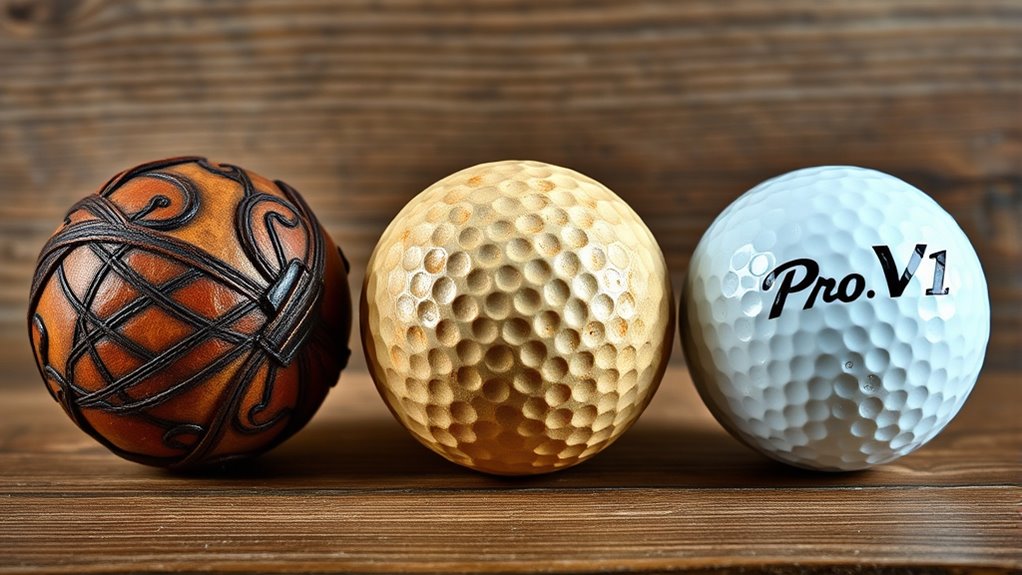
The evolution of golf balls has considerably transformed how you approach the game, influencing both your play style and technique. Modern balls with advanced dimple patterns and softer covers allow you to achieve better ball control, giving you more consistency on shots. As a result, your swing mechanics become more refined because you can focus on precision rather than compensating for unpredictable ball behavior. With these improvements, you can shape shots more easily and manage spin to target specific areas of the course. The enhanced distance and control offered by newer golf ball designs also encourage more aggressive play when appropriate. Overall, the technological advancements have made the game more skill-dependent, emphasizing precision and technique over mere power.
Future Trends and Innovations in Golf Ball Design
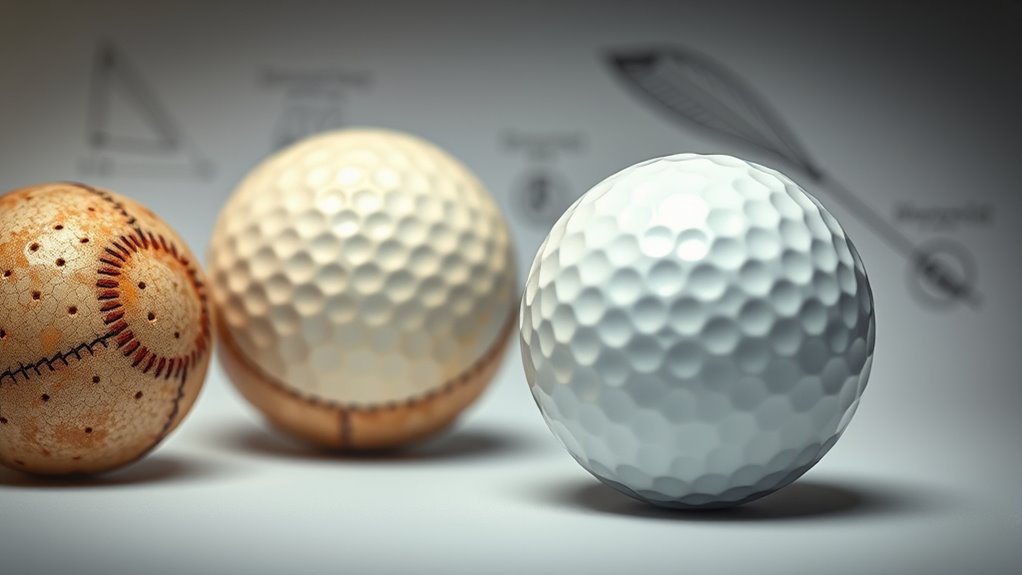
Advancements in golf ball technology continue to push the boundaries of performance, promising even greater precision and consistency on the course. Future innovations focus on integrating biomechanical analysis to optimize ball design for different swings and playing styles. Expect materials that adapt dynamically, improving control and distance. Environmental sustainability also takes center stage, with manufacturers exploring biodegradable cores and eco-friendly covers to reduce waste. To stay ahead, watch for:
Future golf balls will enhance precision, adapt dynamically, and prioritize eco-friendly materials for better performance and sustainability.
- Smart golf balls with sensors providing real-time feedback based on biomechanical data
- Sustainable materials that maintain high performance without harming the environment
- Advanced core and cover technologies enhancing spin control and durability
These trends aim to elevate your game while promoting eco-conscious practices, shaping the future of golf ball design.
Frequently Asked Questions
How Do Golf Ball Regulations Influence Design Innovations?
Historical regulations and manufacturing standards directly shape your golf ball’s design innovations. They set limits on size, weight, and performance to ensure fairness and consistency. When manufacturers innovate, they must adhere to these rules, leading to creative solutions within constraints. This balance encourages advancements like dimple patterns and materials, helping you achieve better control and distance without violating regulations. So, regulations push you toward smarter, compliant design improvements.
What Environmental Impacts Are Associated With Modern Golf Ball Manufacturing?
You might not realize it, but modern golf ball manufacturing can have a massive environmental footprint. From the huge manufacturing emissions released into the air to the energy-intensive processes involved, it’s like a tiny planet-sized impact! These processes can contribute to pollution and resource depletion, making you wonder how sustainable the sport really is. Thankfully, many brands are now working to reduce these effects and create greener golf balls.
How Do Different Golf Ball Types Suit Various Playing Styles?
You choose your golf ball based on your playing style to optimize distance and spin control. For example, if you seek longer drives, a distance-optimized ball with a harder cover works best. If you need better spin control for approach shots, a softer, multi-layer ball helps. Understanding your swing and shot preferences allows you to select a ball that enhances your game, balancing both distance and control effectively.
What Role Does Aerodynamics Play in Golf Ball Performance?
Aerodynamics play a vital role in golf ball performance by affecting spin optimization and surface texture. You’ll notice that a ball’s surface design, like dimples, helps reduce drag and stabilize flight, allowing you to control spin better. When you choose a ball with optimized aerodynamics, it’s easier to achieve consistent shots, longer distance, and accurate trajectory, ultimately boosting your game on the course.
Are There Any Emerging Materials Promising to Revolutionize Future Golf Balls?
You’ll find that smart materials and biodegradable composites are quietly shaping the future of golf balls. These innovations promise to enhance performance while reducing environmental impact, offering a more sustainable game. Smart materials adapt to your swing, optimizing aerodynamics and control, while biodegradable composites break down naturally, minimizing waste. While they’re still emerging, these materials could revolutionize how you experience golf, blending advanced technology with eco-conscious design for a better game.
Conclusion
Today, golf balls have come a long way, transforming how you play the game. Did you know that modern balls like the Pro V1 can travel up to 20% farther than their early predecessors? As technology advances, you’ll see even more innovations that boost performance and enjoyment. Embrace these changes, and watch your game improve as the science behind the ball continues to evolve. The future of golf balls is exciting—get ready to take your swing to new heights.