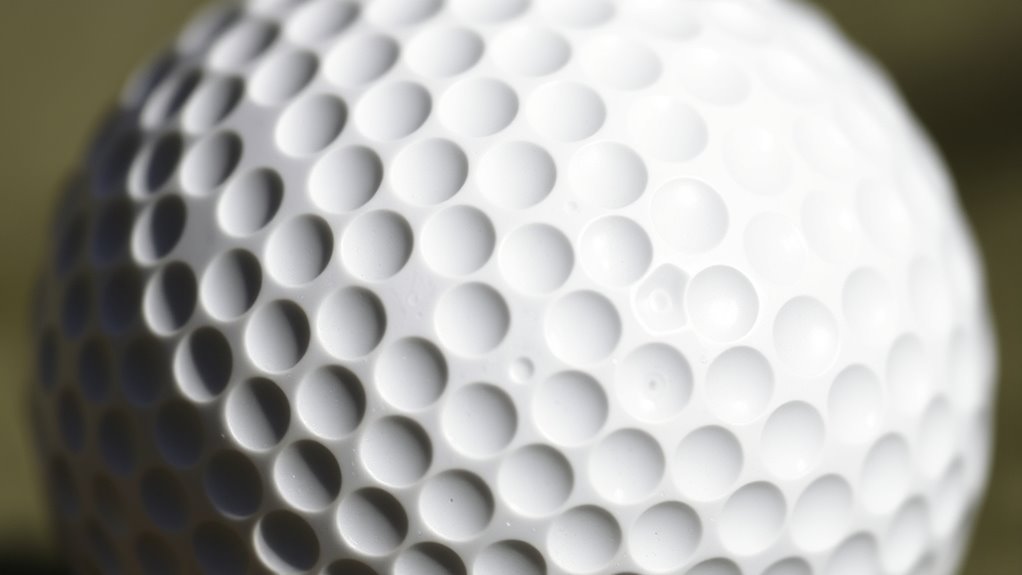

Golf balls have tiny dimples to improve their flight by managing airflow. These craters reduce air resistance and increase lift, allowing the ball to travel farther and stay steadier. The dimples create turbulent boundary layers that help airflow stick to the surface longer, reducing drag. Their pattern, size, and shape markedly influence performance. If you’re curious about how these small features make such a big difference, you’ll find more fascinating details ahead.
Key Takeaways
- Golf ball dimples create turbulence in airflow, reducing drag and allowing the ball to fly farther.
- The craters disrupt smooth airflow, helping maintain lift and improve shot stability.
- Dimple design influences boundary layer behavior, optimizing the transition from laminar to turbulent flow.
- Well-designed dimples enhance aerodynamic efficiency, increasing distance and accuracy during flight.
- Different dimple patterns and sizes are used to balance performance with aesthetic appeal.
The Purpose of Golf Ball Dimples
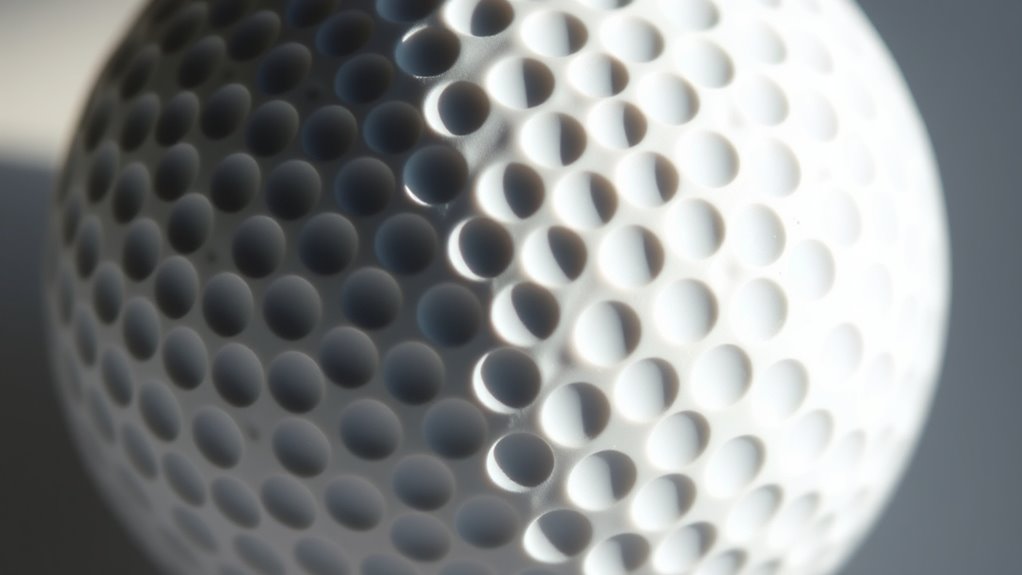
Golf ball dimples serve a essential purpose in enhancing the ball’s flight. They are carefully designed to optimize aerodynamics, helping you achieve longer, more accurate shots. When manufacturing golf balls, manufacturers consider both functionality and aesthetics, as dimples also influence the ball’s appearance. The manufacturing processes involve precision molding to create consistent, evenly spaced dimples that improve lift and reduce drag. These tiny craters disrupt the airflow around the ball, giving it a lift that counters gravity. The design and placement of the dimples are fundamental, and they balance performance with the golf ball’s aesthetic appeal. By understanding how these dimples work, you can better appreciate the engineering that goes into producing a high-performing golf ball. Understanding aerodynamics is crucial for designing golf balls that maximize distance and accuracy. Additionally, advances in manufacturing precision ensure each golf ball performs reliably and consistently, which is essential for consistent performance. Properly designed dimples also influence the ball’s visual appeal, making it more attractive to players and consumers alike. Modern innovations incorporate material science to enhance durability and flight characteristics.
How Air Resistance Affects Golf Ball Flight
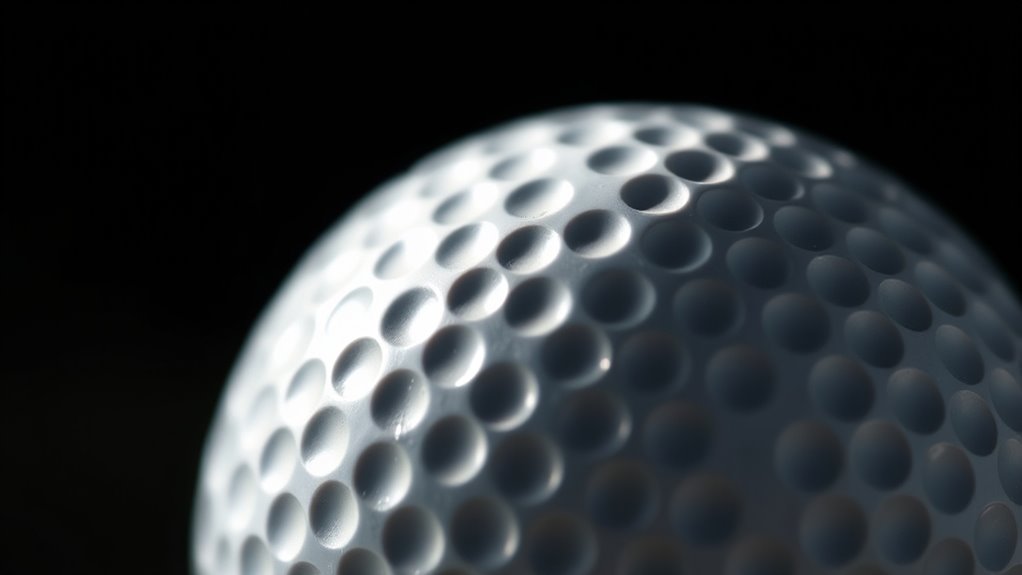
Air resistance, also known as drag, considerably impacts the flight of a golf ball by slowing it down as it moves through the air. This resistance depends on factors like the ball’s speed, shape, and surface design, which influence how air flows around it. Dimpled surfaces help reduce drag by creating a turbulent boundary layer, allowing the ball to stay aerodynamic longer. From an environmental impact perspective, manufacturers are exploring sustainable materials and streamlined manufacturing techniques to minimize waste and energy use. These innovations aim to produce golf balls that fly farther with less resistance, reducing the need for frequent replacements. Additionally, understanding airflow management in golf ball design can lead to even more efficient flight characteristics. Understanding how air resistance affects flight encourages improvements in design, ultimately benefiting both players and the environment. Moreover, advancements in aerodynamic optimization are driving the development of golf balls that perform better under various conditions. Incorporating sustainable materials in manufacturing processes can also help reduce the environmental footprint of golf ball production. Recognizing the role of innovative materials can further enhance the performance and eco-friendliness of golf balls. Furthermore, ongoing research into surface texture modifications continues to push the boundaries of aerodynamic efficiency.
The Physics of Boundary Layers and Turbulence

As air flows over a surface, a boundary layer forms, changing how drag and lift behave. When this layer shifts from smooth to turbulent, it can considerably reduce drag and improve flight. Understanding these dynamics helps explain how surface textures like dimples influence overall performance. Boundary layer transition plays a crucial role in optimizing aerodynamic efficiency.
Boundary Layer Formation Dynamics
Understanding boundary layer formation requires examining how fluid flow interacts with surfaces. As air streams over a golf ball, a boundary layer develops where fluid velocity smoothly increases from zero at the surface to free-stream speed. Initially, this layer is laminar, with smooth flow, but as flow continues, instabilities cause vortex shedding—periodic detachments of vortices from the boundary layer’s edge. These vortices influence the flow’s separation point, affecting drag and lift forces on the ball. The dynamics of boundary layer formation and vortex shedding are vital because they determine how airflow reattaches or separates from the surface. This process impacts the ball’s flight stability and how the dimples modify airflow, ultimately influencing how smoothly the boundary layer forms and sheds around the golf ball. Additionally, turbulence control techniques can be employed to manage vortex behavior, optimizing flight performance.
Transition to Turbulence
Have you ever wondered how smooth, laminar flow suddenly becomes chaotic and turbulent? It happens when the boundary layer reaches a critical point, often triggered by changes in surface roughness or ball spin. As the golf ball moves faster, the flow initially stays smooth, but small disturbances grow. Increased surface roughness, like those dimples, helps trigger this changeover by tripling the boundary layer’s momentum. Ball spin also influences the process; it can either delay or promote turbulence depending on the direction and speed. When the flow shifts, it moves from orderly layers to chaotic swirls and eddies. This move to turbulence significantly affects how air clings to the ball, ultimately influencing its flight characteristics. Understanding how boundary layer dynamics work is key to comprehending the effect of dimples on golf ball aerodynamics. Additionally, turbulence onset is crucial for optimizing golf ball design to improve performance. Recognizing how airflow patterns evolve over textured surfaces is fundamental to improving ball design and maximizing distance, especially as researchers study aerodynamic efficiency in sports equipment. Recent studies also suggest that surface textures can be engineered to precisely control turbulence, leading to even better flight performance.
Impact on Drag and Lift
The boundary layer’s change from laminar to turbulent flow has a direct and significant impact on both drag and lift forces acting on a golf ball. When turbulence occurs, the boundary layer stays attached longer, reducing pressure drag and allowing the ball to travel farther. Dimple aesthetics influence how effectively this shift happens; well-designed dimples promote turbulence at just the right moment. Manufacturing techniques guarantee these dimples are precise, optimizing aerodynamic performance. Properly crafted dimples generate better lift by creating a pressure differential, helping the ball stay in the air longer. In contrast, poor manufacturing or inconsistent dimple design can disrupt airflow, increasing drag. Additionally, the aerodynamic design of the golf ball’s surface plays a crucial role in managing boundary layer behavior. Understanding the boundary layer transition is essential for engineers to fine-tune dimple patterns for optimal flight. The boundary layer behavior is also affected by factors such as surface roughness, which can be manipulated through manufacturing to improve performance. Adjustments in surface roughness can influence the boundary layer’s transition point, further enhancing flight characteristics. By studying boundary layer behavior, engineers can develop better golf balls that maximize distance and control through controlled boundary layer behavior.
The Impact of Dimples on Lift and Drag

Dimples on a surface help you generate more lift by creating a turbulent boundary layer that sticks better to the shape. They also cut down on air resistance, making movement smoother and more efficient. Understanding how these tiny indentations work can reveal ways to improve aerodynamic performance. Additionally, studying the reconditioning process of surfaces can help optimize their design for better efficiency. For example, advances in surface treatment techniques can enhance the durability and performance of sporting equipment like golf balls.
Enhanced Lift Generation
When dimples are strategically incorporated onto surfaces, they can substantially enhance lift by influencing airflow patterns. This effect depends heavily on dimple materials and the ball surface finish. First, the textured surface creates turbulent airflow, which sticks closer to the ball, increasing lift. Second, the improved airflow reduces drag, allowing for smoother flight and more lift generation. Third, high-quality dimple materials help maintain the durability and consistency of the surface finish, ensuring ideal aerodynamic performance. By optimizing these factors, you can maximize lift, allowing the ball to stay in the air longer and travel farther. The combination of well-chosen materials and precise surface finish makes dimples a critical feature for enhancing lift and overall performance.
Reduced Air Resistance
Have you ever wondered how dimples help reduce air resistance during a ball’s flight? The answer lies in their effect on airflow. Dimples create a turbulent boundary layer around the golf ball, allowing air to flow more smoothly and decreasing drag. This improved aerodynamics means the ball travels farther with less effort. When designing golf balls, manufacturers focus on both aesthetics and function, ensuring the dimples are uniform and visually appealing. The manufacturing process carefully molds these tiny craters to maximize their aerodynamic benefits. By reducing air resistance, dimples help you achieve longer, more stable shots. So, those small craters aren’t just for looks—they’re a vital part of how golf balls perform during your game.
Designing the Perfect Dimple Pattern
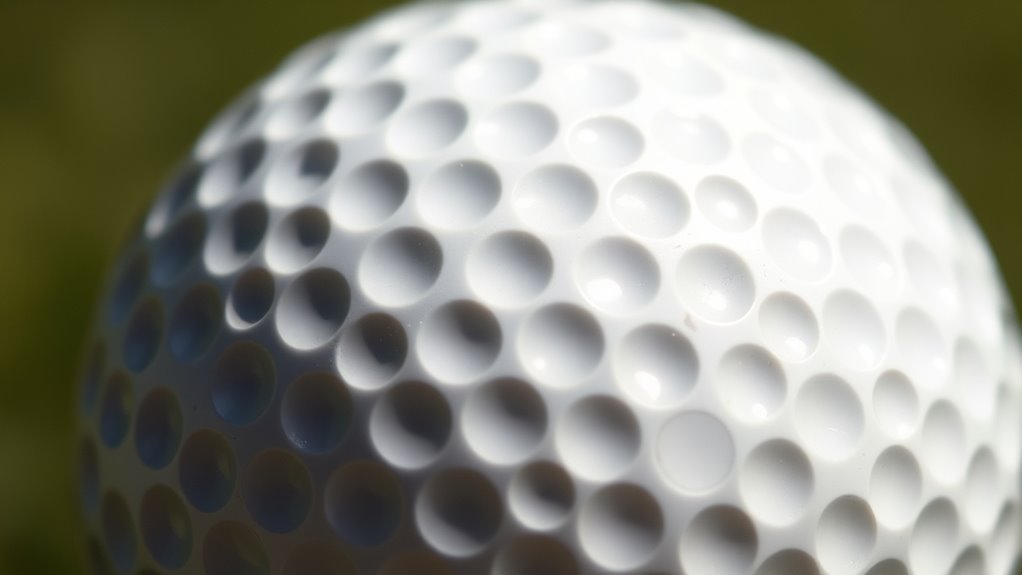
Designing the perfect dimple pattern involves carefully considering how the placement and size of each dimple influence the ball’s flight and stability. Your goal is to optimize ball aerodynamics for maximum distance and control. To achieve this, focus on these key aspects:
- Experiment with different dimple patterns to find the most efficient arrangement for airflow management.
- Adjust dimple sizes and depths to balance lift and drag, enhancing stability during flight.
- Consider the overall pattern symmetry to make certain of consistent performance across various swings.
Comparing Dimpled and Smooth Golf Balls
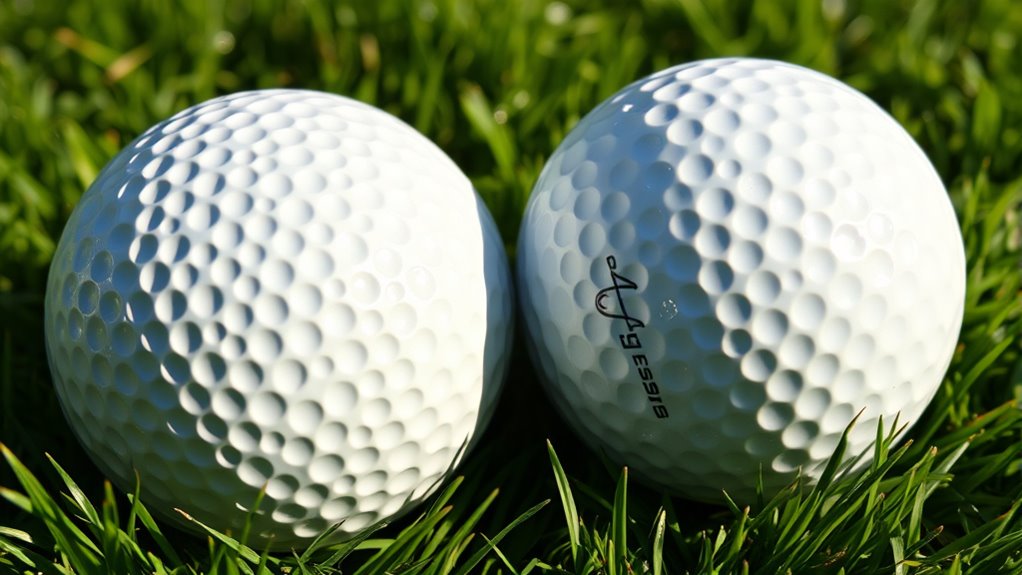
You’ll notice that dimpled golf balls generally fly farther and have better control than smooth ones. This is because the dimples improve aerodynamics, reducing drag and helping the ball stay in the air longer. As a result, your performance can vary markedly depending on which type of ball you choose.
Aerodynamics Benefits of Dimples
Dimples on a golf ball substantially enhance its aerodynamics by reducing air resistance, allowing the ball to travel farther and more accurately. When you compare a dimpled ball to a smooth one, you’ll notice a significant difference in flight. Dimples create turbulence in the airflow, which helps the ball cut through the air more efficiently. This aerodynamic advantage is why many players prefer dimpled balls despite their simple dimple aesthetics.
Consider these benefits:
- Improved lift and reduced drag, leading to longer shots.
- Enhanced stability in flight, making shots more predictable.
- Smarter marketing strategies utilize the aerodynamic benefits to appeal to players seeking better performance.
These factors make dimples a essential design element beyond just aesthetics.
Performance Differences in Play
When comparing golf balls with and without dimples during actual play, the performance differences become quite noticeable. Dimpled balls tend to fly farther and more accurately because their aerodynamics reduce drag and improve lift, enhancing your control and distance. In contrast, smooth golf balls often struggle with stability and can veer off course. The manufacturing process for dimpled balls also influences performance; precise dimple patterns optimize flight, while aesthetics appeal to players who value style along with function. Golf ball aesthetics, including the pattern and finish, can impact your confidence at address. Overall, dimples make a significant difference in how a golf ball reacts on impact, offering more consistent results and better performance compared to smooth alternatives.
The Evolution of Dimple Design Over Time

The design of golf ball dimples has evolved considerably as manufacturers seek to optimize performance. Over time, innovations in dimple shape, size, and pattern have improved flight distance and stability.
- Early designs featured simple round dimples, but brands experimented with varying depths and arrangements to enhance aerodynamics.
- Advances in manufacturing processes allowed for more precise and consistent dimple patterns, boosting performance across different brands.
- Modern branding efforts incorporate unique dimple configurations to distinguish products and appeal to specific player needs.
These developments reflect a focus on optimizing aerodynamics while maintaining cost-effective manufacturing. As a result, golf ball branding now often highlights the specific dimple design as a key feature, showcasing how evolution in dimple design directly impacts performance and market appeal.
How Temperature and Humidity Influence Dimple Effectiveness
Temperature and humidity can considerably affect how effectively golf ball dimples perform during play. When the air is humid, moisture absorption by the ball’s surface can alter its weight and surface texture, impacting how the dimples influence airflow. Higher temperatures cause the ball’s material to expand slightly, affecting its aerodynamics and potentially reducing the dimple’s ability to generate lift. Conversely, colder conditions can make the ball more rigid, diminishing its responsiveness. Humidity can also cause subtle changes in the ball’s surface, impacting how air flows over the dimples. These temperature effects and moisture absorption can lead to minor variations in ball flight, making it important to evaluate weather conditions when determining dimple performance for ideal gameplay.
Advances in Materials and Manufacturing of Dimples
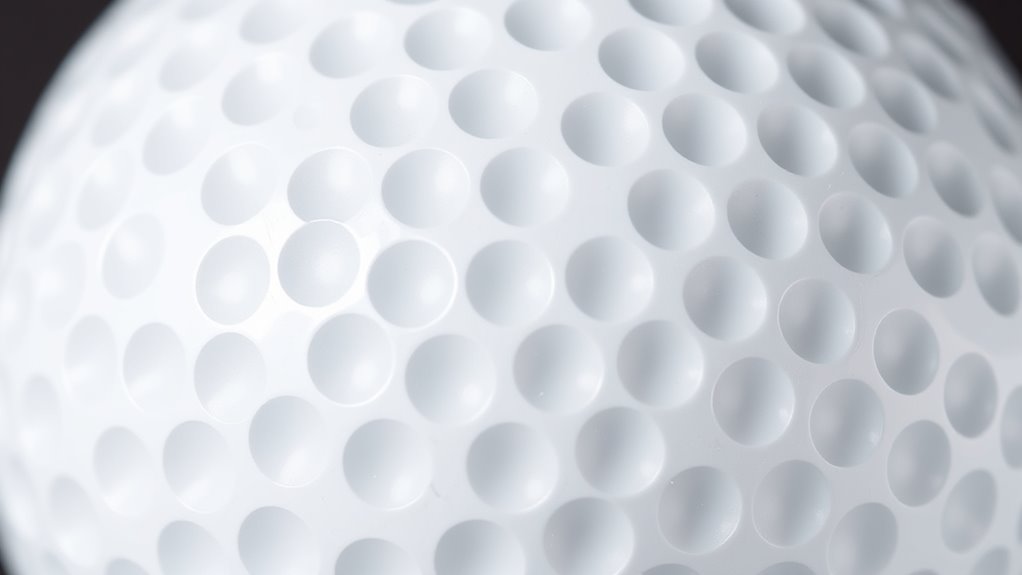
Recent advancements in materials and manufacturing techniques have considerably improved the design and performance of golf ball dimples. These innovations allow for more precise dimple manufacturing, enhancing aerodynamics and consistency.
- Material innovations have led to the use of lightweight, durable compounds, optimizing ball flight and control.
- Advanced manufacturing processes, such as laser etching and precision molding, ensure uniform dimple shape and size, reducing drag.
- New coatings and surface treatments improve durability and aerodynamics, maintaining performance over repeated hits.
Future Trends in Golf Ball Aerodynamics
Advancements in material science and manufacturing techniques are paving the way for innovative designs that could revolutionize golf ball aerodynamics. Future trends focus on optimizing dimple patterns and materials to enhance flight stability and distance. You’ll see innovations tailored to improve golf ball aesthetics, making balls more visually appealing and personalized, which influences marketing strategies. These developments might include adaptive dimples that change shape mid-flight or ultra-light materials that reduce drag. The table below highlights potential future directions:
| Design Focus | Expected Impact | Marketing Strategy |
|---|---|---|
| Customizable dimple patterns | Increased personalization and brand differentiation | Highlighting unique designs in campaigns |
| Smart materials | Better aerodynamics and durability | Emphasizing technological innovation |
| Aesthetic enhancements | Attracting diverse consumer preferences | Leveraging golf ball aesthetics for branding |
| Shape-shifting dimples | Improved flight control | Promoting cutting-edge features |
| Eco-friendly materials | Sustainability appeal | Aligning with environmental values |
Frequently Asked Questions
How Do Different Dimple Shapes Affect Golf Ball Aerodynamics?
Different dimple shapes markedly impact your golf ball’s aerodynamics. For example, shallow dimples may increase lift, while deeper or more complex patterns can improve aerodynamic efficiency by reducing drag. By choosing specific dimple patterns, you can optimize your ball’s flight, gaining more distance and control. Experimenting with various shapes helps you find the best aerodynamic setup for your swing, ultimately enhancing your overall game performance.
What Role Do Dimples Play in Controlling Spin and Accuracy?
You might think dimples only improve distance, but they also play a key role in spin control and accuracy enhancement. When you strike the ball, dimples create a turbulent airflow that reduces drag and helps you manage spin rates. This means you can better control your shot’s trajectory, improving precision and consistency. So, dimples aren’t just about distance—they’re essential for fine-tuning your shots and hitting more accurate targets.
Are There Environmental Factors That Diminish Dimple Effectiveness?
Environmental factors like humidity effects and temperature variations can reduce a golf ball’s dimple effectiveness. High humidity may cause the ball’s surface to become slick, decreasing lift and stability, while temperature fluctuations can alter the ball’s material properties, affecting aerodynamics. You might notice less control or distance in extreme weather, so playing in moderate conditions helps maintain ideal dimple performance. Keep these factors in mind to maximize your game.
How Do Professional Golfers Choose Between Dimpled and Smooth Balls?
You choose between dimpled and smooth balls based on your playing style and preferences. Professional golfers often consider ball personalization, selecting the type that offers ideal control and distance. They also think about marketing strategies, as some brands promote specific ball designs for performance or branding purposes. Testing different options helps you find what suits your swing best, whether it’s the aerodynamics of dimples or the sleek feel of a smooth ball.
Can Dimple Technology Be Applied to Other Sports Equipment?
Think of dimple design as a secret weapon—it’s not just for golf balls anymore. You can see sports innovation through applying dimple technology to soccer balls, baseballs, or even frisbees to improve aerodynamics and control. For example, some soccer balls feature dimples to enhance flight stability. Dimple technology is versatile, and you can use it to elevate performance across various sports, making equipment more efficient and exciting.
Conclusion
Ultimately, those tiny dimples turn a simple ball into a marvel of physics, transforming air resistance from a foe into an ally. While their intricate patterns and materials evolve with technology, the fundamental goal remains: to optimize your flight. It’s a reminder that in golf, as in science, small details can create a big difference—proving that sometimes, the tiniest craters hold the greatest power.