Holding the club too tightly can restrict wrist movement, cause tension in your muscles, and lead to inconsistent swings and shots. It often results in less clubface control, reduced accuracy, and increased injury risk over time. If your grip feels tight or tense, it’s a sign you may be squeezing too hard. To improve your game, learn how maintaining a relaxed, moderate grip enhances control, power, and fluidity — and there’s more to discover on how to perfect it.
Key Takeaways
- Holding the club too tightly causes muscle tension, reducing swing fluidity and control.
- A relaxed grip around 50% pressure enhances wrist mobility and clubface accuracy.
- Excessive grip pressure can lead to inconsistent shots and reduced shot distance.
- Monitor your grip tension regularly to prevent tension buildup that hampers performance.
- Using drills and feedback tools can help develop a comfortable, optimal grip pressure.
Garmin Approach R10, Portable Golf Launch Monitor, Take Your Game Home, Indoors or to The Driving Range, Up to 10 Hours Battery Life - 010-02356-00
Work to improve your game at home, indoors or on the driving range with a portable launch monitor...
As an affiliate, we earn on qualifying purchases.
Understanding Grip Pressure and Its Impact on Your Swing

Understanding grip pressure is essential because it directly influences your swing’s consistency and control. When you hold the club too tightly, you restrict wrist mobility and limit your ability to make smooth, natural swings. Conversely, gripping too lightly can cause the club to shift or wobble, reducing accuracy. Maintaining an ideal grip pressure, typically around 50% of your maximum, helps you achieve better control over clubface orientation and shot direction. Consistent grip pressure allows for a more repeatable swing, minimizing variability from shot to shot. It also helps manage face angle at impact, vital for controlling ball flight. Additionally, proper grip pressure supports better coordination between your hands and arms, leading to improved swing mechanics. Developing an awareness of grip pressure can help you make real-time adjustments during your swing for better results. Recognizing the importance of consistent pressure can help you develop a more reliable and effective swing. Incorporating techniques for maintaining grip pressure can further enhance your control and consistency. Being mindful of feedback from your grip during practice can help reinforce proper pressure levels and improve overall technique.

Rapsodo MLM2PRO Golf Launch Monitor, Simulators for Home & Training, Mobile Launch Monitor for Golf Swing Analysis, Measures Spin Rate & Axis, Tracker & Swing Analyzer, Indoor Outdoor (3 Pro V1 Balls)
Advanced Golf Launch Monitor – The Rapsodo MLM2PRO golf launch monitor delivers pro-level accuracy, measuring 13 core golf...
As an affiliate, we earn on qualifying purchases.
Typical Grip Pressure Patterns Among Different Skill Levels

You’ll notice that better golfers keep their grip pressure more consistent throughout the swing, especially at setup and impact. Beginners often grip too tightly early on, which can lead to less control and accuracy. Maintaining a steady grip pressure is key to improving your overall performance and shot consistency. Additionally, understanding the importance of proper grip technique can significantly influence your ability to execute clean, accurate shots. Recognizing the role of authenticity in technique can further enhance your practice and overall game. Being mindful of muscle tension throughout the swing can help prevent unnecessary strain and promote a smoother motion. Developing an awareness of feedback mechanisms can also help golfers become more aware of their grip pressure and tension levels during practice. Incorporating auditory feedback therapy techniques can also help golfers become more aware of their grip pressure and tension levels during practice.
Grip Tightness by Skill
Golfers’ grip pressure patterns vary considerably with skill level, with beginners and high-handicappers tending to grip too lightly at address and during early swing phases. This light grip often leads to a lack of control and inconsistent shots. As skills improve, players learn to apply a more moderate, steady grip that maintains club control without tension. Pros typically squeeze the club firmly at setup but relax during the swing, especially in the shift and impact phases. This balance allows for better face control and shot accuracy. Inexperienced golfers may grip too tightly or too loosely, causing erratic ball flight. Skilled players develop a consistent grip pressure pattern, which helps optimize power, control, and shot consistency throughout the swing. Additionally, using appropriate golf equipment, such as grips designed for comfort and control, can further enhance grip consistency and overall performance.
Consistency in Grip Pressure
Consistency in grip pressure varies considerably across different skill levels, with highly skilled players demonstrating more stable and predictable patterns. They tend to maintain a steady grip throughout the swing, avoiding abrupt changes that can disrupt control. In addition, adopting smart home automation techniques can help golfers develop consistent routines and reminders to monitor their grip during practice sessions. Moreover, sensor technology can provide real-time feedback to support golfers in maintaining optimal grip pressure. In contrast, amateurs often fluctuate between too tight and too loose, causing inconsistent ball striking. Maintaining consistent grip pressure is essential for developing better control and improving overall performance. Additionally, understanding how grip pressure patterns evolve with experience can help players identify areas for improvement and develop more effective practice routines. Recognizing the importance of muscle memory can also aid golfers in developing a natural, consistent grip over time.

Garmin Approach S12, Easy-to-Use GPS Golf Watch, 42k+ Preloaded Courses, Black, 010-02472-00
New round watch design with a high-resolution sunlight-readable display
As an affiliate, we earn on qualifying purchases.
How Excessive Grip Tightness Affects Ball Flight and Accuracy

Excessive grip tightness can throw off your swing path, often causing an outside-in motion that leads to slices. It also hampers your clubface control, making it harder to square the club at impact and resulting in inconsistent ball flights. When your grip is too tight, even small errors can become amplified, reducing your accuracy and shot consistency. Maintaining the proper grip pressure can help prevent injury risks and promote better healing and performance. Additionally, practicing mindful grip pressure can foster artistic expression, encouraging a more fluid and natural swing. Proper grip pressure also supports natural movement, which is essential for a smooth and effective golf swing. Developing a consistent grip pressure aligns with techniques for quality assessment that ensure optimal swing mechanics and overall performance. Cultivating awareness of body tension can further enhance your ability to maintain appropriate grip pressure and improve your overall game.
Impact on Swing Path
Tight grip pressure during the swing can considerably alter your swing path, often leading to less accurate shots. When you squeeze the club too tightly, you restrict wrist mobility and reduce your ability to make fluid, natural movements. This tension often causes an outside-in swing path, promoting slices or pushes. Excessive grip pressure can also hinder proper sequencing, causing the club to approach the ball from an improper angle. As a result, your ball flight becomes inconsistent, with hooks or slices more likely. Maintaining a relaxed grip allows your wrists to hinge properly and promotes a more on-plane, inside-out swing path. This not only improves shot accuracy but also increases consistency, helping you achieve better control over your ball flight and overall performance. Additionally, understanding how grip pressure influences your swing mechanics can help you develop a more relaxed and effective golf swing. Being aware of the importance of proper grip can make a significant difference in your shot consistency and accuracy. Moreover, using the right equipment and maintaining it properly can further enhance your swing efficiency and shot precision. Recognizing the impact of tension on your swing can motivate you to focus on relaxation during your shot routine, leading to better performance. Developing a consistent, relaxed grip can also reduce muscle tension, which often causes unnecessary strain and affects swing fluidity.
Clubface Control Issues
When you grip the club too tightly, it limits your wrist mobility and hampers proper clubface control. A tight grip causes your wrists to become stiff, making it difficult to adjust the face angle during the swing. This stiffness often results in inconsistent clubface alignment at impact, leading to erratic shot shape and reduced accuracy. Excessive grip pressure can cause you to inadvertently close or open the clubface, producing hooks or slices. It also diminishes your ability to respond to the ball’s flight, making it harder to control trajectory and spin. Maintaining a moderate grip allows your wrists to remain supple, giving you better feel and control over the clubface. Improving grip pressure helps you deliver more consistent strikes and more accurate shot placement.

SC4 PRO Golf Launch Monitor & 3D Driving Range Simulator for Indoor and Outdoor Use | Portable Golf Swing Analyzer Home Golf Tracker with Built-in Screen w/Voice Output No Monthly Subscription
Pro-Grade Accuracy with Prometrics Engine: The SC4 Pro golf launch monitor and golf shot tracker delivers precise ball...
As an affiliate, we earn on qualifying purchases.
The Relationship Between Grip Strength and Performance Metrics

Grip strength plays a crucial role in determining key performance metrics like clubhead speed and shot accuracy. When your grip is strong enough, you can generate more force during the swing, leading to increased clubhead velocity and longer shots. Conversely, insufficient grip strength can limit power and reduce control, making it harder to hit accurate shots consistently. Studies show that professional golfers and long-drive competitors tend to have higher grip strength, which correlates with greater distance and precision. Building grip strength through targeted exercises can enhance your ability to control the clubface and optimize ball flight. However, it’s essential to balance strength with proper grip pressure; too much grip force can hinder fluid motion, while too little can compromise stability and power.
Strategies to Find and Maintain the Optimal Grip Pressure
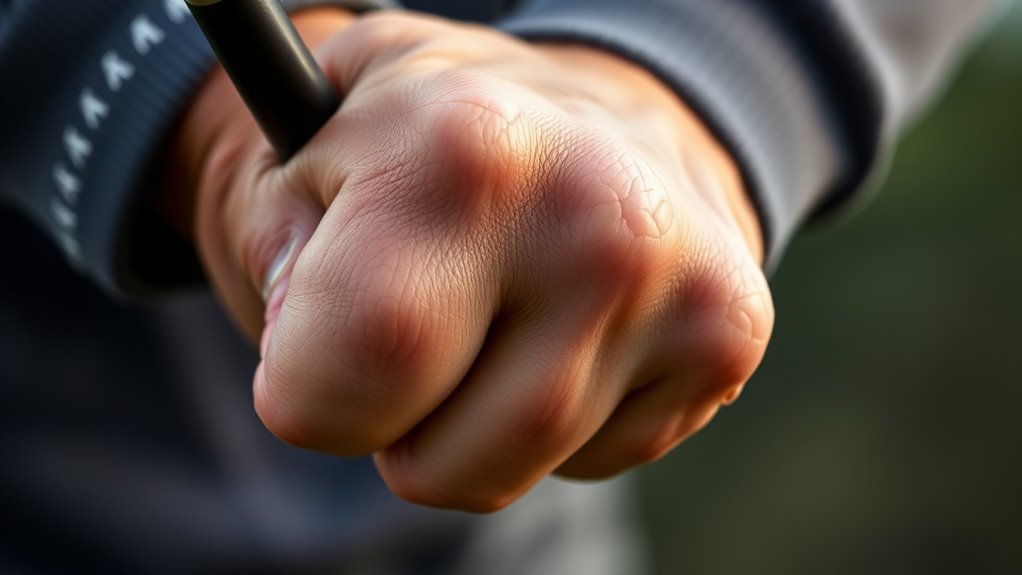
Finding and maintaining the ideal grip pressure is essential for consistent golf performance, and it requires a mindful approach. To do this, start by gently holding the club, avoiding excessive force. Focus on a firm but relaxed grip, especially in the lead hand, and monitor your pressure throughout your swing. Use drills like the “light grip swing” to build awareness. Additionally, incorporate feedback tools, such as grip pressure sensors, to track your progress. Being aware of your muscle tension can help prevent tension buildup and improve your overall swing fluidity. Regularly practicing with a comfortable grip can reinforce proper pressure and reduce fatigue during play. Understanding security zone info can also help you create a secure environment where you can practice and refine your skills without distractions.
Incorporating Grip Pressure Control Into Your Practice Routine

Incorporating grip pressure control into your practice routine is essential for developing consistent swing mechanics and better shot accuracy. Start by intentionally practicing with a light grip, focusing on maintaining that feeling throughout your swings. Use drills like squeezing the club slightly at address, then relaxing during the backswing and passage, and reapplying steady pressure at impact. Incorporate tempo drills that emphasize smooth, controlled swings, paying attention to how grip pressure influences clubface control. Record yourself or use a mirror to monitor grip consistency across different shots. Regularly pause during practice to check your grip, ensuring it stays within a comfortable, moderate range. Over time, this focus ingrains proper grip pressure habits, helping you achieve more reliable, accurate shots on the course.
Frequently Asked Questions
How Can I Measure My Current Grip Pressure Accurately?
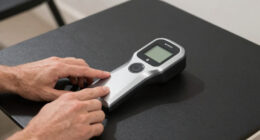
You can measure your grip pressure accurately by using specialized tools like a grip pressure sensor or pressure-sensitive gloves that provide real-time feedback. Alternatively, you can use a digital force gauge or a grip strength dynamometer to assess your maximum grip force. Practice with these devices to understand your typical pressure during swings, helping you develop a more consistent and ideal grip. Regular measurement ensures you stay aware of your grip habits.
Does Grip Pressure Vary With Different Clubs or Swing Types?
Yes, your grip pressure varies with different clubs and swing types. You tend to apply more force with longer clubs like drivers and less with shorter ones like wedges. Also, your swing style influences grip pressure; aggressive swings often require firmer grips, while smoother, controlled swings benefit from softer grips. Adjusting your grip based on club and swing can improve control, consistency, and overall performance.
Can Grip Pressure Influence Injury Risk During a Golf Swing?
Think of your grip like the tension in a bowstring—too tight and you risk snapping, too loose and you lose control. Excessive grip pressure can strain your hands, wrists, and arms, increasing injury risk during the swing. When you squeeze too hard, muscles and joints are under undue stress, making strains, tendinitis, or even ligament injuries more likely. Keeping a steady, moderate grip helps protect your body and keeps your swing smooth.
What Are Quick Drills to Improve Grip Pressure Consistency?
To improve grip pressure consistency, try practicing the “light grip” drill. Hold the club with a relaxed grip, then gradually tighten until you feel firm but not tight. Focus on maintaining this moderate pressure throughout your swing. You can also do timed holds, squeezing the grip for a few seconds, then relaxing, to develop muscle memory. Incorporate these drills regularly to promote smoother, more controlled swings.
How Do Weather Conditions Affect Grip Pressure During Play?
Weather conditions can considerably influence your grip pressure during play. When it’s hot and humid, your hands may sweat, causing you to grip the club tighter to prevent slipping. Cold weather can make your hands numb, leading to a looser grip. Rain or wet conditions increase the need for a secure grip, but overcompensating can cause tension. Adjust your grip pressure accordingly, staying relaxed to maintain control and consistency regardless of weather.
Conclusion
Think of grip pressure like tuning a guitar string—too tight, and the sound distorts; too loose, and it’s out of tune. Finding that sweet spot is key to a consistent, accurate swing. By paying attention to how tightly you hold the club and practicing grip control, you’ll improve your ball flight and overall performance. Remember, it’s not about squeezing harder, but about holding just enough to stay in control and hit your best shots.