For a golf simulator bar, my best overall pick is the Erivess 110-can beverage refrigerator, which offers a useful middle ground between capacity and footprint. The hOmeLabs 120-can cooler stands out for a fuller entertaining setup, while the EUHOMY 24-can mini fridge suits a compact bay where quieter operation matters. The main tradeoff is choosing between a small unit that preserves floor space and a larger glass-door model that can hold drinks for a group but needs more room and ventilation. I compare all 12 options by capacity, fit, usability, and likely role in a simulator bar. Read on for the full breakdown and a guide to choosing the right size for your layout.

Get travel and outdoor gear delivered free with Prime
- Fast, free delivery on millions of items
- Prime Video, Amazon Music and more included
- Member-only deals all year
Complete the kit


Key Takeaways
- The 110-to-130-can class is the strongest fit for group play: it offers more drink capacity than the 24-can models without requiring a commercial-size setup.
- Compact models solve a different problem: the 24-can EUHOMY and Feelfunn options are better for a single bay, countertop placement, or a small drink selection than for hosting a league night.
- Capacity labels do not settle the fit question: can counts are useful for comparison, but shelf layout, bottle shapes, and the actual cabinet dimensions affect how much a bar can hold.
- Glass doors suit visible, self-serve bars: they make drink selection easier during play, but call for thoughtful placement away from glare, direct sun, and frequent door swings near the hitting area.
- The standout choices separate by use, not by one universal winner: hOmeLabs leads for a fuller hosting setup, the compact countertop models favor tight spaces, and mid-capacity picks balance capacity with room constraints.
| Erivess Mini Fridge 110 Can Beverage Refrigerator Cooler with Glass Door |  | Best Overall for a Dedicated Simulator Bar | Capacity: 110 cans | Volume: 3.1 cubic feet | Temperature: 37°F | VIEW ON AMAZON | See Our Full Breakdown |
| Feelfunn 24 Can Beverage Refrigerator, Mini Fridge, Black |  | Best for a Small Countertop Setup | Capacity: 0.6 cubic feet; up to 24 cans or 6–8 wine bottles | Dimensions: 11.2″ W x 14.9″ D x 16.7″ H | Weight: 20.4 lb | VIEW ON AMAZON | See Our Full Breakdown |
| 130 Can Beverage Refrigerator, 3.2 Cu.ft Mini Fridge, Glass Door, Silver |  | Best for a High-Volume Simulator Lounge | Capacity: 3.2 cubic feet; up to 130 cans | Temperature range: 34°F to 64°F | Shelves: 4 | VIEW ON AMAZON | See Our Full Breakdown |
| EUHOMY 24 Can Mini Fridge, 18L Beverage Refrigerator with Quiet Compressor |  | Best Compact Pick for a Quiet Simulator Room | Capacity: 18 L (0.6 cubic feet); up to 24 cans | Temperature range: 40°F to 61°F | Voltage: 115 V | VIEW ON AMAZON | See Our Full Breakdown |
| Erivess 24 Can Mini Fridge, 0.6 Cu.ft Beverage Refrigerator Cooler, Black |  | Best Small Bar Fridge with Stated Energy Use | Capacity: 0.6 cubic feet; up to 24 cans | Dimensions: 15″ D x 11″ W x 16.5″ H | Temperature range: 40°F to 61°F | VIEW ON AMAZON | See Our Full Breakdown |
| Feelfunn 126 Can Beverage Refrigerator, Glass Door Mini Fridge, 3.2 Cu.Ft |  | Best for Quiet Simulator Rooms | Capacity: 3.2 cu. ft.; up to 126 cans | Temperature range: 34°F–64°F | Dimensions: 17.5″ W x 18.9″ D x 31.2″ H | VIEW ON AMAZON | See Our Full Breakdown |
| 130 Can Beverage Refrigerator, 3.2 Cu.Ft Mini Fridge Beverage Cooler |  | Best for Lockable Drink Storage | Capacity: 3.2 cu. ft.; up to 130 cans | Dimensions: 18.5″ D x 17.5″ W x 32.7″ H | Temperature range: 35°F–65°F | VIEW ON AMAZON | See Our Full Breakdown |
| hOmeLabs Beverage Refrigerator and Cooler, 120 Cans Capacity, 3.2 Cu Ft | 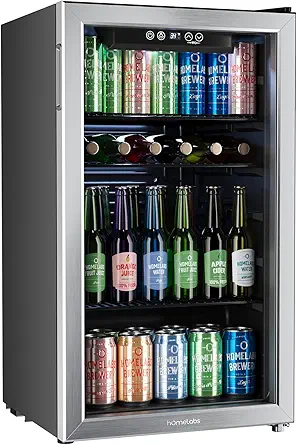 | Best for Established Home Bars | Capacity: 3.2 cu. ft.; up to 120 cans | Temperature: Digital control; cools down to 34°F | Dimensions: 17.3 x 18.9 x 33.3 inches | VIEW ON AMAZON | See Our Full Breakdown |
| 3.1 cu ft Beverage Fridge, 130‑Can Mini Fridge, Glass Door, 34–64°F, Silver |  | Best for Flexible Shelf Layouts | Capacity: 3.1 cu. ft.; up to 130 standard cans | Temperature range: 34°F–64°F | Shelves: 4 adjustable chrome shelves | VIEW ON AMAZON | See Our Full Breakdown |
| EUHOMY 130 Can Mini Fridge with Glass Door, Silver |  | Best for Energy-Conscious Bars | Capacity: 3.2 cu. ft.; up to 130 cans | Dimensions: 18.5″ D x 17.8″ W x 30.9″ H | Temperature range: 37°F–61°F | VIEW ON AMAZON | See Our Full Breakdown |
| Compact Beverage Refrigerator Cooler, 105 Can/3.0 Cubic Feet Mini Fridge with Glass Front Door, Digital Display, Adjustable Shelves |  | Best for a Mid-Size Simulator Bar | Capacity: 3.0 cubic feet | Can capacity: Up to 105 cans | Shelves: 3 adjustable shelves | VIEW ON AMAZON | See Our Full Breakdown |
| 24 Can Beverage Refrigerator, Countertop Mini Fridge with Glass Door, Black |  | Best for a Compact Countertop Bar | Capacity: Up to 24 cans | Temperature range: 40°F–61°F | Dimensions: 14.9 in. D x 11.2 in. W x 16.8 in. H | VIEW ON AMAZON | See Our Full Breakdown |
| mini fridges for golf simulator bar | Capacity | Door | Temperature range | Shelves |
|---|---|---|---|---|
| Erivess Mini Fridge 110 Can Be | 110 cans | Glass with stainless steel frame | — | 3 adjustable chrome shelves |
| Feelfunn 24 Can Beverage Refri | 0.6 cubic feet; up to 24 cans or 6–8 wine bottles | UV-protective glass | 40°F to 61°F | — |
| 130 Can Beverage Refrigerator | 3.2 cubic feet; up to 130 cans | Glass; reversible | 34°F to 64°F | 4 |
| EUHOMY 24 Can Mini Fridge | 18 L (0.6 cubic feet); up to 24 cans | UV-protected | 40°F to 61°F | — |
| Erivess 24 Can Mini Fridge | 0.6 cubic feet; up to 24 cans | Left-hinge acrylic front | 40°F to 61°F | — |
| Feelfunn 126 Can Beverage Refr | 3.2 cu. ft.; up to 126 cans | Double-layer LOW-E glass; reversible | 34°F–64°F | — |
| 130 Can Beverage Refrigerator | 3.2 cu. ft.; up to 130 cans | Single glass door with key lock | 35°F–65°F | 3 removable shelves |
| hOmeLabs Beverage Refrigerator | 3.2 cu. ft.; up to 120 cans | Clear glass | — | Adjustable chrome wire shelves |
| 3.1 cu ft Beverage Fridge | 3.1 cu. ft.; up to 130 standard cans | Reversible glass door | 34°F–64°F | 4 adjustable chrome shelves |
| EUHOMY 130 Can Mini Fridge wit | 3.2 cu. ft.; up to 130 cans | UV-protected glass; reversible | 37°F–61°F | 5 removable shelves |
| Compact Beverage Refrigerator | 3.0 cubic feet | — | — | 3 adjustable shelves |
| 24 Can Beverage Refrigerator | Up to 24 cans | — | 40°F–61°F | 1 removable shelf |
More Details on Our Top Picks
Erivess Mini Fridge 110 Can Beverage Refrigerator Cooler with Glass Door
For a golf simulator bar that needs to keep drinks ready through a group session, the Erivess 110 Can offers a useful balance of capacity and a relatively compact 3.1-cubic-foot cabinet. Its three adjustable shelves make it easier to arrange cans and bottles than the single-shelf Feelfunn 24 Can, while the glass door lets players spot their next drink without opening the fridge. Digital temperature control and auto defrost also reduce routine fuss compared with the manual-defrost compact models here. The tradeoff is that this is a beverage-only, single-zone cooler, not a place to store snacks or keep drinks at different temperatures. Its listed temperature is 37°F, and the glass front calls for more care around clubs, bags, and busy bar traffic. I’d choose it for shared use, not a tight counter nook.
Pros:- 110-can capacity suits group play better than the 24-can compact models
- Three adjustable chrome shelves allow more flexible drink organization
- Digital temperature control makes adjustments straightforward
- Auto defrost and described quiet operation reduce routine maintenance and noise
Cons:- Beverage-only design does not replace a general-purpose food fridge
- Single-zone cooling cannot hold different drinks at separate temperatures
- Glass door needs protection in a busy simulator space
Best for: Golf simulator owners who host several players and want a dedicated, easy-to-browse supply of chilled beverages.
Not ideal for: Buyers who need food storage, multiple temperature zones, or a very small countertop unit.
- Capacity:110 cans
- Volume:3.1 cubic feet
- Temperature:37°F
- Shelves:3 adjustable chrome shelves
- Door:Glass with stainless steel frame
- Voltage:120 V
- Power:240 W
- Cooling and upkeep:Whisper-quiet compressor; auto defrost
Our verdict“Choose the Erivess 110 Can if your simulator bar serves groups and you want roomy beverage storage without stepping up to a larger-format cabinet.”
Feelfunn 24 Can Beverage Refrigerator, Mini Fridge, Black
When the simulator bar is a corner of a garage or a compact counter, the Feelfunn 24 Can is easier to place than the 3.1-cubic-foot Erivess 110 Can. Its footprint is just 11.2 inches wide, and its 40°F–61°F setting range gives more flexibility than a cooler listed at a fixed 37°F. The UV-protective glass and LED display make drink selection simple without turning this into a full-size bar appliance. That compactness sets a firm limit: 24 cans will not carry a busy league night, so expect frequent restocking or pair it with other storage. The single shelf also restricts how much you can organize, and manual defrost adds upkeep absent from the Erivess 110 Can. I’d pick this for a personal bay or a small two-player setup, not for serving a crowd.
Pros:- Narrow 11.2-inch width suits counters and tight simulator corners
- Temperature adjusts from 40°F to 61°F
- UV-protective glass and LED display aid drink visibility
- Compressor operation is specified at 38 dB or less
Cons:- 24-can capacity is limited for group play
- Single shelf restricts storage layout, especially for larger bottles
- Manual defrost requires periodic maintenance
Best for: Solo golfers or couples building a compact simulator nook who want a small, adjustable-temperature drink cooler.
Not ideal for: Hosts running league nights or group sessions who need a large drink reserve and less frequent restocking.
- Capacity:0.6 cubic feet; up to 24 cans or 6–8 wine bottles
- Dimensions:11.2″ W x 14.9″ D x 16.7″ H
- Weight:20.4 lb
- Temperature range:40°F to 61°F
- Shelf:1 removable shelf
- Door:UV-protective glass
- Cooling method:Compressor
- Noise and energy use:≤38 dB; 0.83 kWh per day
Our verdict“Pick the Feelfunn 24 Can for a small personal simulator station where compact dimensions matter more than serving capacity.”
130 Can Beverage Refrigerator, 3.2 Cu.ft Mini Fridge, Glass Door, Silver
For a simulator room that doubles as a regular hangout, this 130-can cooler gives you more stated capacity than the Erivess 110 Can, which can mean fewer interruptions to restock between groups. Its 34°F–64°F range is also broader than the Erivess’s listed 37°F setting, giving the owner more control over how drinks are chilled. Four shelves, eight door slots, and a reversible door help adapt the layout to the room and its mix of cans and bottles. The tradeoff is a bigger commitment than the Feelfunn 24 Can: this unit needs space for a 3.2-cubic-foot cabinet and a 24-hour settling period before first use. The product data provides no energy-consumption figure, so I can’t compare its running use with the compact options. It’s for capacity-first buyers who have a permanent spot for it.
Pros:- 130-can capacity exceeds the Erivess 110 Can’s stated capacity
- 34°F–64°F temperature control covers a broad range of beverage preferences
- Four shelves and eight door slots support organized storage
- Reversible door and LED interior lighting suit varied room layouts
Cons:- Larger cabinet needs a dedicated footprint compared with 0.6-cubic-foot models
- Requires 24 hours to settle before first use
- No energy-consumption figure is provided in the product data
Best for: Owners with a dedicated simulator lounge who stock drinks for groups and want flexible shelves and door placement.
Not ideal for: Small-bay users who need a countertop cooler or buyers who want documented energy-use figures before choosing.
- Capacity:3.2 cubic feet; up to 130 cans
- Temperature range:34°F to 64°F
- Shelves:4
- Door slots:8
- Door:Glass; reversible
- Color:Silver
- Cooling method:Compressor
- Lighting:LED interior
Our verdict“Choose this 130-can model when your simulator lounge serves groups often and you can give a larger beverage cooler a permanent place.”
EUHOMY 24 Can Mini Fridge, 18L Beverage Refrigerator with Quiet Compressor
The EUHOMY 24 Can makes the most sense when a simulator shares space with a home office, bedroom, or quiet practice area. Its 18-liter cabinet takes far less room than the 3.2-cubic-foot 130 Can Beverage Refrigerator, while the compressor is rated below 40 dB for less distracting background noise. A removable shelf offers some flexibility for cans and bottles, and the stated 40°F–61°F range gives the owner control over serving temperature. Capacity is the clear compromise: 24 cans suits a personal bay better than a group bar, and manual defrost means more hands-on care than the Erivess 110 Can’s auto-defrost system. The product data also lists a UV-protected door but does not specify glass as its material. I’d favor this over a larger unit when quiet operation and a small footprint outweigh stocking for a crowd.
Pros:- Compact 18-liter size fits smaller simulator rooms
- Compressor noise is specified at less than 40 dB
- Temperature adjusts from 40°F to 61°F
- Removable shelf allows a choice of storage layout
Cons:- 24-can capacity is too limited for frequent group hosting
- Manual defrost requires periodic upkeep
- Door material is not specified beyond UV protection
Best for: Golfers fitting a beverage fridge into a quiet, shared-use room where low operating noise and compact storage matter.
Not ideal for: Simulator hosts who regularly serve large groups or want a high-capacity, low-maintenance beverage cabinet.
- Capacity:18 L (0.6 cubic feet); up to 24 cans
- Temperature range:40°F to 61°F
- Voltage:115 V
- Cooling method:Compressor
- Shelf:1 removable shelf
- Door:UV-protected
- Noise level:Less than 40 dB
- Weight and warranty:21 lb; 1 year
Our verdict“Choose the EUHOMY 24 Can for a quiet personal simulator setup, but choose a larger cabinet if you stock drinks for several players.”
Erivess 24 Can Mini Fridge, 0.6 Cu.ft Beverage Refrigerator Cooler, Black
This Erivess is a practical choice for a compact simulator bar where a clear view of the drinks and a stated annual energy figure help with planning. At 0.6 cubic feet, it occupies a similar small-space role to the Feelfunn 24 Can and EUHOMY 24 Can, rather than trying to serve a whole group from one cabinet. The see-through acrylic front and removable shelf make it easy to identify and arrange a modest drink selection; its left-hinge door is worth checking against the counter layout before buying. Unlike the Feelfunn, this model provides a stated 65.7 kWh/year consumption figure, though its door is acrylic rather than the Feelfunn’s UV-protective glass. It still has only 24-can capacity, beverage-only storage, and manual defrost. I’d choose it for a small bay if its hinge direction suits the installation.
Pros:- Compact 0.6-cubic-foot size works in small simulator areas
- See-through acrylic door helps identify drinks before opening
- Removable shelf supports alternate storage arrangements
- Annual energy consumption is listed as 65.7 kWh
Cons:- 24-can capacity requires frequent restocking during group sessions
- Manual defrost adds maintenance
- Left-hinge door may not suit every bar layout
Best for: Owners of compact simulator bars who want a small beverage-only fridge with a published annual energy-consumption figure.
Not ideal for: Group hosts who need substantial capacity, buyers who need food storage, or anyone whose layout cannot accommodate a left-hinge door.
- Capacity:0.6 cubic feet; up to 24 cans
- Dimensions:15″ D x 11″ W x 16.5″ H
- Temperature range:40°F to 61°F
- Power:120 V, 240 W
- Shelf:1 removable shelf
- Door:Left-hinge acrylic front
- Cooling method:Compressor
- Energy consumption:65.7 kWh/year
Our verdict“Pick this Erivess for a small simulator bar when the left-hinge door fits and a published annual energy-use figure is useful.”
Feelfunn 126 Can Beverage Refrigerator, Glass Door Mini Fridge, 3.2 Cu.Ft
For a simulator room that shares space with a lounge or living area, I’d favor the Feelfunn for its stated 36 dB operation and generous 3.2-cubic-foot capacity. Its 34°F–64°F controls cover a useful range for chilled cans, while the glass door and blue LED make it easy to see what’s on hand between rounds. Compared with the hOmeLabs 120-can cooler, this model lists room for six more cans and a wider upper temperature limit; the hOmeLabs, by contrast, gives a clear 120-can figure and a lower stated minimum of 34°F. The Feelfunn’s reversible door and adjustable feet also help with placement beneath a counter. Its tradeoffs are a 24-hour upright wait before use, fragile glass to handle carefully, and beverage-only storage with no freezer.
Pros:- 3.2-cubic-foot interior is listed to hold up to 126 cans.
- Digital temperature control spans 34°F–64°F.
- 36 dB operation suits a room where simulator audio and conversation matter.
- Reversible door and adjustable feet support flexible freestanding or under-counter placement.
Cons:- Requires 24 hours upright before first use.
- Beverage-only design has no freezer compartment.
- Glass door needs careful handling in a busy recreation room.
Best for: Golf simulator owners who want a quiet, high-capacity drink fridge in a room used for conversation or entertainment.
Not ideal for: Buyers who need freezer space, want to store food alongside drinks, or cannot leave the fridge upright for 24 hours before setup.
- Capacity:3.2 cu. ft.; up to 126 cans
- Temperature range:34°F–64°F
- Dimensions:17.5″ W x 18.9″ D x 31.2″ H
- Noise level:36 dB
- Cooling system:Compressor cooling
- Door:Double-layer LOW-E glass; reversible
- Lighting:Blue LED
- Placement:Freestanding or under-counter
Our verdict“Choose the Feelfunn if quiet operation and flexible placement matter more than freezer space or instant setup.”
130 Can Beverage Refrigerator, 3.2 Cu.Ft Mini Fridge Beverage Cooler
This 130-can cooler earns its place for simulator bars where guests may help themselves: its key lock gives it a practical advantage over the Feelfunn 126 Can, which lists flexible placement but no lock. The 3.2-cubic-foot capacity and three removable shelves allow a bar manager to arrange cans, bottles, or taller drinks, while the digital thermostat covers 35°F–65°F. Its frost-free system also reduces routine defrost work compared with models whose supplied details do not specify frost-free operation. The glass door and blue lighting keep drinks visible without opening the fridge. There are limits: its stated temperature range starts a degree warmer than several alternatives, including the hOmeLabs cooler, and it has no freezer. It also needs a corded outlet, so placement depends on power access rather than just available floor or counter space.
Pros:- Listed capacity of up to 130 cans in a 3.2-cubic-foot cabinet.
- Key lock can restrict access to drinks.
- Three removable shelves allow storage to be rearranged.
- Frost-free system and quiet compressor cooling reduce upkeep and operating distraction.
Cons:- Temperature range begins at 35°F, warmer than the 34°F minimum listed for the hOmeLabs and Feelfunn models.
- No freezer compartment.
- Requires a corded electric outlet, limiting placement options.
Best for: Simulator bar owners who want a large, adjustable beverage fridge that can be locked between sessions or when the room is unattended.
Not ideal for: Buyers who need a freezer, want the coldest stated setting among these options, or have no convenient powered location.
- Capacity:3.2 cu. ft.; up to 130 cans
- Dimensions:18.5″ D x 17.5″ W x 32.7″ H
- Temperature range:35°F–65°F
- Shelves:3 removable shelves
- Cooling system:Compressor
- Defrost system:Frost free
- Door:Single glass door with key lock
- Power:115 volts
Our verdict“Pick this model when a lock and frost-free operation matter more than the coldest listed setting or freezer space.”
hOmeLabs Beverage Refrigerator and Cooler, 120 Cans Capacity, 3.2 Cu Ft
The hOmeLabs is a straightforward fit for a permanent simulator bar that needs dependable bulk drink storage more than maximum can count. Its 3.2-cubic-foot cabinet holds up to 120 cans, and the digital control reaches 34°F for serving drinks cold. That matches the Feelfunn’s stated minimum, though the Feelfunn lists six more cans and a 64°F upper limit. The hOmeLabs’ adjustable chrome wire shelves and glass-front lighting make drink selection simple during a session, while its quiet operation is suited to indoor use. I’d choose it over the Feelfunn if the familiar 120-can layout and a compact footprint matter more than extra capacity. Its main drawback for a simulator setup is weight: at 68.3 pounds, it is less convenient to shift around, and the supplied information limits it to indoor use.
Pros:- Holds up to 120 cans in a 3.2-cubic-foot interior.
- Digital temperature control cools to 34°F.
- Adjustable chrome wire shelves help accommodate different drink sizes.
- Quiet operation and an illuminated glass door suit an indoor entertainment space.
Cons:- At 68.3 pounds, it is harder to reposition than a lighter compact cooler.
- Listed for indoor use only.
- Its stated 120-can capacity is lower than the 126- and 130-can alternatives in this group.
Best for: Golf simulator owners setting up a stationary indoor bar who want clearly specified capacity and cold beverage storage.
Not ideal for: People who regularly rearrange their simulator room, need outdoor-rated equipment, or want more than 120 cans of stated capacity.
- Capacity:3.2 cu. ft.; up to 120 cans
- Temperature:Digital control; cools down to 34°F
- Dimensions:17.3 x 18.9 x 33.3 inches
- Weight:68.3 pounds
- Shelves:Adjustable chrome wire shelves
- Door:Clear glass
- Lighting:LED
- Use:Indoor
Our verdict“Choose the hOmeLabs for a fixed indoor simulator bar where a 34°F setting matters more than easier moving or maximum capacity.”
3.1 cu ft Beverage Fridge, 130‑Can Mini Fridge, Glass Door, 34–64°F, Silver
When a simulator bar serves more than standard cans, this silver fridge stands out for its four adjustable chrome shelves and eight tiered door slots. That layout gives more ways to separate cans and bottles than the three-shelf 130 Can Beverage Refrigerator, though the latter offers 3.2 cubic feet versus this model’s 3.1. Both list room for up to 130 cans, so the difference is less about headline capacity and more about how drinks can be organized. The 34°F–64°F compressor range, glass door, and LED lighting suit quick selection between holes; a reversible door and leveling legs also help with installation. It is still a full-size floor appliance rather than a countertop cooler, and the required 24-hour upright wait can complicate a same-day room setup.
Pros:- Listed capacity of up to 130 standard cans in a compact-format cabinet.
- Four adjustable shelves and eight tiered door slots support varied drink storage.
- Compressor cooling covers 34°F–64°F.
- Reversible glass door and leveling legs help accommodate different room layouts.
Cons:- Must stand upright for 24 hours before first use.
- No freezer compartment.
- Despite its compact designation, the cabinet may not fit very tight simulator rooms.
Best for: Simulator bar owners who stock a mix of cans and bottles and want more shelf and door-slot arrangements.
Not ideal for: Buyers with very tight floor space, anyone needing freezer storage, or those who need to plug in and use a fridge immediately after delivery.
- Capacity:3.1 cu. ft.; up to 130 standard cans
- Temperature range:34°F–64°F
- Shelves:4 adjustable chrome shelves
- Door storage:8 tiered slots
- Cooling method:Compressor
- Door:Reversible glass door
- Color:Silver
- Certification:ETL certified
Our verdict“Pick this fridge if drink variety and shelf flexibility matter more than the extra 0.1 cubic foot listed for the competing 3.2-cubic-foot models.”
EUHOMY 130 Can Mini Fridge with Glass Door, Silver
The EUHOMY is the strongest fit here for a simulator bar that stays stocked and running between sessions: its listed energy use is 0.69 kWh per day, paired with a reported 36 dB noise level. Five removable shelves offer more layout options than the three shelves in the 130 Can Beverage Refrigerator, useful when a group brings different cans or bottles. Its 3.2-cubic-foot interior is listed for up to 130 cans, while the digital control spans 37°F–61°F. That narrower range starts warmer than the Feelfunn 126 Can and the hOmeLabs, both listed down to 34°F, so I would not choose it for the coldest serving preference. The glass door has UV protection and can be reversed for placement, but it still requires a 24-hour upright wait before startup.
Pros:- Listed energy consumption is 0.69 kWh per day.
- Five removable shelves provide flexible storage arrangements.
- 36 dB noise level suits an indoor simulator lounge.
- Reversible, UV-protected glass door supports flexible placement and visible storage.
Cons:- 37°F minimum is warmer than the 34°F minimum listed for the Feelfunn and hOmeLabs models.
- Requires 24 hours upright before first use.
- No freezer compartment.
Best for: Owners of a frequently used indoor simulator bar who value low stated daily energy use, quiet operation, and adjustable storage.
Not ideal for: Buyers who want drinks cooled below 37°F, need freezer space, or cannot wait 24 hours before initial operation.
- Capacity:3.2 cu. ft.; up to 130 cans
- Dimensions:18.5″ D x 17.8″ W x 30.9″ H
- Temperature range:37°F–61°F
- Energy consumption:0.69 kWh per day
- Noise level:36 dB
- Shelves:5 removable shelves
- Door:UV-protected glass; reversible
- Temperature control:Digital control with LED display
Our verdict“Choose the EUHOMY for a regularly used bar where quiet, stated energy use, and shelf flexibility matter more than the lowest available temperature.”
Compact Beverage Refrigerator Cooler, 105 Can/3.0 Cubic Feet Mini Fridge with Glass Front Door, Digital Display, Adjustable Shelves
For a simulator bar that needs more than a countertop drinks stash but cannot spare room for a full-size beverage cooler, this 105-can, 3.0-cubic-foot fridge offers a useful middle ground. Its glass door keeps cans visible, while the digital temperature control makes adjustments easier than on the simpler manual controls found on compact picks such as the Feelfunn 24 Can Beverage Refrigerator. Three adjustable shelves also give you more flexibility for cans and taller bottles. Compared with the larger 110-can Erivess, this model has slightly less listed capacity, so it makes more sense for a smaller household or a bar with limited floor space than for frequent group play. The tradeoff is its 28.9-inch height and 17.5-inch depth: check the planned alcove before buying, and note that it requires a standard 110V outlet.
Pros:- Holds up to 105 cans in 3.0 cubic feet of storage
- Glass front makes drink selection visible without opening the door
- Digital display and adjustable thermostat allow direct temperature adjustments
- Three adjustable shelves accommodate different drink sizes
Cons:- Its 17.5-inch depth and 28.9-inch height may not fit compact bar cabinetry
- Requires a 110V power supply, limiting placement to an appropriate outlet
- Offers slightly less stated capacity than the 110-can Erivess option
Best for: Golf simulator owners who want visible, digitally controlled drink storage for regular small-group sessions without stepping up to a larger 110-can cooler.
Not ideal for: Buyers with a shallow bar cabinet, very tight floor space, or frequent large gatherings that call for maximum can capacity.
- Capacity:3.0 cubic feet
- Can capacity:Up to 105 cans
- Shelves:3 adjustable shelves
- Temperature control:Digital display with adjustable thermostat
- Dimensions:17.5 in. D x 16.9 in. W x 28.9 in. H
- Voltage:110V
- Weight:45 lb
- Finish and door:Silver stainless steel with glass door
- Energy consumption:185 kWh annually
Our verdict“Choose this model for a mid-size simulator bar that needs adjustable, easy-to-see drink storage and has room for its deeper cabinet footprint.”
24 Can Beverage Refrigerator, Countertop Mini Fridge with Glass Door, Black
This compact refrigerator suits a simulator setup where every inch of floor space is spoken for and drinks are served in small batches. At 14.9 inches deep and 16.8 inches tall, it can sit on a sturdy counter or side cabinet, unlike the 105-can Compact Beverage Refrigerator Cooler, which needs a dedicated floor-level spot. The 24-can capacity is better for a couple of players or a short session than for a full league night; restocking will be part of the routine if the bay hosts a crowd. Its compressor cooling, removable shelf, and stated 40°F–61°F range provide practical control for cans, while blue LED lighting helps locate drinks in a dim golf room. The smaller footprint comes with a real compromise: it stores far fewer drinks than the larger fridges in this roundup and has no freezer compartment.
Pros:- Compact dimensions suit countertop and small-bar placements
- Blue LED lighting makes drinks easier to see in a dim simulator room
- Removable shelf provides some flexibility for different containers
- Compressor cooling with a stated 40°F–61°F temperature range
Cons:- Capacity is limited to 24 cans, far below the 105-can mid-size option
- No freezer compartment for ice or frozen items
- Requires a 115V outlet near the counter or cabinet
Best for: Simulator owners with a sturdy countertop or side cabinet who serve a few players at a time and want a small, illuminated drink station.
Not ideal for: Hosts running league nights or parties who need enough cold storage for a group without frequent restocking.
- Capacity:Up to 24 cans
- Temperature range:40°F–61°F
- Dimensions:14.9 in. D x 11.2 in. W x 16.8 in. H
- Weight:22.7 lb
- Shelves:1 removable shelf
- Cooling system:Compressor
- Voltage:115V
- Refrigerant:R-600A
- Door and finish:Glass door, black finish, blue LED lighting
Our verdict“Pick this countertop model for a space-constrained simulator serving a few players, but choose a larger cooler for group play or less frequent restocking.”

How We Picked
I ranked these mini fridges for golf simulator bars around the job they need to do: keep drinks accessible without crowding a hitting bay or interrupting play. I compared stated capacity, listed dimensions and volume where available, glass-door and display features, shelf adjustability, and any stated noise or temperature details. I also considered whether each form factor makes more sense as a main bar fridge, a secondary cooler, or a countertop option.
The ranking favors useful capacity with a realistic footprint over the largest can count alone. Mid-size models lead because they are more likely to serve a small group while fitting a home simulator room; compact units rank higher for restricted spaces, not for hosting volume. Where several products share similar capacity, I distinguish them by the details supplied in their listings and avoid treating similar-looking specifications as proof of different cooling performance. Buyers should confirm exact dimensions, ventilation clearance, and temperature range with the manufacturer before planning a built-in installation.
Factors to Consider When Choosing Mini Fridges For Golf Simulator Bars
Choosing a fridge for a simulator bar is partly about cooling and partly about how people move through the room. I would start with the available footprint, number of players, and whether guests will serve themselves during a session. These factors can matter more than a headline can count.
Match Capacity to Your Typical Group
Think about the number of drinks you want cold at the start of a session, not just the maximum number of cans listed. Can-capacity figures generally assume a tidy arrangement of standard cans; bottles, tall cans, and irregular packaging can reduce usable space. A compact 24-can model can work well for one or two players who restock often, but may feel undersized for a league night. A roughly 105-to-130-can unit gives a group more reserve, though it takes more floor or counter space. I would choose for your busiest usual session rather than an occasional party, then keep overflow in a separate cooler if needed.
Measure the Room and the Fridge’s Airflow Needs
Measure the intended location, including door swing, nearby stools, and the path from the hitting area to the bar. A fridge that fits its opening on paper can still block a walkway when its door is open. Freestanding beverage coolers also need suitable airflow around the cabinet, so a tight enclosure or flush fit can interfere with operation unless the maker permits it. Check the product’s installation guidance and leave the specified clearance rather than guessing. For a narrow simulator room, a countertop model may preserve circulation; for a dedicated lounge area, a larger upright unit can be easier to reach.
Choose Placement Around Noise and Play
Compressor sound can be more noticeable in a simulator room than in a kitchen, especially during quiet putting or when the fridge sits close to the hitting mat. A listing that describes a model as quiet is useful context, but it does not give a comparable measured sound level across all products. If the fridge will sit beside the player, prioritize a stated quiet-compressor feature and consider placing it behind the seating area instead. Avoid putting it where opening the door distracts someone swinging or blocks the projection path. The right placement can matter as much as choosing a smaller unit.
Decide Whether a Glass Door Helps Your Bar
A glass front makes drink choices visible, which can reduce rummaging and suit a self-serve bar. It also exposes the contents to view, so a cluttered or partly empty fridge may look less polished than a solid-door option. Room lighting and projector placement deserve attention: reflections or glare can be distracting if the door faces the screen or the hitting lane. Check whether the interior lighting and display controls can be switched off or adjusted if the cooler will be visible during play. Choose glass for convenience and presentation, not just because it appears on many beverage-fridge listings.
Check Shelves, Drinks, and Temperature Details
Look beyond the can count and check how shelves move, what container sizes fit, and whether the stated temperature range suits the drinks you plan to store. Adjustable shelves are helpful if your bar rotates between cans, bottles, and mixers, but they do not guarantee every container will fit upright. Many beverage coolers are designed for drinks rather than perishable food, so do not assume one can replace a food refrigerator. Also verify the temperature range in the product’s full specifications; listings may emphasize a display without making the usable range equally clear. If your menu includes wine or other drinks with different serving preferences, separate storage may be a better choice than forcing one setting to serve everything.
Plan for Cleaning, Restocking, and Long-Term Use
A golf simulator bar can collect dust from mats, clubs, and regular foot traffic, so leave room to clean around and behind the appliance. A glass door shows fingerprints and smudges more readily, while removable shelves can make interior spills easier to address. Consider who will restock the fridge and whether its door opens comfortably from the bar side. A larger model can reduce refill trips but needs more room and a larger initial stock of drinks; a smaller one is easier to fit but may require frequent replenishment. Review the care instructions and warranty terms before purchase, especially if the fridge will run in a warm or enclosed space.
Frequently Asked Questions
Is a 24-can mini fridge enough for a golf simulator bar?
It can be enough for a personal simulator room or a pair of regular players who keep only a small selection chilled. For several guests or a longer session, the limited capacity may mean repeated restocking or storing extra drinks elsewhere. Remember that the stated can count may not reflect your actual mix of bottles and cans. I would treat compact models as personal or secondary coolers unless your group is consistently small. If the bar hosts leagues or parties, a mid-size or larger unit is a safer starting point.
Can I install a beverage fridge inside a bar cabinet?
Only do so if the manufacturer allows that installation and the cabinet provides the required airflow and clearances. Many beverage coolers are designed to stand freestanding, and surrounding them tightly can affect heat removal and operation. Measure the fridge, its open-door arc, and the space needed for ventilation before building the cabinet. A front glass door does not mean a model is suitable for built-in use. If the listing does not clearly specify installation requirements, ask the manufacturer before committing to cabinetry.
Should I choose a glass-door fridge if the projector is nearby?
A glass door can make self-service easier, but its reflections may compete with the screen or create distracting light in the room. The effect depends on the projector, room lighting, door angle, and where players stand. If possible, position the fridge so its front does not face the screen or hitting area directly. You can also check whether interior lighting can be turned off when play starts. If the room is very dark and glare control is a priority, a solid-door refrigerator may be the simpler choice.
Can a beverage mini fridge store food as well as drinks?
Do not assume it can safely replace a food refrigerator. Beverage coolers may have temperature ranges and operating conditions intended for drinks, and some product listings focus on can storage rather than food safety. Check the full specifications and the manufacturer’s guidance for the types of food you plan to store. For snacks that need reliable food-safe refrigeration, use an appliance rated for that purpose. A beverage fridge works best when its role is clear: chilled drinks within easy reach of the bar.
How do I choose between a 105-can and a 130-can model?
Start by checking the actual exterior dimensions and usable shelf arrangement rather than relying on the can count alone. The higher-capacity label may help when you host larger groups, but it is less useful if the unit crowds a walkway or cannot fit your preferred bottles. A 105-can model may be a better room-fit compromise for a compact lounge, while a 130-can model makes more sense when you have a dedicated bar zone and frequent group play. Compare ventilation needs and door clearance as well as volume. If your gatherings vary, a mid-size fridge plus a separate party cooler can be more flexible than sizing the permanent unit for rare events.
Conclusion
For most home simulator bars, I would start with the Erivess 110-can beverage refrigerator as the best overall balance of group capacity and manageable scale. For a fuller hosting setup, the hOmeLabs 120-can cooler is my best premium-style pick among these options, while the similar 3.2-cubic-foot models make sense when capacity takes priority over a smaller footprint. Beginners with a tight layout should look at the 24-can EUHOMY or a countertop model; the Feelfunn 24-can is another compact alternative if its dimensions better suit the space. For a small room where every inch matters, favor a compact unit; for league nights, choose a larger model and plan its airflow and door swing before buying. My final check would be to verify the exact dimensions, temperature range, and installation guidance for the specific listing.
Halloween Picks
halloween
As an affiliate, we earn on qualifying purchases.