
TL;DR

Get travel and outdoor gear delivered free with Prime
- Fast, free delivery on millions of items
- Prime Video, Amazon Music and more included
- Member-only deals all year
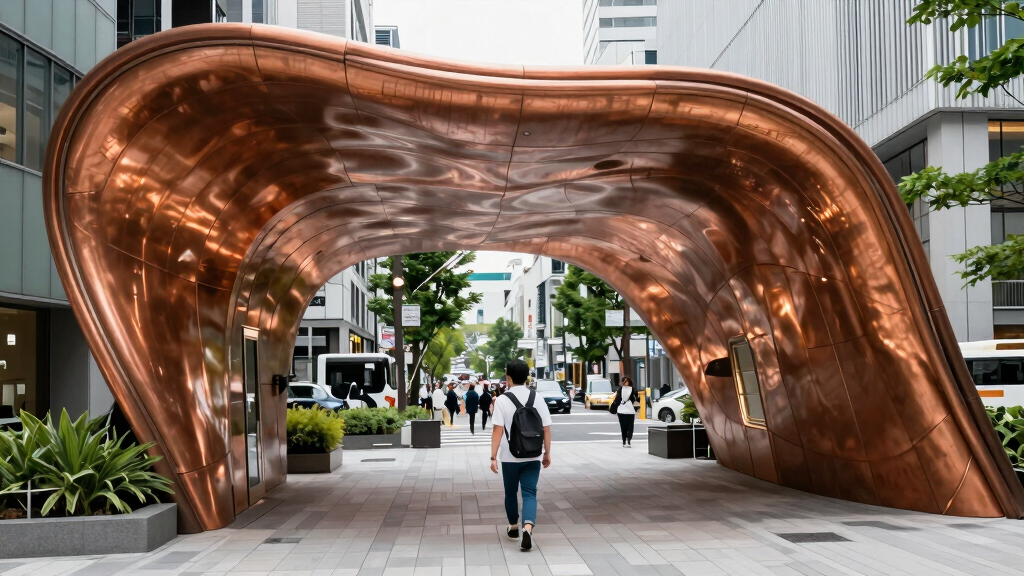
Nikken Sekkei has unveiled Hatmachida, a small community hub in Tokyo featuring a distinctive copper canopy. This project aims to transform a busy street into a civic space that fosters gathering and local activity. The design emphasizes evolving materials and flexible functions, serving as a model for urban micro-interventions.
Nikken Sekkei has completed Hatmachida, a 22.7-square-meter community hub in Tokyo featuring a sculptural copper canopy. The project aims to transform a section of Haramachida Odori into an active civic space that supports gathering, information exchange, and small-scale commerce, marking a significant step in urban micro-landmark design.
Located along Haramachida Odori, a major boulevard in Machida, the structure blurs the boundary between street and public space. Its defining feature is an eight-meter-high copper roof, crafted using traditional ichimonji-buki standing-seam technique, which naturally develops a patina over time. The roof shelters a pavilion with six counters for information, sales, and community activities, supported by integrated lighting for nighttime visibility.
The design incorporates four key functions: information, takeout, shop, and spot, fostering interaction among residents, visitors, and local businesses. Developed through social experiments conducted in 2021 and 2022, the project emphasizes adaptability and ongoing public engagement. It is part of a broader strategy to activate public space along the boulevard, with potential future expansion to similar hubs across the district.
Impact of Copper Canopy on Urban Public Space
The copper canopy of Hatmachida serves as a visual landmark and a catalyst for civic interaction in a transit-oriented district. Its design demonstrates how small-scale architectural interventions can support community gathering, promote local commerce, and enhance urban livability. The project exemplifies a new approach to civic infrastructure, integrating functionality with craftsmanship and material aging to foster a sense of place and temporal continuity.
As an affiliate, we earn on qualifying purchases.
Urban Transformation Along Haramachida Odori
Haramachida Odori was originally designed as a major automobile corridor, which limited pedestrian engagement and public activity. The project in Machida seeks to reimagine parts of this street as a civic space through targeted interventions. The site includes a long-standing police box that functions as a local landmark, providing a reference point for the new hub. This initiative is part of a wider effort by Machida City and local stakeholders to create more inviting, human-scaled public environments, moving away from purely transit-focused infrastructure.
“The copper roof’s evolving patina reflects environmental change, emphasizing the project’s temporal dimension.”
— Nikken Sekkei Design Studio
As an affiliate, we earn on qualifying purchases.
Future Development and Broader Urban Impact
It is not yet clear how the project will evolve over time, including the potential for expansion to other locations or the long-term use of the space. The extent of community engagement and the permanence of commercial activities supported by the hub remain to be seen. Details on how the space will adapt with environmental aging of the copper roof are also still emerging.
As an affiliate, we earn on qualifying purchases.
Next Steps for Civic Activation and Urban Integration
Further monitoring of public use and community feedback will inform potential adjustments and expansions of the project. Officials and designers plan to evaluate the hub’s role in activating Haramachida Odori and may develop additional similar structures, aiming to create a network of civic micro-landmarks that foster ongoing urban vitality. Implementation of complementary programs and partnerships with local businesses are also anticipated.
As an affiliate, we earn on qualifying purchases.
Key Questions
What is the purpose of the copper canopy in the project?
The copper canopy serves as a visual landmark, provides shelter, and symbolizes the project’s emphasis on material aging and environmental interaction, enhancing the civic character of the space.
How does the project support local community activities?
It incorporates functions such as information dissemination, small food takeout, local product sales, and flexible gathering spaces, fostering community engagement and supporting small businesses.
Will the structure be permanent or temporary?
The design emphasizes adaptability and ongoing public use, with the copper material aging naturally over time, but the long-term permanence depends on future maintenance and community needs.
Are there plans to replicate this hub in other parts of Tokyo?
Yes, the project is envisioned as part of a broader strategy to activate multiple locations along Haramachida Odori, with potential expansion to other districts based on success and community feedback.
What are the main benefits of this architectural intervention?
It transforms a transit-oriented street into a vibrant civic space, supports local commerce, encourages community interaction, and introduces an evolving material that reflects environmental change.
Source: designboom
Columbus Day / Indigenous Peoples' Day Picks
long weekend sales
As an affiliate, we earn on qualifying purchases.